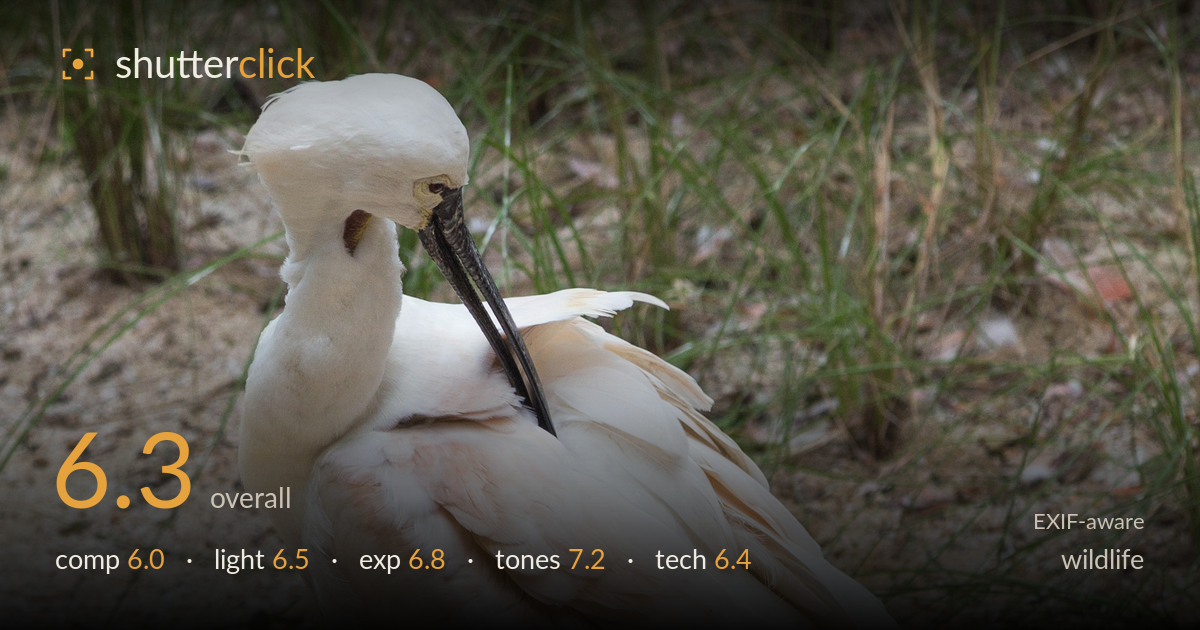
Spoonbill preening on the sand
Photo by Marcin Konsek

| Focal length | 105 mm |
| Aperture | f / 5.6 |
| Shutter | 1/250 s |
| ISO | ISO 400 |
| Exp. comp. | 0.0 EV |
| Shot at | 06:11 · Feb 11, 2016 |
A well-observed preening moment from a spoonbill, captured in flat but flattering light that renders the soft peach-toned plumage cleanly. The behaviour — the bird tucking its bill into its flank — carries the frame and reads as authentic. What most holds it back is focus placement: the sharpest detail sits on the breast and back feathers rather than the eye, which is soft and partly hidden behind the bill. The eye is the anchor of any wildlife shot and needs to be tack sharp. The composition also crowds the top of the frame, and the leg band flags a captive subject.
The near-vertical framing suits the standing bird, and the diagonal of the grass-to-sand transition adds some depth behind it. The subject sits slightly left, giving room into the direction the bill points, which works. But the head nearly touches the top edge, cramping the frame where breathing room would help, while the lower third is a large expanse of undifferentiated sand. Reframing to lower the bird and lend headroom, or a tighter crop excluding some foreground gravel, would balance the weight better and strengthen the subject's presence.
Soft, diffused overcast light bathes the bird evenly, avoiding blown highlights on the white plumage — a genuine advantage with a pale subject. It renders the delicate peach wash across the feathers faithfully and keeps shadows gentle. The trade-off is flatness: there is little directional modelling to sculpt form or add dimension, and no catchlight in the eye to bring it alive. A touch of side or raking light, or shooting near golden hour, would lend the feathers more texture and give the shot a sense of atmosphere it currently lacks.
Exposure is handled well for a difficult subject. The white and pastel plumage retains detail throughout without clipping — no small feat, and the histogram sits comfortably to the right without pushing into pure white. Shadow detail in the dark legs holds up too. The overall reading is a touch bright on the sand, which pulls some attention, but the bird itself is metered accurately with 0 EV compensation. Slightly negative compensation would have protected the brightest breast feathers with even more margin while deepening the ground.
The tonal handling is the strongest aspect here. White balance is neutral and believable, letting the subtle salmon-and-cream gradient across the wing coverts show its full range against the cool, muted greens of the grass and the warm neutral sand. Contrast is low, in keeping with the overcast light, and the palette is harmonious and restrained. The delicate colour separation in the feathers is well preserved. A modest contrast lift in post would add a little punch without sacrificing the natural, gentle character of the rendering.
The 105mm end of the 24-105 f/4L at f/5.6 is a reasonable choice for a cooperative, stationary bird, giving enough depth of field to hold the body while still separating it from the grass behind. ISO 400 is conservative and clean, and 1/250s is ample for a preening subject with no fast movement. The critical shortfall is focus: the sharpest plane falls on the breast and folded wing rather than the eye. In wildlife the eye must be the point of critical focus, and here it is soft and further obscured by the bill crossing in front of it. Single-point AF placed deliberately on the eye, or focus-and-recompose at this working distance, would have fixed this. The background is acceptably soft but not fully melted; a longer lens or wider aperture would isolate the bird more decisively. The metal leg band is a giveaway of a captive or banded bird, worth noting for context but not a technical fault.
What would elevate it
Tags
Shot something like this?
Expert photo critique, on demand — scored across six categories, EXIF-aware. Start with 3 free critiques, no credit card.
critique my photo — free