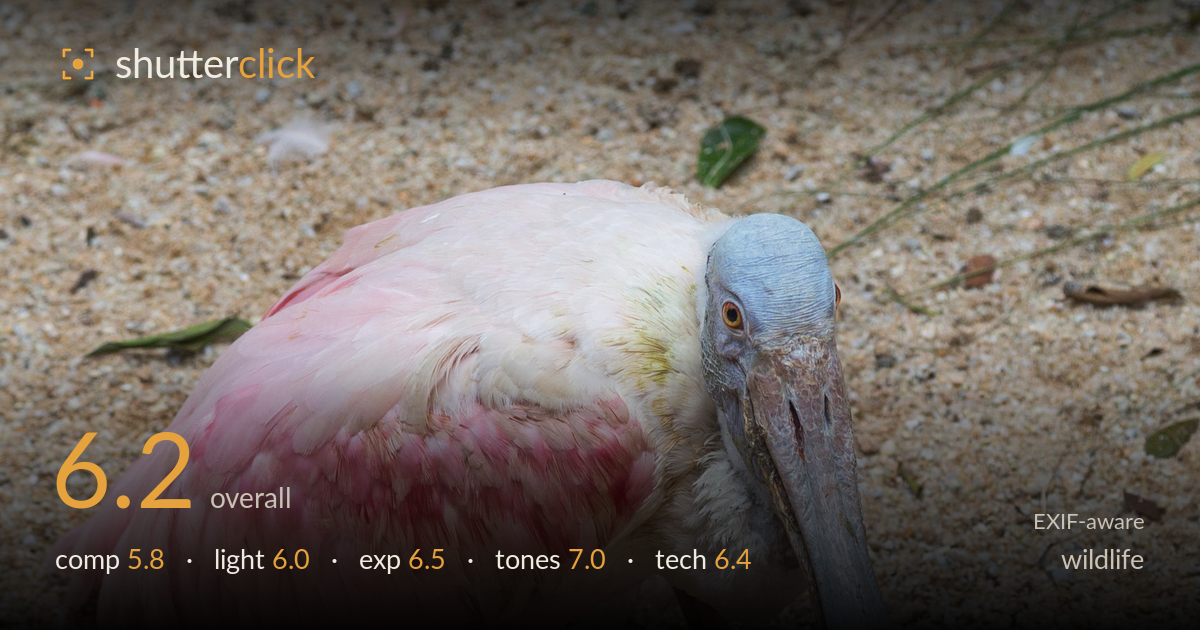
Spoonbill turning to the lens
Photo by Marcin Konsek

| Focal length | 105 mm |
| Aperture | f / 5.6 |
| Shutter | 1/200 s |
| ISO | ISO 400 |
| Exp. comp. | 0.0 EV |
| Shot at | 06:10 · Feb 11, 2016 |
A characterful low-angle portrait of a roseate spoonbill with strong eye contact and the distinctive bill turned toward the lens — the pose has real personality. The pink plumage against sandy neutral ground is the picture's biggest strength. What most holds it back is the busy, uniform substrate: the gravel-and-sand background offers no separation and the flat overcast light keeps the whole frame low in contrast. The bird also sits low and slightly cramped against the left edge. A cleaner background, a touch more separation, and a shooting position closer to eye level would lift this from a competent record shot to a compelling one.
Getting down low to the bird's level pays off — the pose, with the bill dipped and the eye locked on the lens, carries genuine engagement. The diagonal of the neck and bill leads the eye well. But the subject sits heavily in the left and lower half, and the sprawling feet and bill run close to the frame edges, leaving the composition feeling slightly cramped. The upper-right grass adds little. A touch more room ahead of the bill and higher subject placement would give the gesture space to breathe.
The soft, diffuse overcast light is flattering for the delicate pinks — no blown highlights on the pale plumage and no harsh shadows crushing the feet. It renders the subtle rose gradients faithfully. The trade-off is flatness: without directional light the feathers lack the modelling and dimensionality that would separate wings from body, and the bill's smooth blue surface reads a little dull. A low, raking side light or the warmer directionality of early morning would have added shape and sparkle to the plumage.
Exposure is well judged for a tricky subject. The pale pink and white plumage retains detail throughout with no clipped highlights, which is easy to lose on a bright bird in open light. Shadow detail in the dark, textured feet holds up too. The overall brightness suits the sandy setting. If anything the midtones sit a fraction flat, a direct consequence of the even light rather than an exposure error. A slight increase in local contrast on the bird would give the frame more punch without risking the highlights.
The colour rendering is the standout here. The gradient from soft blush to saturated carmine across the wing is beautifully held, and the white balance keeps the sand a believable warm neutral without pushing it yellow. The blue-grey bill and reddish feet add welcome tonal variety against the pinks. Contrast is on the gentle side, matching the light. A modest boost to overall contrast and a hair more saturation restraint in the deepest wing reds would keep them from edging toward oversaturation while preserving the delicacy.
At 105mm, f/5.6, 1/200s and ISO 400, the settings are reasonable for a stationary bird in flat light, and the results are largely clean — ISO 400 keeps noise negligible and the exposure is solid. Focus appears to land on the head and eye, which is exactly where it should be for wildlife, though critical sharpness looks marginally soft on the eye; a slight front-focus toward the bill base is possible, or subtle motion at 1/200s. That shutter is adequate for a still bird but leaves little margin if it moved. f/5.6 at this focal length and working distance gives moderate depth of field but not enough to separate the bird cleanly from the cluttered substrate — the background stays distractingly detailed. Stopping down would only worsen that; instead a longer lens or wider aperture with a lower angle would blur the ground. The 24-105 is a versatile travel zoom but lacks the reach and subject isolation a dedicated telephoto brings to wildlife.
What would elevate it
Tags
Shot something like this?
Expert photo critique, on demand — scored across six categories, EXIF-aware. Start with 3 free critiques, no credit card.
critique my photo — free