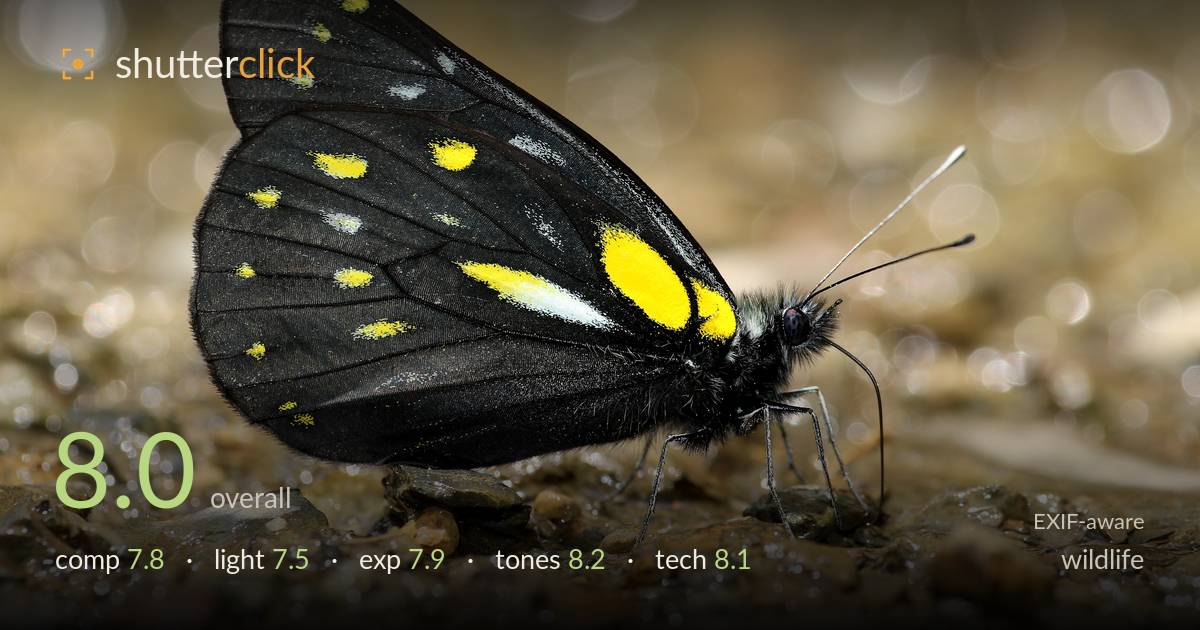
Spotted butterfly puddling on wet gravel
Photo by Atanu Bose Photography

| Focal length | 180 mm |
| Aperture | f / 6.3 |
| Shutter | 1/250 s |
| ISO | ISO 100 |
| Exp. comp. | 0.0 EV |
| Shot at | 11:49 · May 14, 2018 |
A clean, well-executed macro-wildlife portrait of a puddling butterfly, its yellow and white wing markings reading crisply against a soft, warm background. The eye and head are sharp, and the specular bokeh gives the frame a pleasant airiness. What most holds it back is the head-into-frame orientation with limited space ahead of the antennae, which slightly crowds the subject's direction of travel, and a plane of focus that favours the near wing while the head sits a touch soft. The wet gravel foreground is busy but grounds the scene honestly. A strong, repeatable result overall.
The side-profile places the wing pattern in full display, and the diagonal of the body leads naturally toward the head and antennae. Subject placement sits slightly right of centre, which works, but the antennae push toward the frame edge with little breathing room ahead of the subject's gaze. The wet gravel foreground adds context yet competes for attention. A touch more negative space in front and a slightly lower angle would strengthen the sense of forward direction and better isolate the insect from the busy ground.
Soft, diffused daylight wraps the wing evenly and avoids harsh clipping on the black surfaces, letting the scale texture and vein structure read clearly. The warm background light produces attractive circular bokeh that lifts the mood. Direction is fairly flat, however, so the wing lacks the raking modelling that would emphasise its three-dimensional curvature. A catchlight sits in the eye, which helps. Slightly more directional side light would carve out more depth without sacrificing the gentle, glare-free rendering.
Exposure is well judged for a high-contrast subject: the black wing retains detail in the scales and veins without blocking up, while the bright yellow patches hold saturation short of clipping. The specular highlights in the background bokeh flirt with pure white but that is appropriate for the effect. Shadow detail on the underside and legs is preserved. Midtones on the gravel sit comfortably. The overall balance looks deliberate, with no obvious under- or over-exposure on the subject that matters most.
Colour rendering is a strong point. The yellow markings are vivid and clean, the white spots read crisply, and the warm sandy background provides a complementary, cohesive palette. White balance leans warm, which suits the setting without going orange. Contrast between the dark wing and bright markings is punchy yet controlled, and the tonal gradation across the wing scales holds up. The wet gravel adds cool speculars that balance the warmth. Saturation is confident without tipping into artificiality.
The 180mm macro lens is an ideal choice here, delivering working distance and flattering compression on a skittish subject. At f/6.3 the depth of field is shallow for this magnification: the near wing and body are sharp, and the eye carries a usable catchlight, but focus falls off across the head and antennae, and the far leading edge of the wing softens. Stopping to f/9–f/11 would have carried the head and antenna tips more fully, at the cost of busier background bokeh. ISO 100 keeps the image clean with no noise penalty, appropriate given the diffused light. 1/250s froze the stationary insect adequately, though it leaves little margin for any wing or antenna flicker. Focus was placed on the near wing rather than the eye, which for wildlife is the higher-priority plane; nudging the focus point onto the eye would sharpen the most important detail. Execution is otherwise clean and technically assured.
What would elevate it
Tags
Shot something like this?
Expert photo critique, on demand — scored across six categories, EXIF-aware. Start with 3 free critiques, no credit card.
critique my photo — free