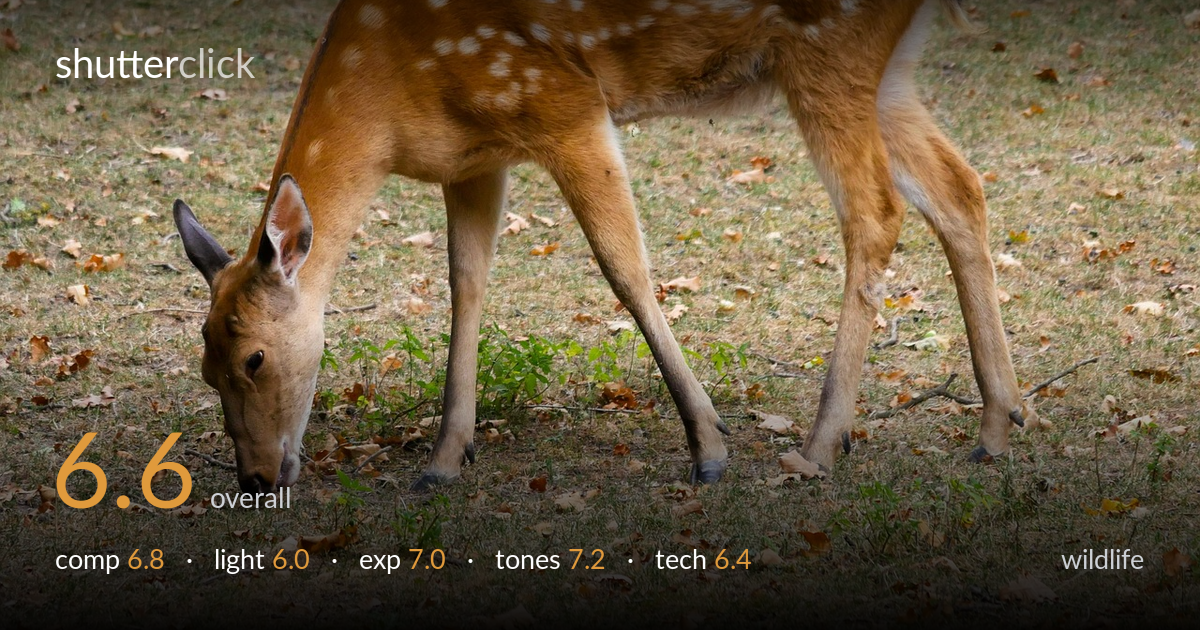
Spotted deer grazing in autumn
Photo by garten-gg

No EXIF metadata in this file
Technical analysis based on visual assessment only.
A clean, well-exposed portrait of a grazing sika deer that captures natural behaviour but settles for documentation rather than impact. The spotted coat is rendered with good colour and detail, and the lowered-head grazing pose reads as authentic and relaxed. What holds the frame back most is flat, overcast light that gives the animal little dimension, and a busy leaf-strewn background that competes for attention. The eye, the crucial element in any wildlife shot, sits in shadow and lacks a catchlight, so the gaze loses its hold. Better light and tighter separation would lift this considerably.
The deer fills the frame well and the grazing posture creates a pleasing diagonal sweep from rump down to the lowered head, leading the eye to the action. Placing the animal slightly right of centre with its head reaching into open ground gives the gesture room to breathe. The full-body framing leaves a touch too much empty grass above the back, and the legs crowd the lower edge. A slightly lower angle would have brought eye-level intimacy rather than this looking-down perspective.
Flat, diffuse overcast light dominates here. It renders the spotted coat evenly and avoids harsh shadows, which suits the soft texture of the fur, but it gives the animal almost no modelling or dimension. The head, dipped low and turned away from any directional source, falls into shadow and the eye receives no catchlight, draining the gaze of life. Soft side or low-angle light, ideally early or late in the day, would carve form into the coat and add the spark this shot needs.
Exposure is well managed across a tricky tonal range. The bright spots on the coat hold detail without clipping, and the rich rufous tones keep their density. The grass and scattered leaves retain texture in both highlights and shadows. The shaded head sits a little dark, costing detail around the eye and muzzle, but the overall balance reads as deliberate and controlled. Lifting the shadows slightly in post would recover the eye area without flattening the rest of the frame.
The colour palette is the image's quiet strength. The warm orange-brown coat with crisp white spots plays nicely against the muted greens and browns of the grass and fallen leaves, an autumnal harmony that feels natural and unforced. White balance is accurate and saturation restrained. Contrast is gentle, in keeping with the soft light, though the mid-tones could carry a touch more punch to lift the animal off the similarly-toned ground. The shadowed head reads slightly muddy and would benefit from a tonal lift.
Focus appears to land on the body and neck, where the spotted coat shows good sharpness and fine fur detail. The depth of field is adequate to keep most of the standing animal acceptably crisp. The weak point is the head: the eye and muzzle are softer and sit in shadow, and in wildlife work a tack-sharp eye is the single most important element. Whether this is focus falling slightly behind the head or simply the shaded position is hard to separate, but the result is the same loss of impact. The background is rendered with too much detail, suggesting an aperture or working distance that didn't deliver enough separation, so the scattered leaves compete with the subject. A longer focal length or wider aperture would have thrown that clutter into a softer wash. Shutter speed clearly froze the motion cleanly, and noise is well controlled. Prioritising the eye for focus and acquiring more background blur would elevate the technical execution considerably.
What would elevate it
Tags
Shot something like this?
Expert photo critique, on demand — scored across six categories, EXIF-aware. Start with 3 free critiques, no credit card.
critique my photo — free