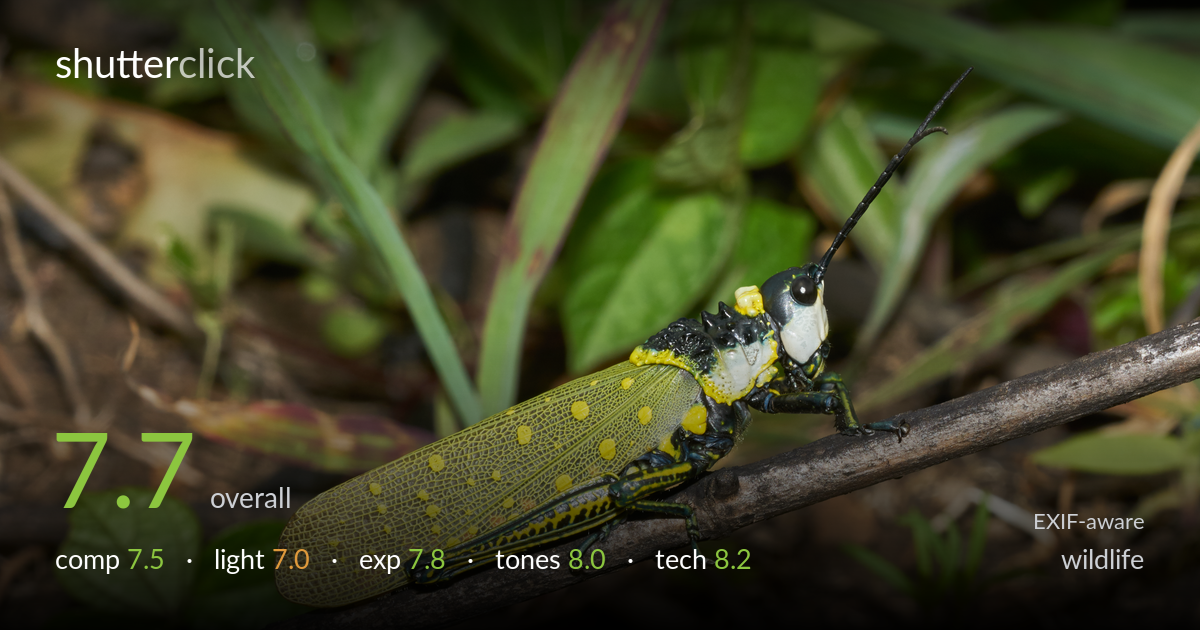
Spotted grasshopper on a twig
Photo by Jeevan Jose, Kerala, India

| Focal length | 150 mm |
| Aperture | f / 14.0 |
| Shutter | 1/200 s |
| ISO | ISO 200 |
| Exp. comp. | 0.0 EV |
| Shot at | 10:42 · Aug 13, 2016 |
A clean, well-resolved macro-leaning wildlife frame of a spotted grasshopper, with the diagonal perch carrying the eye through the body to a sharp, catchlit eye. The yellow spotting on the translucent wing reads beautifully against the green. What most holds the frame back is the busy background near the head and the slightly tight space ahead of the antenna, which the insect points into. Light is even but flat, giving good colour but little dimensional shaping. The diagonal twig is a strength, though it does crowd the bottom edge. Strong identification value and texture throughout.
The diagonal branch is a natural leading line that delivers the eye straight to the head, and the side-on profile shows the full body and wing detail cleanly. The subject sits slightly right of centre with the gaze and antenna pointing into limited space ahead, which feels a touch cramped at the top-right. The lower twig runs close to the frame edge. More breathing room in front of the antenna and a fraction more headroom would relieve the tension and let the diagonal resolve more comfortably.
Soft, diffused light renders the green and yellow with good saturation and no harsh highlight blowout on the glossy black thorax — an asset on such a reflective subject. There is a clean catchlight in the eye, which anchors the shot. The trade-off is flatness: the light is largely frontal and even, so the textured, spiny thorax and the wing venation gain little three-quarter modelling. A touch of raking side light would carve out the spines and the wing's relief for more dimensional impact.
Exposure is well judged for a high-contrast subject. The black body retains structure rather than blocking up, and the pale yellow head plate and wing spots hold their detail without clipping. The translucent wing's luminosity is handled cleanly. Shadows in the background go appropriately dark, isolating the insect. There is a slight risk of the brightest cheek plate edging toward overexposure, but it stays within range. Overall a balanced histogram with deliberate placement of the difficult dark midtones.
Colour is the strongest element: the warm yellows of the spots and head sit vividly against cool, deep greens, and the white balance is accurate with no green or magenta cast. Contrast suits the subject, separating glossy black from translucent wing. The background greens stay rich without oversaturating, and the earthy browns of the perch add tonal variety. The wing's olive translucency gives a pleasing gradient. A subtle pull on the most saturated yellows could keep them from edging toward clipping, but the grade is convincing.
The 150mm f/2.8 macro lens is ideal reach for a wary insect, and f/14 is a sensible call to pull adequate depth of field across the angled body — the eye, head plate, and wing spots are all crisply rendered, with the deep front-to-back coverage that a side-on subject demands. Focus lands precisely on the eye, the priority plane. ISO 200 keeps the file clean and detailed, with no visible noise in the shadows. The 1/200s shutter is sufficient for a stationary subject on a stable perch, though it leaves little margin had the insect twitched. At f/14, diffraction softening is marginally present but not damaging at this output size. The background blur is smooth despite the small aperture, thanks to the working distance and focal length. A touch more depth via focus stacking would have brought the rear leg and wing tip fully sharp, but as a single frame this is technically assured execution.
What would elevate it
Tags
Shot something like this?
Expert photo critique, on demand — scored across six categories, EXIF-aware. Start with 3 free critiques, no credit card.
critique my photo — free