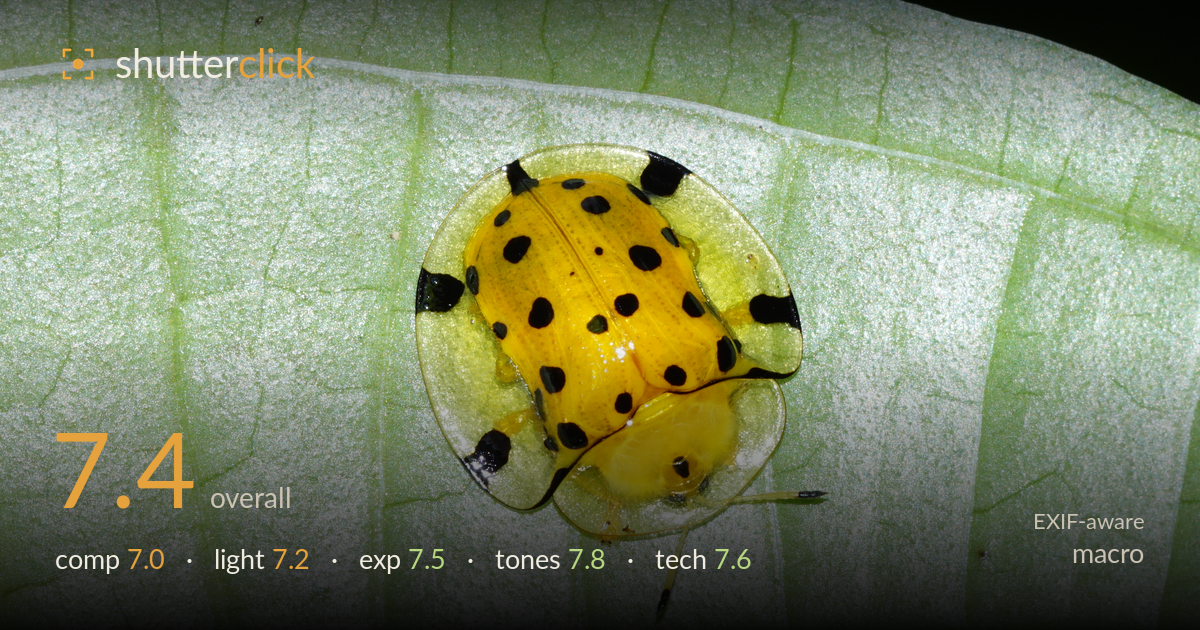
Spotted tortoise beetle on a leaf
Photo by Vengolis

| Focal length | 150 mm |
| Aperture | f / 11.0 |
| Shutter | 1/125 s |
| ISO | ISO 160 |
| Exp. comp. | 0.0 EV |
| Shot at | 11:05 · Aug 3, 2015 |
A tortoise beetle rendered with the translucent skirt of its shell reading clearly against the leaf — the standout feature here, and it's well captured. The yellow-and-black body pops beautifully against the muted green. What holds the shot back most is focus placement: the key plane sits on the spotted upper shell while the extended legs and lower edge fall soft. The subject sits slightly high in a large frame, leaving negative space that's pleasant but not fully purposeful. A touch more depth of field control and a slightly tighter frame would sharpen the impact of an already strong specimen shot.
The beetle is placed just above center on a broad expanse of leaf, and the veining radiating outward gives the frame gentle structure. The negative space works to isolate the subject, though there's a lot of it and the beetle reads slightly small for the amount of room given. The extended antenna and legs trailing toward the lower right add a diagonal that pulls the eye, but they also break the otherwise clean silhouette. A slightly tighter frame would give the transparent shell margin more presence.
Soft, even light — likely diffused flash or open shade — renders the leaf's fine surface texture and the glassy edge of the shell without harsh hotspots. The translucent skirt of the carapace catches light well enough to read as transparent, which is the whole point of this species and it's handled nicely. There are a few small specular highlights on the wet-looking body that read as slightly blown. A hair more directional light raking across the shell would emphasize its domed form and separate it further from the flat leaf.
Exposure is well judged across a tricky subject: the bright yellow body holds saturation without clipping into flat orange, and the pale green leaf retains its subtle veining and sheen. The black spots stay dense without crushing surrounding detail. The pure black background is a clean, intentional cutoff that isolates the subject. A couple of the wettest highlights on the body edge approach clipping, but nothing damaging. Overall the histogram appears well distributed with deliberate midtone placement.
The colour relationship is the image's real strength — vivid warm yellow against cool, desaturated green makes for a clean complementary pairing that carries the frame. White balance is accurate, with the leaf reading as a believable pale green rather than skewing cyan or magenta. The black spots and the amber transparency of the shell margin give a satisfying tonal range from deep shadow to bright highlight. Saturation is pushed but stays this side of garish. Contrast is well controlled for macro detail.
At f/11 on a 150mm macro, the depth of field is stretched about as far as diffraction allows, yet it still isn't quite enough to hold the whole beetle sharp. Focus lands on the upper spotted shell, which is the right call, but the lower body, the transparent skirt near the legs, and the extended antenna all drift soft. A focus stack of two or three frames would have carried edge-to-edge sharpness on a subject this flat and cooperative. ISO 160 keeps noise negligible and 1/125s is fine for a static insect on a still leaf, so the settings are sound in isolation. The trade-off is the classic macro one: stopping down further would only worsen diffraction, so stacking is the real answer here. Sharpness where focus does land is crisp, resolving the leaf's fine papillae and the shell's pitting cleanly. Lens choice and working distance are appropriate for the subject.
What would elevate it
Tags
Shot something like this?
Expert photo critique, on demand — scored across six categories, EXIF-aware. Start with 3 free critiques, no credit card.
critique my photo — free