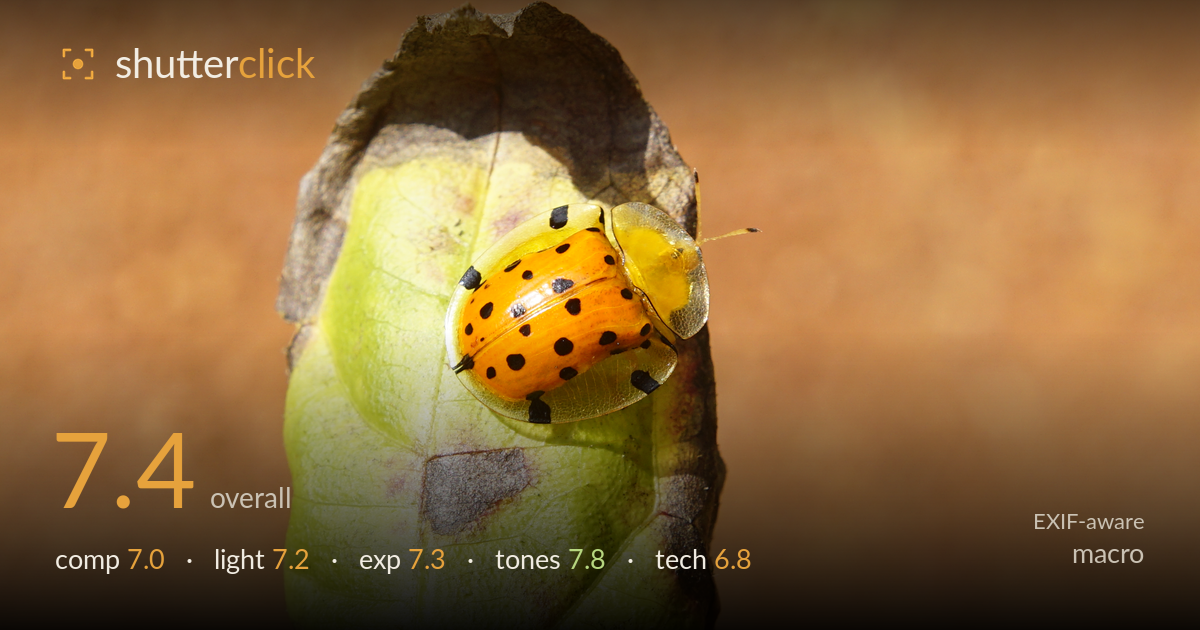
Spotted tortoise beetle on a leaf
Photo by Vengolis

| Focal length | 35 mm |
| Aperture | f / 8.0 |
| Shutter | 1/200 s |
| ISO | ISO 200 |
| Exp. comp. | 0.0 EV |
| Shot at | 00:13 · Nov 5, 2018 |
A striking subject well isolated against a clean, warm background — the translucent-edged tortoise beetle with its jewel-like orange centre and black spots is the clear star, and the colour contrast against the amber backdrop is genuinely arresting. The main limitation is depth of field: at f/8 the beetle's near flank and spots are crisp, but the transparent margin and antenna drift soft, and the leaf recedes quickly. The beetle also sits low-left with a lot of empty leaf tip above it. Focus precision on the eye and a slightly higher magnification would push this from a good record shot to a compelling macro.
The beetle anchors the left-of-centre lower third, and the vertical leaf gives a natural pedestal that leads the eye upward. The clean, uncluttered background does a lot of work isolating the subject. That said, the dead brown leaf tip occupies a large slice of upper frame with little payoff, leaving the beetle feeling slightly stranded. A tighter crop bringing the beetle nearer frame centre, or angling to include more of the leaf's green body beneath, would balance the weight and remove the dead space above.
Hard, direct sun rakes across the scene, lighting the beetle's dome and catching the translucent margin nicely — the specular highlight on the shell adds life and reveals the glassy edge. The trade-off is harsh, contrasty shadow on the right of the leaf and some blown speculars on the shell's crown. A diffuser or shooting in softer, overcast light would tame the highlights and render the beetle's spots and texture more evenly across the whole body.
Overall exposure is well judged — the beetle holds colour and detail, and the background stays bright without washing out. The brightest speculars on the shell's dome edge toward clipping, but they're small and arguably acceptable as sheen on a glossy surface. Shadow areas on the leaf retain detail. A third of a stop of negative compensation would have protected those top highlights while leaving the rest untouched, giving a touch more recoverable detail on the shell's crown.
The colour palette is the standout: the saturated orange centre against the amber-brown background and lime-green leaf creates a warm, cohesive harmony that feels intentional rather than accidental. White balance sits warm, suiting the subject, and the greens stay natural. Contrast is punchy without crushing. The black spots read cleanly against the orange. If anything the warmth is a hair heavy in the background, but here it complements the beetle rather than competing, and the tonal range is well handled throughout.
The EXIF tells the story: this was shot on an 18-35mm zoom at 35mm, which is not a true macro lens, so working distance and magnification are limited and the beetle can't fill the frame the way a dedicated macro would. f/8 is a sensible depth-of-field compromise, but at this magnification it still isn't enough to hold the whole beetle sharp — the near spots are crisp while the translucent margin and antenna soften. Focus appears to land on the shell body rather than the head or eye, which costs the shot its critical anchor point. ISO 200 and 1/200s are well chosen: noise is negligible and the shutter froze the static subject cleanly. A dedicated macro lens (or extension tubes) would allow closer framing, and focus stacking at f/5.6–f/8 across several frames would render the entire domed shell and antenna sharp. Placing the focus plane on the head would also give the eye the sharpness a macro needs.
What would elevate it
Tags
Shot something like this?
Expert photo critique, on demand — scored across six categories, EXIF-aware. Start with 3 free critiques, no credit card.
critique my photo — free