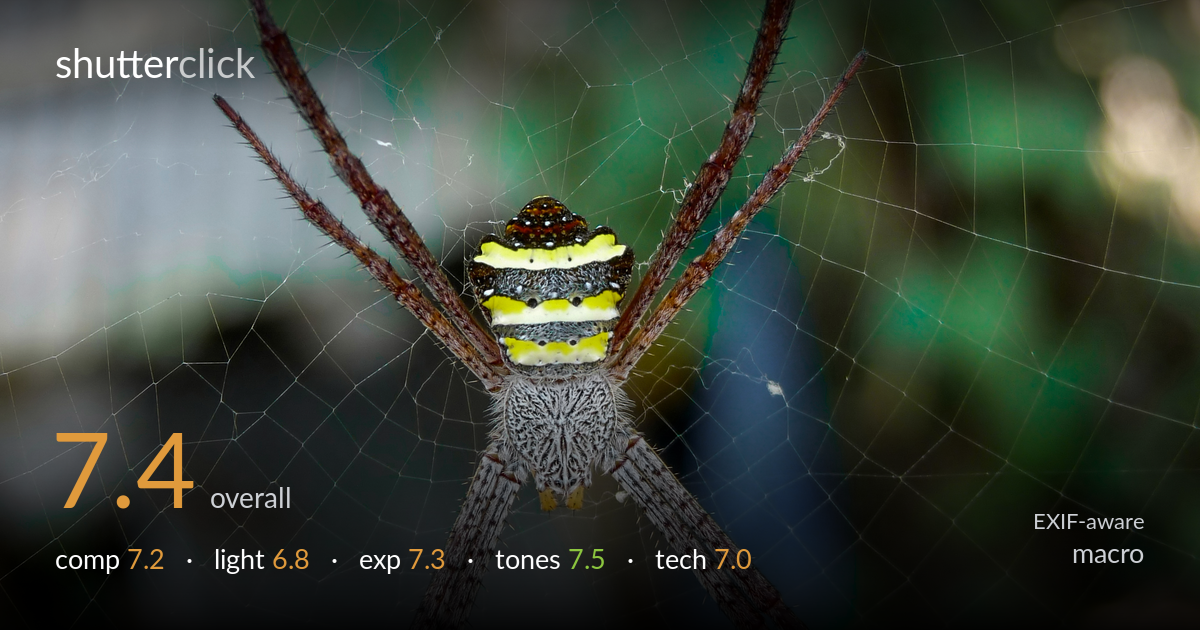
St andrew's cross spider on its web
Photo by Jeevan Jose, Kerala, India

| Shot at | 12:22 · Dec 6, 2014 |
A well-handled macro of a St Andrew's Cross spider with strong subject sharpness across the body and that distinctive stabilimentum zigzag preserved in frame. The yellow banding pops against muted greens, and the smaller male in the upper right adds a behavioural story most single-spider shots lack. What most holds it back is the slightly central placement and the legs that splay almost to all four edges, leaving little breathing room. The background, while pleasantly soft, is busy with competing colour patches that pull attention. Tighter framing intention and a cleaner backdrop would lift this from a solid record shot toward something more deliberate.
The spider sits nearly dead-centre with legs radiating to the frame edges, which suits the symmetry of the animal but crowds the borders — the lower legs nearly clip out. Including the smaller male top-right and the white zigzag stabilimentum bottom-right adds genuine narrative and breaks the symmetry usefully. The diagonal web lines give subtle structure. A touch more room around the leg tips, or a deliberate offset placing the female on a third, would relieve the cramped edges and let the radiating legs read as lines rather than crops.
Soft, diffuse daylight filtered through foliage gives even illumination across the spider with no harsh blown highlights — appropriate for revealing the banding and the fine hair texture on the legs. The flatness, however, leaves the abdomen looking slightly low in dimension; there is little directional modelling to separate the body from the web. A hint of raking side light would have carved out the silvery cephalothorax hairs and the spiny leg detail. The catchlight-free, gentle quality is safe but not shaping the subject dramatically.
Exposure is well judged for a high-contrast subject against a bright, dappled background. The yellow bands hold colour without clipping, and shadow detail in the dark leg joints and abdomen markings is retained. The web strands read clearly without being lost to glare. Highlights in the bright background patches sit near the top but don't distract. Midtones on the grey cephalothorax are placed naturally. Overall a clean, deliberate-looking exposure with full use of the available range and no obvious accidental under- or over-exposure.
White balance reads accurate — the greens are natural, the yellows vivid without veering acid, and the brown-red legs hold believable warmth. Contrast is moderate and well controlled, separating the patterned abdomen from the softer body. The muted background palette of greens, blues and earth tones complements the subject without competing on saturation. Mid-tone gradation on the grey hairs is smooth. If anything, the background colour blocks are slightly busy, but the tonal rendering of the spider itself is the photograph's strongest aspect.
Shot on a Panasonic DMC-FZ28 superzoom, this is a strong result given the small sensor. Focus lands accurately on the abdomen and cephalothorax, with the patterned dorsal surface and leg spines crisply rendered — the key plane is well chosen. Depth of field is shallow enough to throw the background into clean bokeh yet deep enough to keep most of the spider sharp, though the front leg tips drift slightly soft, suggesting the focal plane sat just behind them. Noise is well controlled, indicating a sensible low ISO in good light. The bridge camera's macro reach handles the small subject capably, and the web strands are resolved with surprising clarity. A slightly smaller aperture, or a focus-stacked pair, would have pulled the splayed legs fully into focus. Stabilising against the inevitable web movement paid off — there's no visible motion blur on the subject. A genuinely competent capture from modest gear.
What would elevate it
Tags
Shot something like this?
Expert photo critique, on demand — scored across six categories, EXIF-aware. Start with 3 free critiques, no credit card.
critique my photo — free