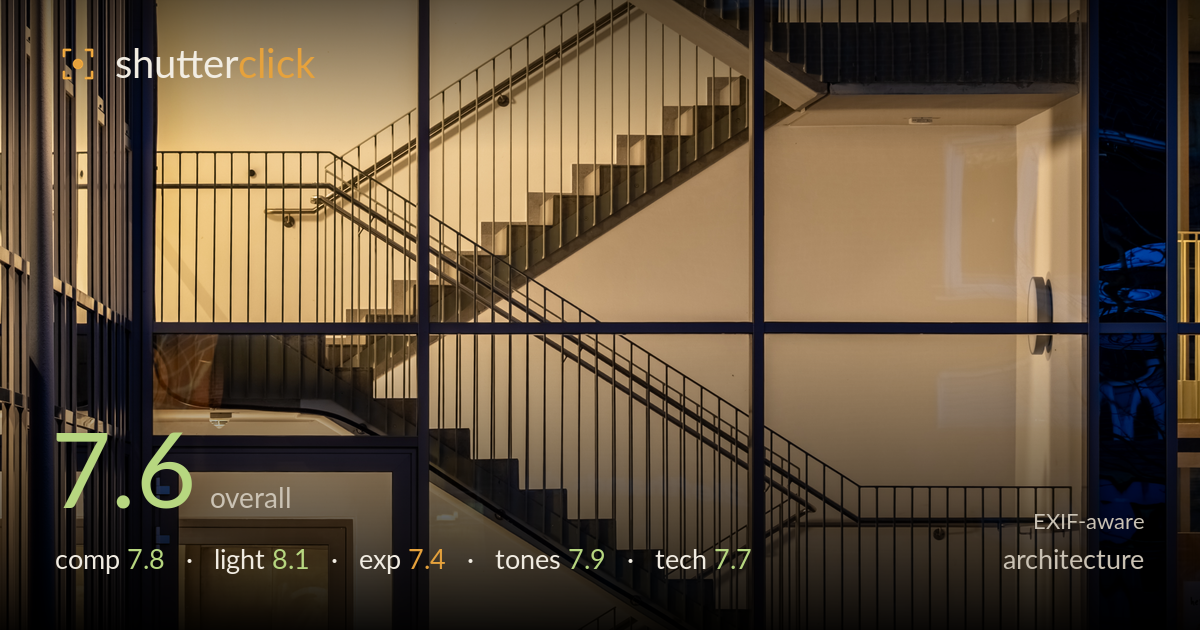
Staircase behind glass at blue hour
Photo by Dietmar Rabich

| Focal length | 81 mm |
| Aperture | f / 7.1 |
| Shutter | 1/20 s |
| ISO | ISO 125 |
| Exp. comp. | -5.0 EV |
| Shot at | 18:38 · Apr 7, 2026 |
A strong graphic read of a zigzagging staircase seen through a glass curtain wall at blue hour, where the warm interior glow plays cleanly against the cool exterior brick. The switchback stair forms a natural repeating rhythm that carries the eye up through the frame, and the mullion grid organizes everything with quiet discipline. What holds it back most is the foreground: the empty paving occupies nearly the bottom third with little purpose, and the parked bicycles clutter the base of an otherwise clean composition. Verticals are well controlled and the warm-cool balance is the picture's real strength.
The switchback staircase is the whole show, and its zigzag reads beautifully against the flat white interior, with the window mullions supplying a steady grid to hold it all. The eye climbs the stairs naturally from bottom to top. Two weaknesses drag on it: the foreground paving eats the lower third with little to say, and the two bicycles at the base introduce clutter that competes with the clean geometry. A tighter crop that lifted the bottom edge and lost some empty pavement would concentrate attention on the stair rhythm.
The timing is the picture's biggest asset. Shooting at blue hour lets the warm tungsten glow of the interior read against the cool blue brick above, and that temperature contrast gives the frame its whole mood. The light rakes across the concrete treads enough to describe their edges without flattening them, and the single street lamp at left adds a warm accent that balances the composition. The interior stays soft and even, which suits the architecture. Very little to fault in the choice of when to shoot.
Exposure is broadly well judged for a mixed-light scene. The bright interior holds its highlights without the white walls blowing out, and the darker brick and paving retain structure. The heavy negative exposure compensation was the right call to protect the glowing interior from clipping, though it leaves the foreground pavement muddy and a touch flat. Shadow detail in the lower corners is thin. A slightly lifted shadow range in post would recover texture in the paving without disturbing the carefully preserved highlights inside.
The warm-cool split is the tonal signature here, and it is handled with restraint: amber interior against blue-grey brick, neither pushed to garish. White balance sits believably between the two sources. The concrete treads carry a pleasing neutral-to-warm gradation, and contrast is controlled enough to keep the glass reflections legible. The brick above could hold a fraction more separation in its blues, and the paving reads slightly flat and dull. Overall a mature, cohesive palette that serves the architecture rather than decorating it.
The settings suit a static architectural subject shot from a tripod. At f/7.1 on the 70-300 at 81mm, depth of field is ample to hold the stair and glass sharp across the plane, and ISO 125 keeps noise absent with clean shadows. The 1/20s shutter is only viable because the building doesn't move, and the sharpness through the frame confirms a stable support was used. Focus lands accurately on the stair treads and railings, which read crisply through the glass. The long lens is a slightly unusual choice for architecture but here it compresses the facade cleanly and keeps verticals from diverging, which the well-controlled parallels confirm. The main technical caveat is the mixed glass reflections at right, which introduce some flare and doubling that the settings can't address. Focus stacking wasn't needed at this distance and aperture. A polarizer might have cut some of the reflective haze on the glass, though it would also have dimmed the interior glow.
What would elevate it
Tags
Shot something like this?
Expert photo critique, on demand — scored across six categories, EXIF-aware. Start with 3 free critiques, no credit card.
critique my photo — free