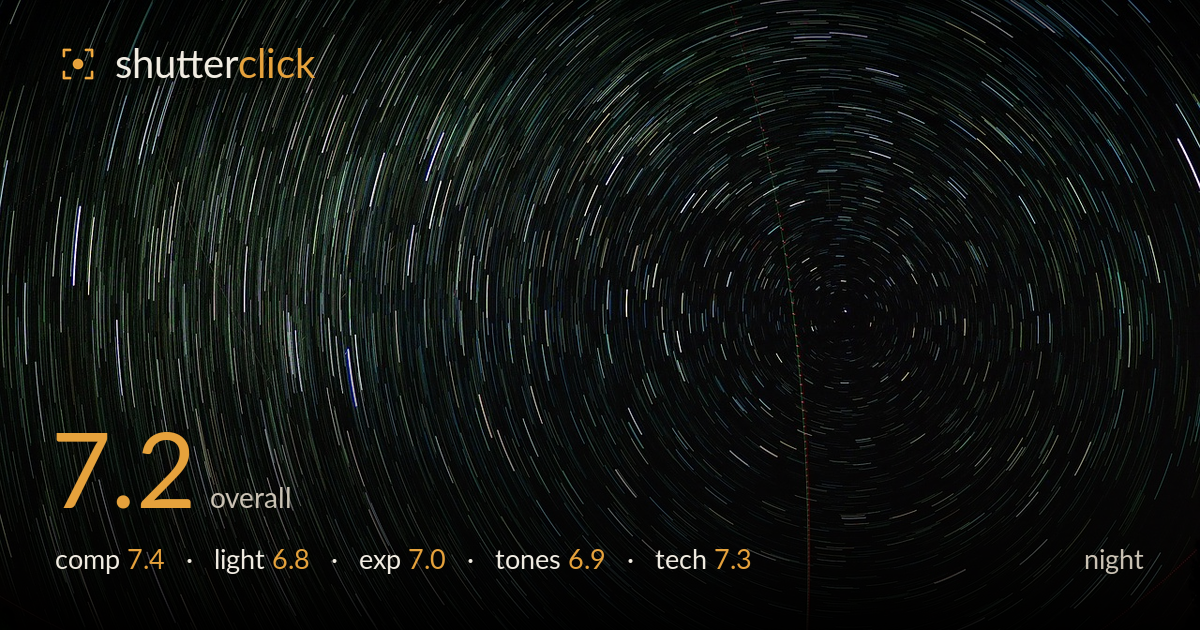
Star trails circling the pole
Photo by Hans

No EXIF metadata in this file
Technical analysis based on visual assessment only.
A well-executed star trail with Polaris placed off-centre and a clean circular sweep that carries the eye around the frame. The fisheye lens gives the sky an expansive dome-like feel, and the accumulation of concentric arcs reads clearly. What most holds it back is the foreground: the tree-line silhouette is a thin, undifferentiated strip with little shape or interest, and a strong red aircraft/beacon trail cutting through the pivot point competes with the natural geometry. The orange light pollution at the horizon is honest to the location but muddies the lower tones. Solid technique, needing a stronger anchor at the base.
Placing the celestial pole right of centre and high gives the arcs room to spiral, and the fisheye reinforces the sense of a full sky dome. The circular motion is the clear organising principle and it works. The weakness is the base: the silhouetted ridge and trees form a thin, flat band with no dominant foreground element to anchor the rotation. A distinctive tree, structure, or ridgeline shape near the pivot's vertical axis would give the composition a foothold rather than leaving the lower fifth as filler.
This is accumulated star light plus ambient sky glow rather than shaped lighting, so the judgement rests on timing and ambient control. The orange band along the horizon is sodium light pollution, which adds a warm gradient but also flattens the tree silhouette into near-black with no separation. The upper sky holds a pleasing deep tone where trails register cleanly against darkness. A darker site, or shooting away from the town glow, would deepen the base and let the trails hold contrast right down to the horizon.
The stacked exposure balances trail brightness against sky darkness well — the brighter stars register as bold arcs without blowing out, and the darker sky retains its depth. Shadow areas at the base are crushed to black, acceptable for silhouette but it swallows any foreground texture. The horizon glow is bright but not clipped. Overall the exposure decisions read as deliberate and the dynamic range is handled sensibly for a long-duration composite; a touch more shadow lift on the trees would recover shape without harming the sky.
The cool blue-white of the trails against the near-neutral dark sky is attractive and the varied star colours — faint reds, blues, whites — add subtle richness. The dominant issue is the muddy orange horizon glow, which sits awkwardly against the cool sky and doesn't fully resolve into either warm ambience or clean night. White balance leans slightly warm at the base. Selectively cooling and darkening the horizon band, or grading it toward a more intentional warm-to-cool transition, would tidy the tonal split.
Execution of the trail stacking is competent — arcs are continuous without obvious gaps, suggesting well-timed intervals and consistent exposures, and noise is controlled for a night composite. Focus reads as accurate, with tight star points forming crisp trails rather than bloated smears, which points to careful manual focusing on infinity. The fisheye is a defensible choice for capturing the whole rotation, though it introduces heavy barrel distortion and stretches the corners; whether that serves the image is a taste call, but here it exaggerates the dome effect usefully. The most intrusive technical element is the bright red near-vertical line running through the pole — an aircraft or satellite beacon trail — which draws the eye straight to it and disrupts the concentric pattern. That, plus the fainter horizontal red dotted trails lower down, would ideally be cloned out or masked during stacking. Otherwise the frame is clean, sharp where it matters, and free of significant hot pixels or amp glow.
What would elevate it
Tags
Shot something like this?
Expert photo critique, on demand — scored across six categories, EXIF-aware. Start with 3 free critiques, no credit card.
critique my photo — free