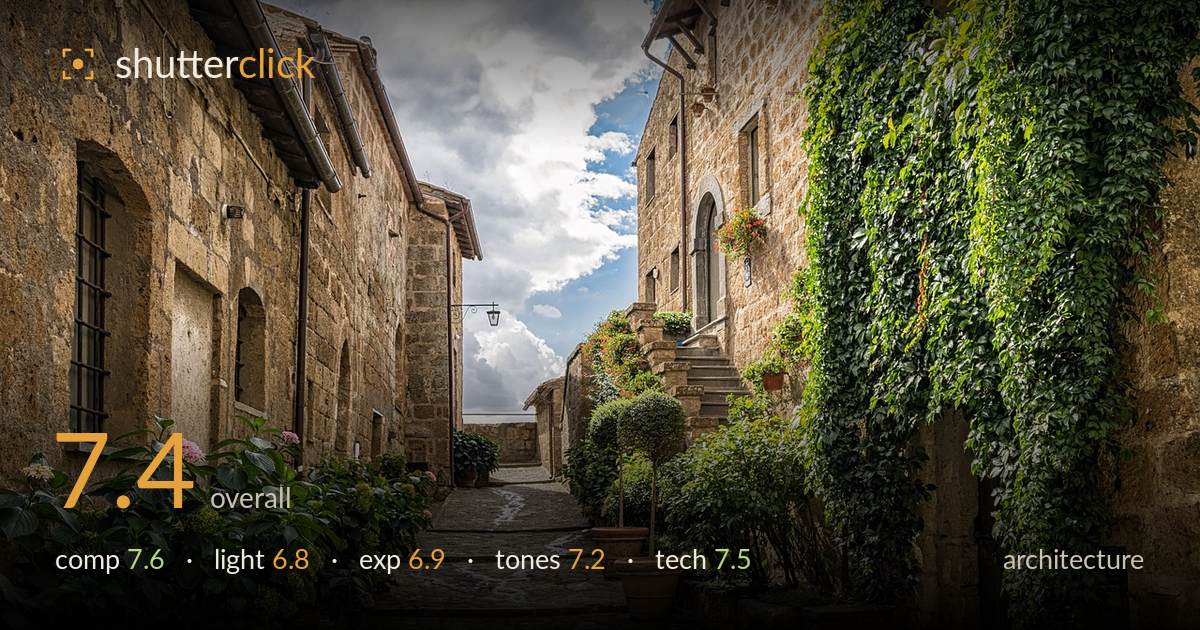
Stone alley descending to the sky
Photo by Tama66

No EXIF metadata in this file
Technical analysis based on visual assessment only.
A well-observed old-town alley that uses the converging stone walls and the descending stairway as a natural funnel toward the bright sky opening. The greenery, potted plants and hydrangeas add welcome colour and depth against the warm stone. What most holds it back is the HDR-leaning treatment: the sky is blown near the horizon while the shadowed masonry carries slightly muddy, over-processed midtones. The overcast-to-broken light flattens the stone texture that should be the star. A cleaner tonal balance and a moment of more directional light would lift a solid travel frame into a memorable one.
The two stone facades converge as strong leading lines, drawing the eye down the stepped path toward the distant sky opening — a classic and effective vignetting of a medieval street. The ivy-draped right wall balances the barred windows on the left, and the foreground planters add layered depth. The lantern and stairway act as secondary anchors. The vanishing point sits a touch low and central, and the busy foreground planting slightly crowds the entry. A hair more room at the bottom of the steps would strengthen the descent.
The light is soft and diffuse from broken cloud, which evenly reveals the alley but gives up the raking directionality that makes rough stone sing. The bright sky gap provides a focal glow but competes with the shaded walls for attention, creating an uneven luminance split across the frame. Highlights on the clouds edge toward flat white while the lower walls sit in open shade. Early or late side light grazing along these facades would carve the masonry texture and add the warmth the scene is reaching for.
Exposure is balanced for the shadowed street, keeping the stone and foliage detailed and readable, but the sky pays for it — the clouds near the horizon are pushed toward clipping and lose gradation. The HDR-style processing lifts the shadows enough that some midtone contrast goes soft and slightly grey. Overall the histogram leans toward a compressed dynamic range with little true black. Protecting the sky with a graduated approach or a gentler tone curve would restore highlight detail without darkening the alley itself.
Warm sandstone plays nicely against the cool blue sky and the saturated green ivy, a pleasing complementary balance for a Tuscan-style scene. The colour handling is generally faithful, if a touch punchy — the greens and the pink hydrangeas verge on oversaturated, and the shadows carry a slightly muddy, HDR-tinged cast. Contrast in the midtones is soft, flattening the stone. Dialling back global saturation, deepening the blacks a little, and cleaning the shadow tint would give the palette more honesty and let the stone read warmer.
Focus is well distributed front to back, with the near planters, the stepped path and the distant walls all holding acceptable sharpness — consistent with a moderately stopped-down aperture and a wide-to-standard focal length suited to the confined street. There is no visible motion blur and noise is not an issue in this light. The verticals are reasonably controlled: the walls lean only slightly, and no aggressive keystoning distracts, which is a real strength for an architectural interior street shot handheld. The main technical limitation is the processing rather than capture — the HDR tone-mapping introduces mild halo-like transitions along the roofline against the bright sky and softens local micro-contrast in the masonry. Sharpening looks applied globally, giving the foliage a faintly crunchy edge. A single well-exposed frame with restrained tone-mapping, or exposure blending with a lighter hand, would preserve the clean detail already captured while avoiding the over-processed look that undercuts an otherwise technically sound image.
What would elevate it
Tags
Shot something like this?
Expert photo critique, on demand — scored across six categories, EXIF-aware. Start with 3 free critiques, no credit card.
critique my photo — free