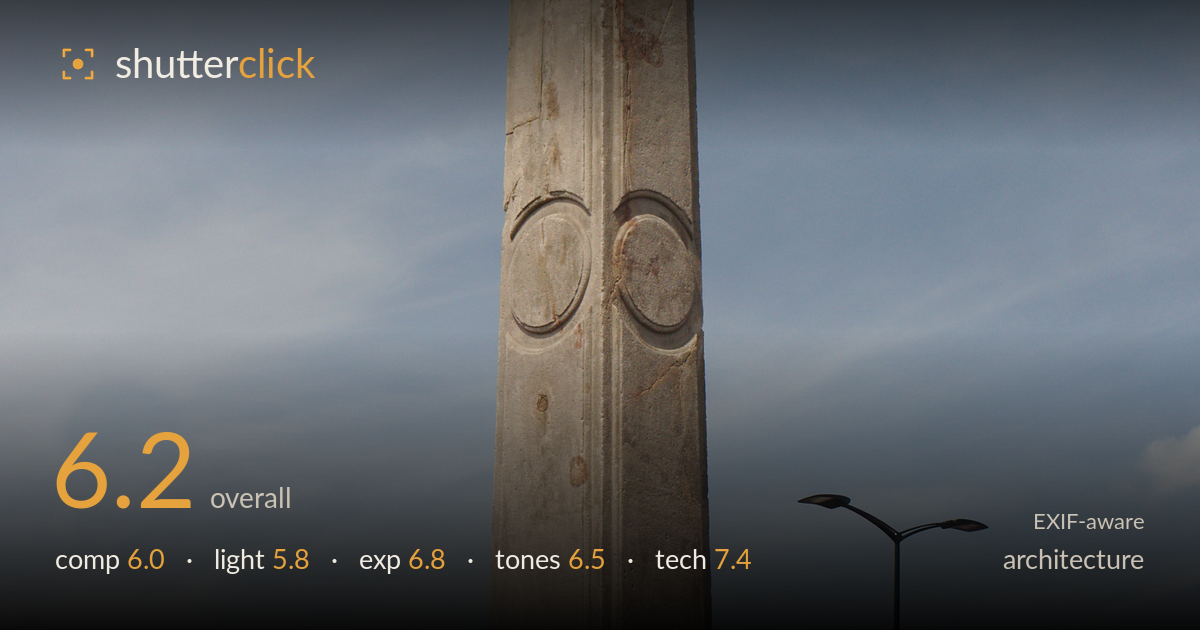
Stone obelisk in a car park
Photo by Rodhullandemu

| Focal length | 24 mm |
| Aperture | f / 8.0 |
| Shutter | 1/250 s |
| ISO | ISO 100 |
| Exp. comp. | 0.0 EV |
| Shot at | 13:08 · Jun 1, 2021 |
The obelisk is documented cleanly and kept convincingly vertical, which is the hardest part of shooting a tall monument, and the framing captures the full structure top to base. What most holds the image back is the setting: the cluttered car-lot background, street lamps and chain-link fence compete with the subject and pull the eye away from the stone. The flat midday light also flattens the monument's carved detail and reduces the sky to a hazy backdrop. A cleaner angle, warmer light, or a tighter isolation of the obelisk would let the subject dominate the frame the way it deserves.
The obelisk is centred and held impressively upright, with verticals that read true — no obvious keystoning despite the low angle. The full monument from apex to plinth is included, a sound documentary choice. But the base is crowded: parked cars, a chain-and-post fence, street lamps and brick shopfronts fill the lower third and clutter the read. The centred placement suits the symmetry of the subject, yet the busy surroundings undercut it. A cleaner foreground or a viewpoint that suppressed the car lot would give the monument the isolation its geometry asks for.
Flat, high midday sun lights the stone fairly evenly but does little to model the obelisk's edges or reveal the carved roundels and inscription. The light comes from near overhead, so the faceted surfaces read with low contrast and the texture of the weathered stone falls flat. The sky is a hazy pale blue with weak cloud definition. Raking side light from a lower sun angle would carve the facets into relief and separate the monument's planes, giving the stone dimension the current lighting flattens away.
Exposure is well controlled for a bright-sky scene. The pale stone holds highlight detail without clipping, and the shadowed base and cars retain sufficient information. The sky is bright but not blown, and the midtones sit reasonably. There is a slight overall flatness — the histogram likely lacks a strong black point given the hazy conditions. A touch more contrast in post would give the frame more punch, but the capture itself is safe and deliberate, with no accidental under- or over-exposure.
White balance reads neutral to slightly cool, appropriate for the grey Portland-type stone, which retains its warm-cream cast in the sunlit areas. The sky is a soft, slightly desaturated blue that suits the hazy day. Contrast is modest, leaving the overall palette a little muted — the stone and sky occupy similar tonal territory, reducing separation. A gentle contrast lift and a small clarity boost on the stone would strengthen tonal range and make the monument stand out from the flat backdrop.
The settings are well chosen for the task. f/8 sits in the lens's sharp aperture range and delivers front-to-back depth appropriate for architecture, keeping both the obelisk and the background acceptably sharp. ISO 100 gives clean, noise-free files, and 1/250s easily freezes any camera shake with the 18-55mm at 24mm. Focus appears accurate on the stone, and detail across the shaft is crisp. The 24mm focal length on the APS-C body (roughly 38mm equivalent) is a sensible moderate-wide choice that includes the full monument without exaggerating perspective, and the verticals were kept commendably straight for a handheld low-angle capture. The main technical limitation is not the gear but the situation: shooting into a hazy bright sky reduces micro-contrast on the stone. Everything within the photographer's control at capture was handled competently — aperture, shutter, ISO and focus all align with the subject's needs.
What would elevate it
Tags
Shot something like this?
Expert photo critique, on demand — scored across six categories, EXIF-aware. Start with 3 free critiques, no credit card.
critique my photo — free