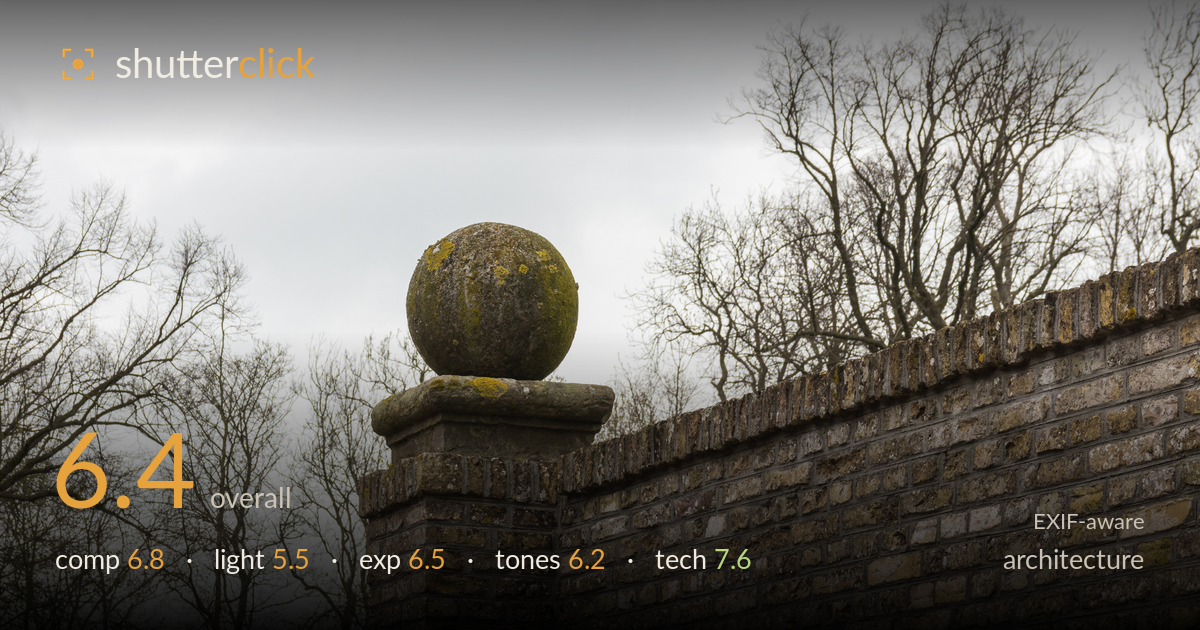
Stone sphere on a garden wall
Photo by Dominicus Johannes Bergsma

| Focal length | 50 mm |
| Aperture | f / 11.0 |
| Shutter | 1/60 s |
| ISO | ISO 100 |
| Exp. comp. | 0.0 EV |
| Shot at | 12:10 · Apr 14, 2017 |
A quietly effective study of a lichen-crusted stone finial against a bare-tree skyline, anchored by the strong diagonal of the receding brick wall. The composition works: the sphere sits at a natural focal node and the wall pulls the eye into the frame with real depth. What most holds it back is the flat, overcast light, which drains the brick and stone of the raking texture this subject rewards, and a sky that reads as blank white filler occupying much of the upper frame. Sharpness and depth of field are handled well. Stronger side light and a tighter framing would lift it considerably.
The receding wall creates a confident diagonal that carries depth and scale, and the moss-topped sphere lands near a thirds intersection as a clear focal point. The corner of the pillar gives a strong structural anchor. The bare trees frame the left and add seasonal context. The weakness is the expanse of empty white sky filling roughly the top half — it dilutes the subject rather than supporting it. A lower angle or tighter crop that reduced the dead sky would concentrate attention on the finial and the brick geometry.
Flat, diffuse overcast light dominates, and for a subject defined by its crumbling stone surface and lichen this is the least flattering condition. The soft light renders the brickwork and sphere evenly but without the raking shadows that would carve out texture and the weathered relief of the masonry. There is no directional modelling to separate the sphere from its plinth or to emphasise the depth of the mortar courses. Directional side light near golden hour would transform the same scene, giving the stone dimensionality it currently lacks.
Exposure is competently judged for a difficult bright-sky situation. The brick and stone retain full detail across shadows and midtones, with no meaningful clipping in the wall itself. The sky is near-blown but reads as a deliberate high-key backdrop rather than an error, and a little highlight information appears to survive. The histogram sits weighted toward the highlights, which suits the overcast conditions. A touch of negative exposure compensation would have preserved more sky tone, though the choice made keeps the subject clean and readable.
The muted earth palette of ochre, grey and green suits the subdued weather and the aged materials. White balance is neutral, perhaps slightly cool, which reinforces the winter mood. The lichen greens and yellow-orange brick offer welcome colour accents against the grey. Contrast is inevitably low given the flat light, leaving the image feeling a little lifeless overall. A modest contrast and clarity lift, along with a small vibrance boost on the moss, would add snap without pushing the naturalistic tones into artificiality.
Settings are well matched to the subject. At f/11 on the 18-55mm at 50mm, depth of field is deep enough to hold the near pillar corner and the far end of the wall acceptably sharp, which is exactly right for an architectural study prioritising front-to-back detail. ISO 100 keeps the file clean, and 1/60s is entirely safe with the IS-equipped lens for a static subject handheld. Focus sits accurately on the sphere and plinth, where it belongs. The optic performs respectably stopped down, with good edge detail in the brick courses. The one technical caution is the near-blown sky, which a graduated approach or slight underexposure with recovery in raw would have managed better. Verticals on the pillar read close to true, though the wall's convergence is a natural product of the viewpoint rather than lens distortion. Overall this is clean, deliberate execution — the gear was used sensibly and the result is technically sound.
What would elevate it
Tags
Shot something like this?
Expert photo critique, on demand — scored across six categories, EXIF-aware. Start with 3 free critiques, no credit card.
critique my photo — free