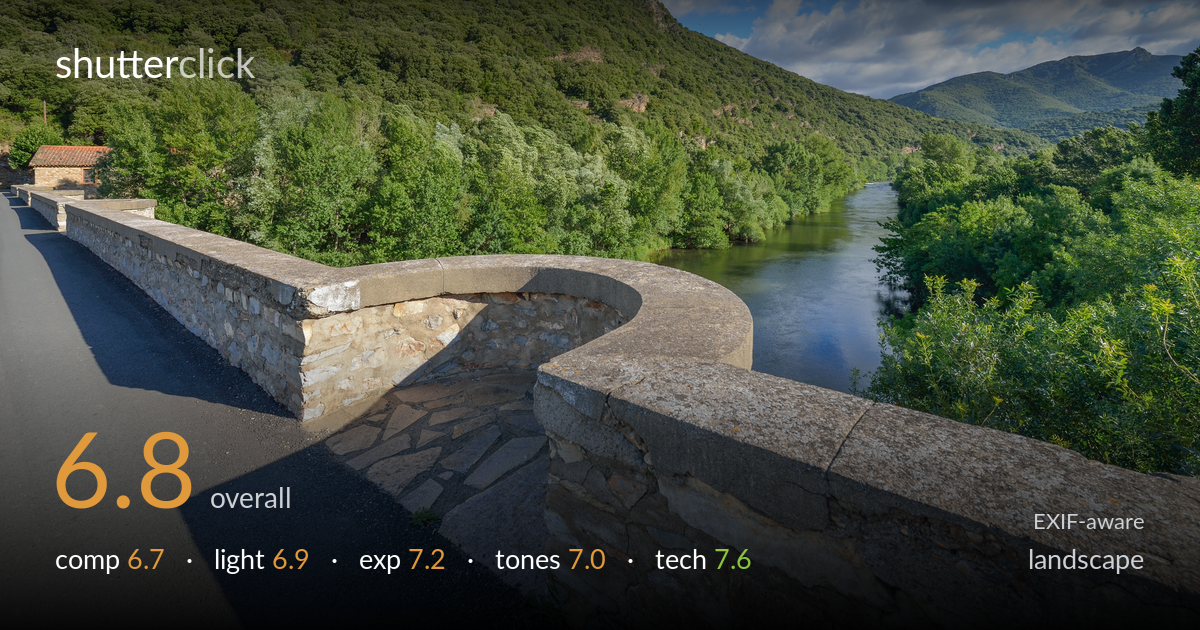
Stone wall curving above the river
Photo by Christian Ferrer

| Focal length | 14 mm |
| Aperture | f / 8.0 |
| Shutter | 1/250 s |
| ISO | ISO 160 |
| Exp. comp. | 0.0 EV |
| Shot at | 08:43 · Jun 23, 2013 |
A pleasant valley vista anchored by a curving stone parapet that draws the eye from foreground to river — the leading line is the strongest idea here. What holds it back is that the wall dominates too much of the lower right, pushing the river and mountains into a thinner band and leaving the bottom corner heavy and busy. The light is bright and clean but flat across the hills, lacking the directional warmth that would carve out depth. A more deliberate horizon and a touch more dynamic range in the foliage would lift it. The bones of a strong scene are present.
The S-curve of the stone wall is a genuine asset, sweeping the eye from the road through the bend toward the river and distant peaks. It works as a leading line. The trouble is balance: the wall and its flagstone apron occupy roughly the lower-right third with heavy weight, crowding the river into a narrow ribbon. The horizon sits high, which suits the layered hills, but the bottom-right corner feels cramped and slightly chaotic. A step back or a slightly higher angle would let the river breathe and ease that corner.
Bright daytime light gives clean separation between the sky's whites and the green hillsides, and the low sun rakes across the wall enough to show its stone texture and cast the long diagonal shadow on the road. That shadow adds a little drama. But across the wider scene the light is fairly flat and frontal, so the distant hills read as a single green mass without much modelling of ridge and valley. The warmer, lower light of golden hour would have given the mountains far more dimensional separation.
Exposure is well controlled for a high-contrast scene. The bright clouds hold their structure rather than blowing out, and the shadowed stonework in the foreground retains detail without muddiness. The midtones in the green foliage sit at a natural level. Some of the brightest cloud edges are close to clipping but recoverable. The river surface holds its subtle reflections well. Overall a confident, balanced read of a wide dynamic range — nothing pushed too far in either direction, and the histogram appears to use its full span.
Colour is clean and believable — the greens are saturated but not cartoonish, the sky is a natural blue, and white balance reads neutral. Contrast is healthy without crushing the shadows. The one limitation is that the vast expanse of green tends toward sameness, with little tonal variation to distinguish near foliage from distant hillside. A slight separation in the green channel, or warmth in the highlights, would add depth. The stone wall's earthy tones provide welcome relief against all that green.
Settings are well matched to the scene. At 14mm on the f/2.8 zoom, f/8 is the sweet spot for this lens — sharp corner to corner with deep depth of field that keeps the foreground stone and distant peaks both rendered crisply. ISO 160 keeps noise invisible, and 1/250s is far more shutter than a static landscape needs, leaving plenty of headroom. Focus appears accurately placed for front-to-back sharpness. The 14mm ultra-wide is the natural choice for this sweeping foreground-to-background relationship, and it delivers the dramatic curve of the wall. The one caution with this focal length is distortion: the wide angle exaggerates the foreground stone and slightly bows the scene, which is part of why the lower-right feels so dominant. The verticals on the small stone hut at left lean inward, a typical wide-angle artifact. Stopping to f/8 was the right call for sharpness; the execution is technically clean throughout with no motion blur or noise concerns.
What would elevate it
Tags
Shot something like this?
Expert photo critique, on demand — scored across six categories, EXIF-aware. Start with 3 free critiques, no credit card.
critique my photo — free