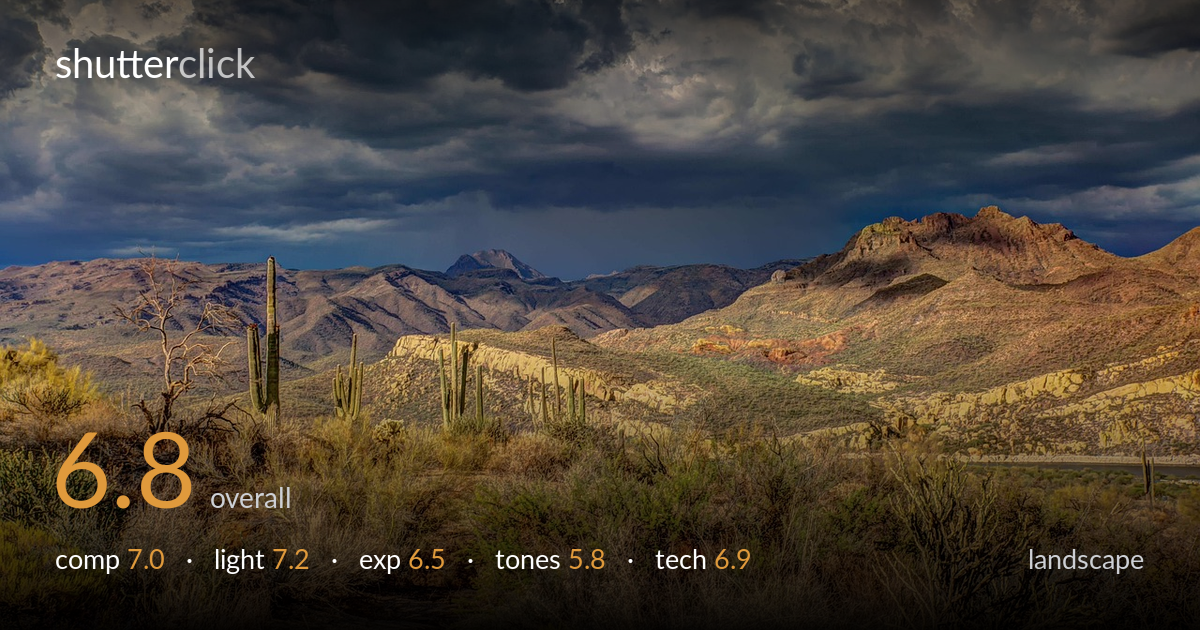
Storm light over the desert
Photo by Pexels

No EXIF metadata in this file
Technical analysis based on visual assessment only.
A dramatic desert scene with a brooding storm sky doing most of the heavy lifting — the layered Sonoran landscape of saguaros, ridgelines and a low band of broken light reads with real depth and atmosphere. What most holds it back is heavy-handed HDR processing: the tones are crunchy, the midtones flat, and a grey-blue cast sits over what should be warm desert earth. The sky's threat and the desert's texture both register, but the grading undercuts believability. Dialled back, this is a strong storm-light landscape. The bones are there; the finish needs restraint.
The frame stacks well — foreground scrub, a midground band of saguaros and rock, receding ridgelines, then the dominant sky. The horizon sits low at roughly the lower third, giving the storm clouds room, which suits the drama. The cluster of cacti on the left anchors the eye and offsets the bright rock face on the right. The foreground brush is busy and slightly undirected, lacking a single clear lead-in. A stronger foreground element or a slightly lower angle would have given the eye a cleaner entry into the depth.
The light is the real story — a break in the storm rakes across the midground ridges and rock face, lifting them against the dark cloud base behind. That selective illumination on the right-hand bluffs creates genuine three-dimensionality and separates the planes. The contrast between lit desert and shadowed peaks beneath the cloud is what gives the scene its tension. The foreground sits in flatter, more even light, so it carries less of that modelling. Catching the light fully on the saguaro cluster would have sharpened the impact further.
Exposure holds detail across a wide range — the bright cloud tops aren't blown and the shadowed slopes retain structure, which is no small feat under this dynamic range. The cost is a flattened, compressed look through the midtones where HDR tone-mapping has pulled everything toward the middle, draining contrast from the desert floor. The darkest cloud bases verge on muddy rather than richly dark. A more natural tonal curve with committed blacks would restore the depth the merge has sapped from the scene.
This is where the image struggles most. A cool grey-blue cast overlays the whole frame, leaving the desert earth and dried grass looking dull and slightly lifeless rather than warm. The HDR processing introduces a crunchy, over-textured quality and localized halos around the ridge edges against the sky. Saturation is uneven — some greens pop while the soil reads flat. White balance pulled a touch warmer and the HDR effect eased back considerably would let the natural desert palette breathe and lend the storm light its true colour and weight.
Sharpness is good across the depth of field — the foreground scrub, midground saguaros and distant ridges all hold detail, suggesting a well-chosen small aperture for front-to-back focus, appropriate for a landscape of this kind. Focus appears accurately placed and there's no obvious motion blur in the cacti despite the wind a storm implies. The main technical concern is processing rather than capture: the HDR tone-mapping has introduced edge halos and an over-crisp, slightly artificial micro-contrast, most visible along the ridgeline where rock meets cloud. Noise is controlled. The lens choice gives a natural perspective without obvious distortion. The raw capture seems technically sound — the dynamic range was handled and detail retained — but the post-processing pushes the textures past what looks believable. A single-exposure raw with careful shadow recovery, or a much gentler tone-map blend, would preserve the same detail without the synthetic crunch that currently flags the image as heavily processed.
What would elevate it
Tags
Shot something like this?
Expert photo critique, on demand — scored across six categories, EXIF-aware. Start with 3 free critiques, no credit card.
critique my photo — free