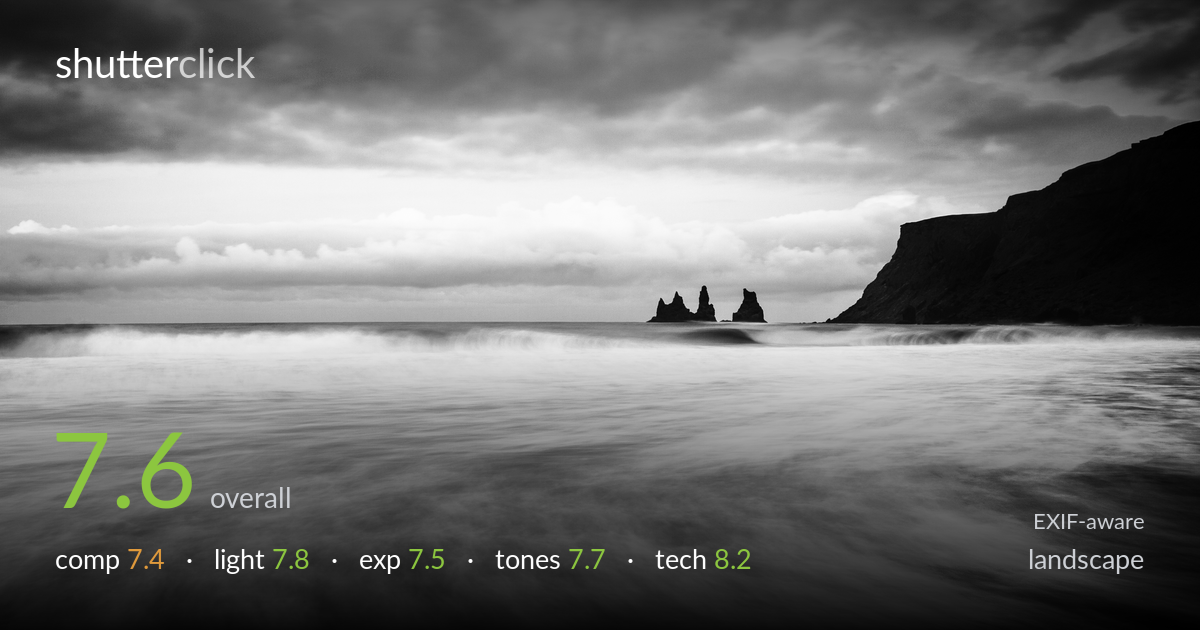
Streaming tide toward the sea stacks
Photo by Martin Sojka

| Focal length | 21 mm |
| Aperture | f / 11.0 |
| Shutter | 4.0 s |
| ISO | ISO 50 |
| Exp. comp. | 0.0 EV |
| Shot at | 03:55 · Jul 23, 2011 |
A moody, atmospheric black-and-white seascape that uses long-exposure motion to genuine effect — the streaming foreground water radiates outward and pulls the eye toward the sea stacks and headland. The drama in the cloud-heavy sky and the silhouetted Reynisdrangar stacks gives the frame real mood. What holds it back most is the foreground: the swept water occupies well over half the frame as a soft, somewhat featureless expanse, with no anchoring rock or texture to land on. The horizon also sits a touch low and slightly off-level. Strong atmosphere, well executed, just needing a stronger foreground anchor.
The radiating water streaks form natural leading lines toward the sea stacks and cliff, and placing the headland on the right edge with the stacks just left of centre gives the eye two distinct points of interest. The low horizon hands the sky generous room for its drama, which works. The weakness is the foreground's sheer dominance — the lower two-thirds is a soft sweep with no rock, no anchor, no textural detail to ground the lines. A foreground element, even small, would give the converging motion somewhere to begin.
Overcast, diffuse light suits this scene well, rendering the clouds in heavy layered tones and keeping the sea stacks and headland as clean silhouettes against the brighter sea horizon. The soft light avoids harsh contrast on the water, letting the long-exposure motion read as smooth silver. There's a luminous band along the horizon where the cloud breaks, adding depth. The mood is consistent and deliberate. A touch more directional light raking across the foreground would have given the water surface more dimension and shadow structure.
Exposure is well managed for a high-contrast scene. The bright horizon band and brightest cloud highlights hold detail rather than blowing out, and the silhouetted stacks and cliff retain shape without sinking to dead black. The four-second exposure at ISO 50 keeps the midtones of the streaming water cleanly placed. Shadow areas in the lower corners go quite dark, but that suits the mood. The overall tonal placement reads deliberate rather than accidental. A graduated approach to balance sky and foreground a hair more evenly would refine it further.
The black-and-white conversion carries a moody, silvery range that fits the subject. Cloud separation is good, with believable mid-tone gradation through the sky, and the water holds a soft luminous quality. Contrast is judged for atmosphere rather than punch, which is the right call here. The deep shadows in the foreground corners add weight. What would lift it is slightly cleaner blacks in the stacks and headland to sharpen the silhouettes, and a touch more local contrast in the foreground water to keep it from reading flat.
The gear and settings are well matched to the intent. The Zeiss Distagon 21mm at f/11 is an ideal pairing for a wide coastal scene, delivering depth of field from the near foreground to the distant cliff with the lens's characteristic edge-to-edge resolution. ISO 50 keeps the file clean and grain-free, which matters for the smooth tonal sweeps of the water. The four-second shutter is the key creative choice — long enough to render the receding water as silken streaks while preserving the textured streaking that gives the foreground its energy, rather than over-smoothing it to featureless milk. Focus appears well placed for hyperfocal coverage, with the stacks reading sharp. A sturdy tripod is evident in the clean rendering of the static cliff against the moving water. The one refinement: the horizon sits very slightly off-level, an easy correction that the wide field makes more noticeable at the edges.
What would elevate it
Tags
Shot something like this?
Expert photo critique, on demand — scored across six categories, EXIF-aware. Start with 3 free critiques, no credit card.
critique my photo — free