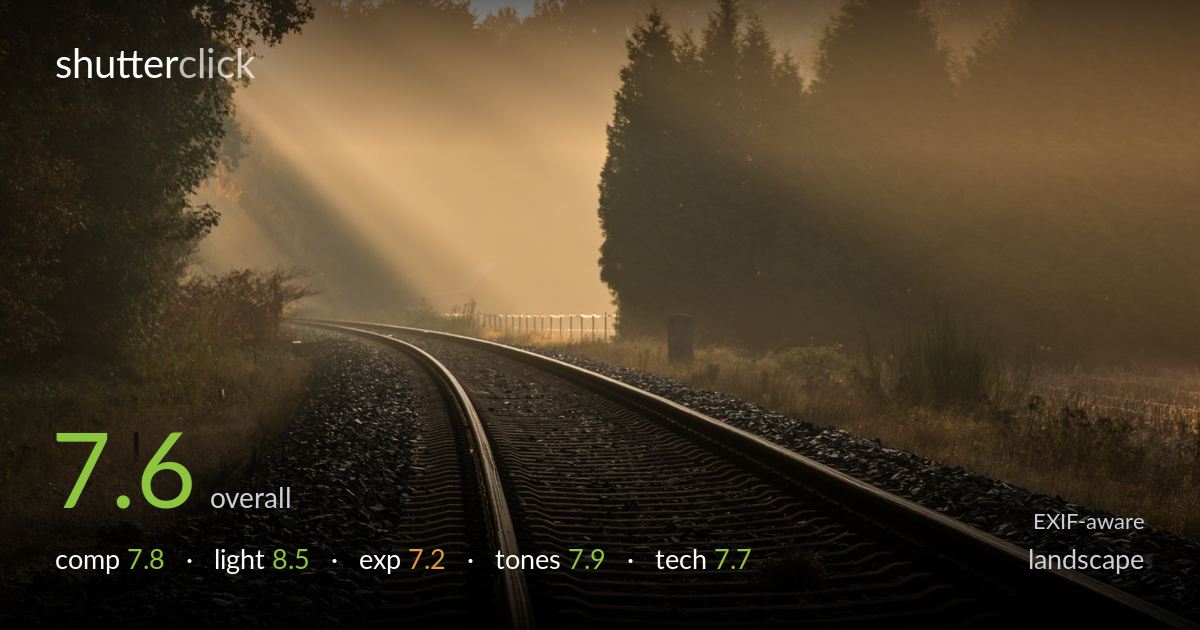
Sun rays over misty railway tracks
Photo by Dietmar Rabich

| Focal length | 85 mm |
| Aperture | f / 10.0 |
| Shutter | 1/200 s |
| ISO | ISO 100 |
| Exp. comp. | -0.33 EV |
| Shot at | 08:48 · Nov 1, 2015 |
Atmospheric backlight is the heart of this frame — crepuscular rays raking through the morning mist down a curving rail line, and that is what makes the image work. The track sweeps in from the lower right and curves into the haze, giving classic leading-line depth. The light is genuinely beautiful, low and golden with visible god rays. What holds it back most is the blown sky: the upper-centre highlights clip to pure white with no detail or tonal anchor, pulling the eye away from the rails. A slightly lower or graduated exposure, and a touch more foreground craft, would lift this from lovely to memorable.
The rails enter low-right and curve left into the mist — a strong, classic leading line that pulls the eye into depth. The tree masses on both sides frame the vanishing point well, and the gap of light at centre gives the curve somewhere to resolve. The horizon sits high, which suits the converging-track subject. The foreground ballast is a little heavy and undifferentiated at the bottom edge, and the small white survey posts mid-frame compete slightly. A fraction lower angle would have emphasised the rail convergence even more.
This is the image's strongest asset. Low backlit sun through morning mist produces clearly defined crepuscular rays fanning down across the scene, and the haze separates the tree layers into receding planes — a real sense of atmosphere. The rails catch the light and glint, reinforcing the lead-in. Direction and timing are well judged: shooting into the sun at this hour is exactly what creates the rays. The only cost is the inevitable flare and the overpowering brightness at the centre, which the framing mostly manages but doesn't fully tame.
Exposure is a reasonable compromise for a backlit scene, but the sky clips to pure white across the upper centre with no recoverable detail, removing any tonal anchor at the brightest point. The -0.33 EV helped protect the rail highlights but wasn't enough for the sun itself. Shadows in the ballast and tree bases hold detail and aren't crushed, which is good. The midtones in the misty mid-ground are pleasant. Bracketing or a graduated approach would have preserved some structure where the sun sits.
The warm golden cast suits the morning mood and the haze carries it convincingly — amber light grading into cooler shadow under the trees. Saturation is restrained and believable rather than pushed. Contrast is gentle in the misty zones, which reads as atmosphere rather than flatness. The ballast holds a nice range of cool greys against the warm light. The main tonal weakness follows the exposure: the highlight roll-off near the sun is abrupt rather than graceful, with a hard transition from amber to blank white.
At 85mm, f/10, 1/200s and ISO 100 the settings are well chosen for the conditions. The longer end of the zoom compresses the receding tree layers and the curving rails nicely, enhancing the sense of depth and mist. f/10 gives ample depth of field for the scene, keeping the foreground ballast and the mid-distance trees acceptably sharp, though the very nearest sleepers at the bottom edge soften slightly — focus appears placed a touch into the frame rather than on the immediate foreground. ISO 100 keeps the file clean with good tonal latitude in the shadows. 1/200s is more than adequate for a static landscape on a stable platform. Shooting straight into the sun risks veiling flare and there is some loss of micro-contrast in the brightest zone, partly optical and partly atmospheric. A lens hood and careful flagging of the sun, or a slightly recomposed angle to place foliage over the disc, would protect contrast without losing the rays.
What would elevate it
Tags
Shot something like this?
Expert photo critique, on demand — scored across six categories, EXIF-aware. Start with 3 free critiques, no credit card.
critique my photo — free