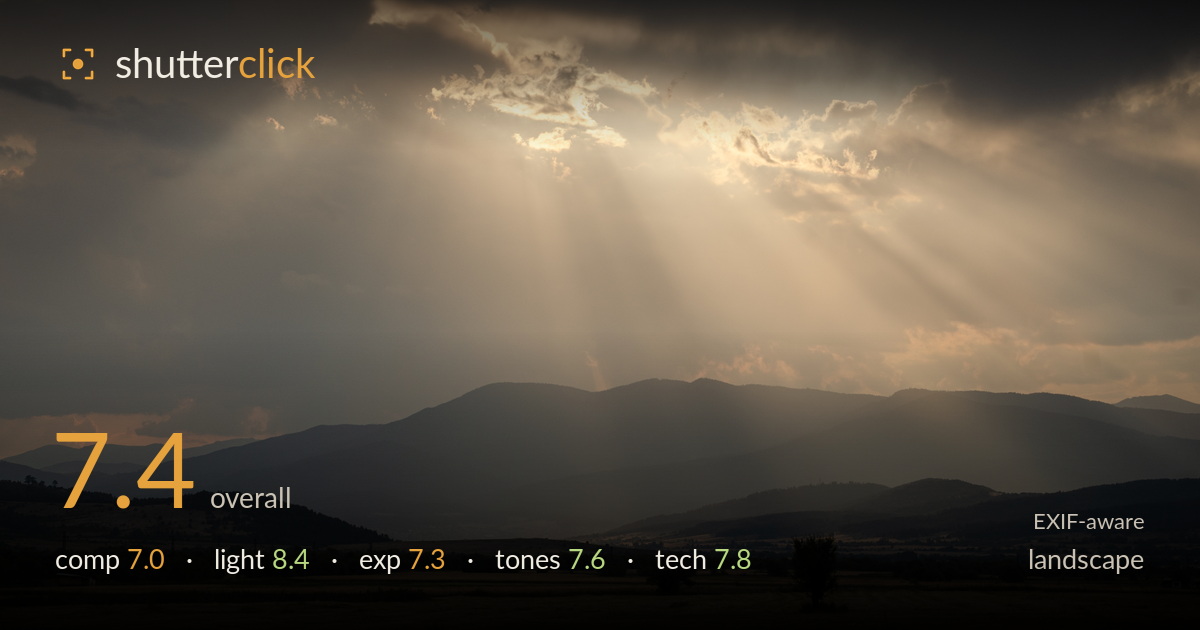
Sunbeams over the mountain valley
Photo by Nannoyani

| Focal length | 50 mm |
| Aperture | f / 8.0 |
| Shutter | 1/350 s |
| ISO | ISO 100 |
| Exp. comp. | -2.0 EV |
| Shot at | 19:31 · Jul 5, 2025 |
The crepuscular rays breaking through a broken sky are the reason this image works — dramatic, well-timed light that gives the layered mountain ridges depth and atmosphere. What holds it back is the foreground. The harvested field occupies the lower third but offers little that rewards attention: no strong lead-in line, no anchoring element beyond the two mid-ground trees. The rays fall just left of centre while the frame's compositional weight sits elsewhere, leaving a slight tension. A stronger foreground and a placement that lets the light beams anchor a clear third would lift this from atmospheric to compelling.
The layered ridgelines give genuine depth, and the horizon sits low enough to let the sky dominate — appropriate given the light show above. The two isolated trees in the mid-ground provide useful anchors. The weakness is the foreground field: it fills the lower third but reads flat and featureless, with faint mowing lines that don't lead the eye anywhere. The rays converge slightly left of centre, not quite aligning with any compositional anchor, so the frame's energy feels marginally unresolved. A more deliberate foreground element would tie the layers together.
The strongest element by far. Sunbeams fanning through a break in heavy cloud create real drama and directionality, spotlighting patches of the distant valley and raking across the mid-ground hills. The backlit ridges gain separation through atmospheric haze, building a clear sense of recession. Timing was seized well — this kind of light lasts moments. The only caution is that the foreground receives comparatively flat, diffuse light, so the eye is pulled entirely upward and the lower frame gets little visual reward.
The -2.0 EV pull was a sound decision to hold the bright sky and preserve the ray structure, and the highlights around the cloud break stay just short of clipping while retaining texture. That protection comes at the foreground's expense — the field and lower hills sit dark and slightly muddy, with shadow detail compressed. Recovery in post could lift the lower third without endangering the sky, since ISO 100 gives clean shadows to work with. The overall balance is deliberate rather than accidental.
The warm, muted palette suits the late-day atmosphere, and the graduated blues of the receding ridges read naturally. White balance leans warm in a way that flatters the light. Contrast is handled with restraint, letting the haze do its work. The foreground grasses carry a pleasant golden cast, though they veer slightly flat and desaturated in the shadowed areas. A touch more separation between the mid-tone greens and golds would add life to the lower frame without disturbing the delicate sky gradation.
The settings are well matched to the scene. f/8 on the 18-105 at 50mm sits in the lens's sweet spot and delivers front-to-back sharpness appropriate for a deep landscape — no need to stop down further and risk diffraction. ISO 100 keeps the shadows clean, which matters here because the foreground needs pushing in post. 1/350s is more than fast enough for a static scene and comfortably handhold-safe at this focal length. Focus appears set toward the mid-ground, and the ridges resolve well through the haze; the softness in the distance is atmospheric, not a focus miss. The 50mm framing compresses the mountain layers pleasingly. The main technical opportunity isn't in capture but in file handling — a bracketed exposure or a single RAW with lifted shadows would recover the foreground that the -2.0 EV protection sacrificed. Solid, unshowy execution that gives good latitude to work with.
What would elevate it
Tags
Shot something like this?
Expert photo critique, on demand — scored across six categories, EXIF-aware. Start with 3 free critiques, no credit card.
critique my photo — free