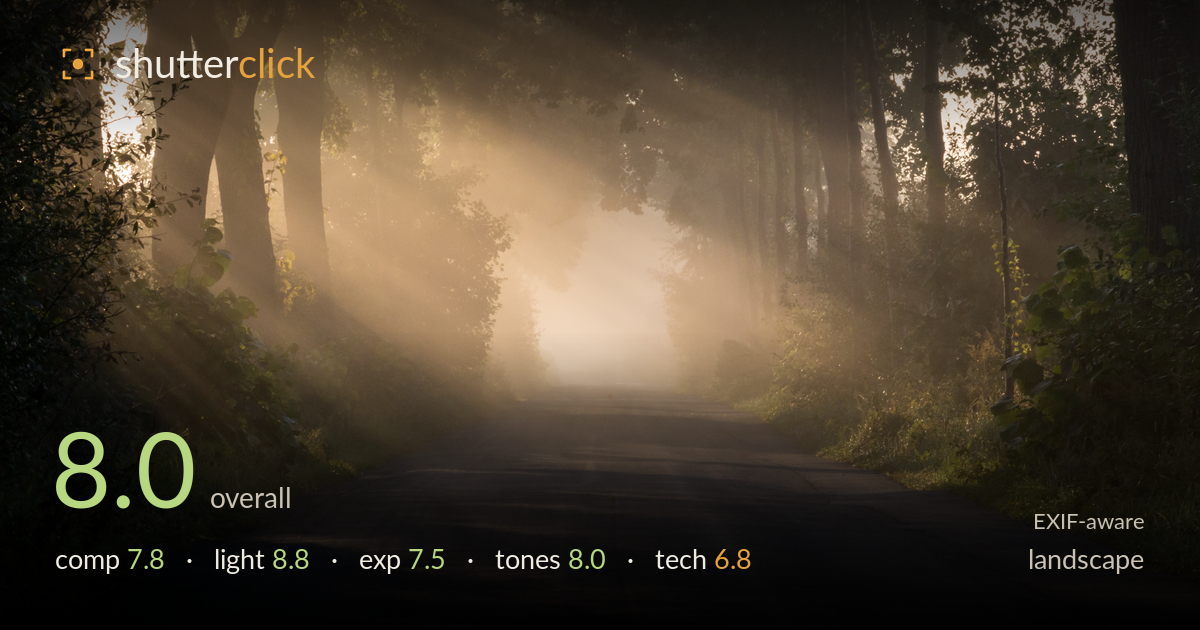
Sunbeams through a misty tree tunnel
Photo by Dietmar Rabich

| Focal length | 106 mm |
| Aperture | f / 22.0 |
| Shutter | 1/160 s |
| ISO | ISO 1000 |
| Exp. comp. | 0.0 EV |
| Shot at | 08:08 · Sep 16, 2012 |
The crepuscular rays cutting through the tree-lined avenue are the whole reason this image works, and they work beautifully — the atmosphere is genuine and hard to fake. The tunnel of trees frames a bright vanishing point that pulls the eye deep into the frame, and the road provides a clean anchor. What holds it back is the foreground: the road's lower third is a large, dark, featureless slab that carries little detail or texture. A slightly lower angle or a touch of foreground interest would balance the weight. Technically the f/22 choice softened the whole frame more than the scene needed.
The converging tree lines form a natural tunnel that funnels the eye toward the glowing vanishing point — classic and effective for this kind of light. The road anchors the base and gives the rays something to land on. The horizon sits high, which suits the vertical thrust of the trees. The weakness is the lower foreground: a broad, dark expanse of asphalt occupies the bottom third with little to reward attention. A lower shooting position, or something in that near road space, would give the frame more depth and balance.
This is the strongest element. Low backlit sun filtered through mist produces distinct, well-separated crepuscular rays that rake across the avenue — the kind of light that can't be manufactured in post. The direction is ideal, coming toward the camera and slightly off-axis so the beams read as discrete shafts rather than a wash. Mist gives the light volume and softens the tree masses into layered silhouettes. Timing was excellent; a few minutes either way and this effect vanishes. Very little to fault here.
Exposure holds the difficult bright core reasonably well — the misty vanishing point is close to clipping but retains a hint of gradation rather than blowing to pure paper white. The shadows in the foreground road and flanking foliage go quite deep, and some of that near detail is lost to near-black. A slightly brighter exposure with highlight recovery in post, or a bracketed frame, would open those foreground shadows without sacrificing the glow. Overall the balance reads deliberate given the backlit conditions.
The warm amber cast of morning sun through mist carries the mood well and feels true to the moment rather than pushed. The tonal transition from deep foreground shadow to luminous centre is smooth and gives the scene depth. Greens in the flanking foliage stay muted and natural, which keeps focus on the light. If anything the overall warmth verges slightly toward monochromatic; a touch more separation in the cooler shadow areas would add dimension. Contrast is well judged for the atmospheric intent.
The settings reveal the main technical compromise. f/22 on this lens introduces significant diffraction softening, robbing the frame of the crispness the misty rays would otherwise show — the effect here is atmospheric enough to partly disguise it, but the entire image is softer than the scene demanded. This subject didn't need f/22 for depth of field; at 106mm and this focusing distance, f/8 to f/11 would have held everything acceptably sharp while avoiding diffraction. ISO 1000 on the 600D adds some noise in the deep shadows, and closing to f/22 is what forced that higher ISO in the first place — a wider aperture would have let the ISO drop toward the base. Shutter at 1/160s was more than sufficient for a static scene on a tripod, or even handheld at this focal length with IS. Focus appears placed reasonably, though the diffraction makes it hard to judge critically. A tripod and a mid-aperture would sharpen the whole result considerably.
What would elevate it
Tags
Shot something like this?
Expert photo critique, on demand — scored across six categories, EXIF-aware. Start with 3 free critiques, no credit card.
critique my photo — free