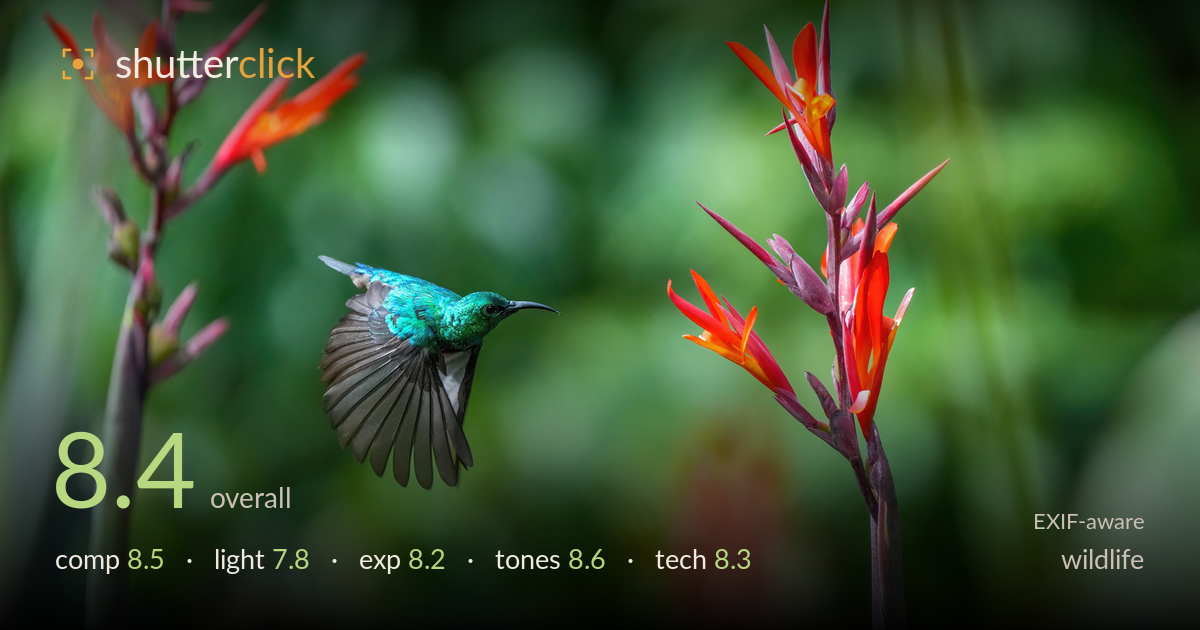
Sunbird hovering among canna blooms
Photo by Giles Laurent

| Focal length | 600 mm |
| Aperture | f / 6.3 |
| Shutter | 1/2000 s |
| ISO | ISO 3200 |
| Exp. comp. | 0.0 EV |
| Shot at | 12:47 · Dec 12, 2022 |
A sunbird caught mid-hover between flowering canna spikes, and the bird's iridescent green gorget reads beautifully against the soft green backdrop. The composition earns its keep: the bird faces into open space toward the right-hand bloom, with the left flowers balancing the frame. The main limitation is the wing — swept fully down and forward, it partly obscures the body and the head sits slightly buried. A frame catching the wings raised or a cleaner body line would elevate this from strong to exceptional. The iridescence, sharp eye and beak, and clean background are the standouts.
The placement works well: the bird sits left of centre facing into the open frame, with the red canna spike anchoring the right and the softer flowers balancing the left. The negative space in the middle gives the hover room to breathe and implies direction. The downswept wing, however, spreads across the lower body and creates a slightly bottom-heavy, closed shape that hides the bird's underside. A frame with the wings up or spread would open the silhouette. Otherwise the triangular flower-bird-flower arrangement holds the eye nicely.
Soft, diffused light — likely overcast or shaded — flatters the plumage and avoids blown highlights on the iridescent green, which is notoriously hard to control in harsh sun. The catchlight in the eye is present and the gorget still shimmers, so the angle preserves enough of the structural colour. The tradeoff is a slight flatness: the flat light gives little modelling to the wing feathers and the reds lack the punch stronger directional light would bring. A touch of side light would add dimension without risking the iridescence.
Exposure is well judged. The bright reds of the canna blooms retain detail without clipping, and the dark wing holds gradation rather than crushing to black. The green background sits at a pleasant mid-brightness that keeps the subject forward. At ISO 3200 the shadows in the wing stay clean and readable. The iridescent head is exposed to show colour rather than wash out. Nothing here looks accidental — brightness placement supports the subject and the histogram appears to use the range without either extreme suffering.
The colour is the image's strongest asset. The emerald-to-teal gradient across the head and breast is rendered with real depth, and it plays against the complementary reds and greens for a vivid, natural palette. White balance sits neutral, the greens are lush without turning acidic, and the reds stay saturated but not oversaturated. The muted browns of the wing provide a grounding contrast. Tonal separation between the bird and the busy background is handled well through both colour and focus. A clean, confident grade.
The 600mm at f/6.3 and 1/2000s is a textbook flight-hummingbird recipe, and it largely delivers. Focus lands on the eye and beak, which are crisp, and the shallow depth of field melts the background into smooth, non-distracting bokeh while keeping the head plane sharp. ISO 3200 is a reasonable concession to freeze motion in soft light, and the ILCE-1's files handle it cleanly with minimal visible noise. The 1/2000s freezes the body and head well; the wingtips show slight softness from motion, which is acceptable and even conveys the hover. The main technical question is depth of field — at f/6.3 and 600mm the far wing and tail sit slightly softer than the head, though for a single-eye-critical wildlife shot that's a defensible tradeoff. The lens reach lets the shot stay uncluttered from a working distance. Solid, deliberate execution throughout with focus placed exactly where it counts.
What would elevate it
Tags
Shot something like this?
Expert photo critique, on demand — scored across six categories, EXIF-aware. Start with 3 free critiques, no credit card.
critique my photo — free