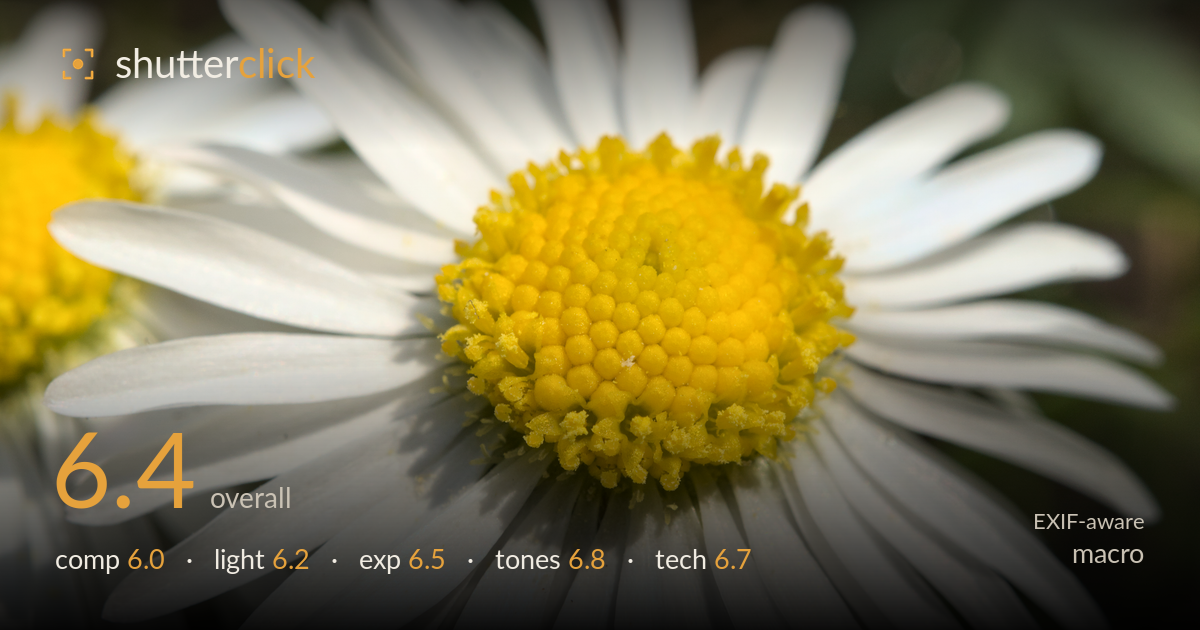
Sunlit daisy in close-up
Photo by August Geyler

| Focal length | 60 mm |
| Aperture | f / 20.0 |
| Shutter | 1/320 s |
| ISO | ISO 250 |
| Exp. comp. | 0.0 EV |
| Shot at | 14:33 · Apr 22, 2023 |
A clean, well-detailed daisy centre anchors this macro, with the tightly packed yellow florets rendering their granular texture beautifully — the strongest part of the frame. What most holds it back is the plane of focus: sharpness sits on the disc florets and the nearest petals, while much of the flower head tilts away into softness, leaving the composition without a fully resolved subject. Placement is near-centred and the head crowds the lower edge. The white petals also skirt clipping in the brightest passages. A focus-stacked capture and a touch more breathing room would elevate a subject with genuine potential.
The flower head sits nearly centred and pushes hard against the bottom edge, where several petals are clipped — a little more room below would let the bloom breathe. The second, softer daisy at the left frames well and adds context without competing. The diagonal tilt of the flower gives some dynamism, but the disc florets landing dead-centre feels static for a subject with this much radial energy. Offsetting the centre slightly and preserving the full petal fringe would strengthen the arrangement.
Direct sunlight rakes across the flower, lifting the texture of the disc florets nicely and giving the yellow real dimension. The trade-off is harshness: the white petals catch specular hits that flatten toward the top edge, and the shadows beneath the petals go abrupt. The low, angled light does reveal the granular centre well, which is the payoff here. Softer, diffused light — or a diffuser held over the bloom — would tame the petal highlights while keeping the centre's modelling intact.
Exposure is close but leans bright in the petals, where the strongest specular whites approach clipping and lose the subtle tonal gradation that gives petals form. The yellow centre holds detail well and the shadows retain information without blocking up. The overall placement is reasonable for a high-key subject in sun. A third-stop of negative compensation, or metering for the petal highlights, would protect that white detail and leave more room to lift shadows in post if needed.
Colour is clean and believable — the yellow disc reads warm and saturated without tipping garish, and the white balance holds neutral against the muted green backdrop. The green bokeh is pleasantly desaturated, keeping attention on the bloom. Contrast between the bright petals and darker background is effective. The white petals do carry a faint cool-blue cast in the shadowed lower half, which slightly muddies their purity; a minor warm nudge there would unify the whites and keep the high-key feel consistent across the flower.
At f/20 on a 60 mm macro lens, the aperture was pushed toward maximum depth of field, yet the flower's tilt still outruns it — the disc florets and nearest petals are sharp while the far petals and the second bloom fall soft. That's the core issue: f/20 also invites diffraction softening, so even the in-focus areas lose a touch of bite, and there's a real penalty for the narrow aperture without the depth to justify it. 1/320s comfortably froze any breeze-driven movement, and ISO 250 keeps noise negligible with clean shadows. Focus fell accurately on the centre, which is the right priority for the eye. The smarter path for a subject on this plane is focus stacking — several frames at a more optimal f/8–f/11 blended together — which would deliver front-to-back sharpness without the diffraction cost. Alternatively, squaring the sensor plane parallel to the flower face would let a single frame carry more of the head in focus.
What would elevate it
Tags
Shot something like this?
Expert photo critique, on demand — scored across six categories, EXIF-aware. Start with 3 free critiques, no credit card.
critique my photo — free