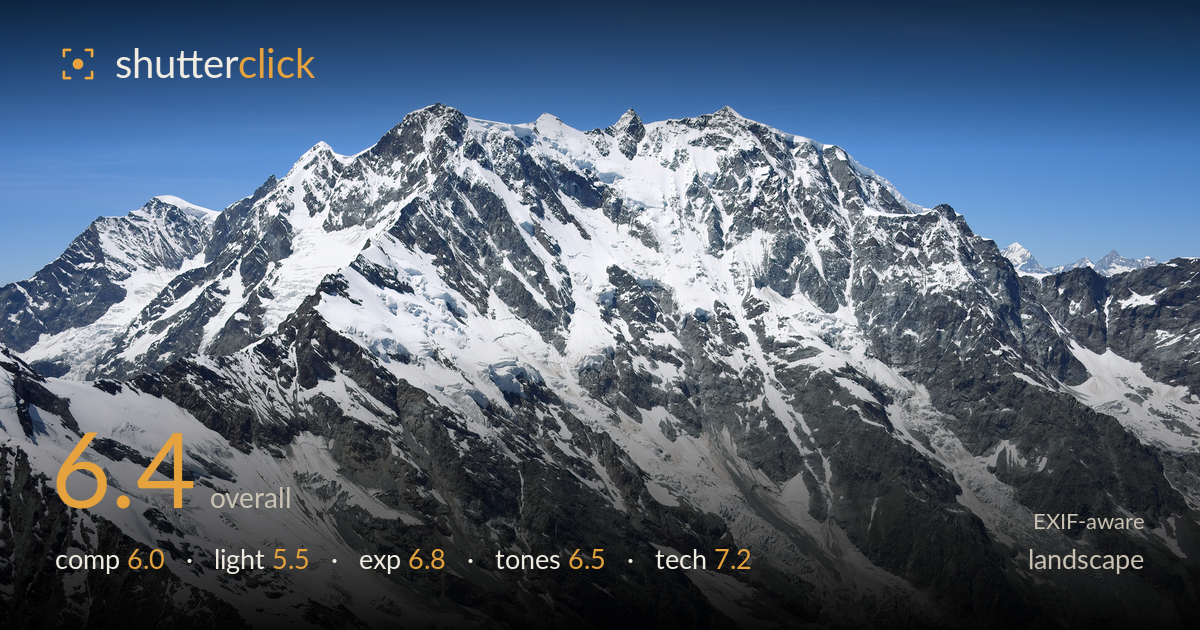
Sunlit snow on the massif
Photo by Carsten Steger

| Focal length | 28 mm |
| Aperture | f / 8.0 |
| Shutter | 1/5000 s |
| ISO | ISO 640 |
| Exp. comp. | 0.0 EV |
| Shot at | 11:36 · Jun 24, 2023 |
A commanding massif rendered with clean detail, but the midday light flattens what should be a dramatic subject. The scale is genuinely impressive and the snow-rock interplay across the face reads well, yet the frame lacks the depth cues a landscape of this grandeur needs — there's no foreground anchor and no sense of atmosphere. The overhead sun kills modelling on the slopes, leaving broad passages that feel documentary rather than evocative. As a record of the mountain it succeeds; as an image it's held back by timing and a somewhat catalogue-like flatness. Stronger light and a layered composition would transform it.
The peak dominates the upper third and the diagonal sweep of the face from lower-left to upper-right gives good directional flow. The distant ranges on the right add a welcome hint of recession. But the framing stops at the mountain's base with no foreground element to anchor the eye or convey scale, so the vastness reads abstractly rather than viscerally. The sky occupies a large clean band at top that does little. Including a ridge, glacier tongue, or valley element in the foreground would build the depth this subject deserves.
This is the shot's main limitation. The high, near-frontal sun flattens the topography — snowfields render as broad bright expanses and the rock faces lose their sculptural relief. There are few of the long, raking shadows that would carve out ridgelines and gullies and give the mountain three-dimensional presence. The light is clean and even, which suits documentation, but it drains drama from a subject that thrives on directional, low-angle illumination. Early morning or late afternoon side light would reveal texture and depth the current timing suppresses.
Well managed given the extreme brightness range of sunlit snow. The highlights on the snowfields largely hold detail rather than blowing out, and the shadowed rock retains information without blocking up. The histogram is pushed right appropriately for a snow scene, avoiding the grey underexposure snow often causes. A touch more contrast recovery is possible in the brightest slopes, but overall the exposure decisions look deliberate and the dynamic range is used competently across a challenging subject.
The blue sky is clean and the white balance reads accurate for high-altitude midday. Snow renders neutral without an unwanted colour cast, and the rock holds a natural grey-brown. However, the tonal range feels a little flat through the midtones — the shadowed rock and lit snow separate, but the slopes lack the tonal gradation that would add richness. The sky gradient from deeper blue at top to paler at horizon is pleasant. A modest contrast lift would give the greys more depth and structure.
The 28mm on the D5 is a sensible wide choice for capturing the massif's breadth, and f/8 sits in the lens's sharp aperture range, delivering front-to-back clarity appropriate for a distant landscape where deep depth of field matters little at this range. Focus is crisp across the face, with fine detail visible in the rock striations and glacier crevassing. ISO 640 is higher than necessary for bright daylight and contributes nothing but marginal noise headroom — ISO 100 would have maximised image quality. The 1/5000s shutter is vastly faster than needed for a static subject; it suggests aperture-priority or a leftover action setting rather than deliberate landscape technique, where a slower speed at base ISO would have been the cleaner choice. None of this harms the result visibly — sharpness and detail are strong — but the settings reveal a grab-shot approach rather than considered landscape execution. A tripod and base ISO would push technical quality to its ceiling.
What would elevate it
Tags
Shot something like this?
Expert photo critique, on demand — scored across six categories, EXIF-aware. Start with 3 free critiques, no credit card.
critique my photo — free