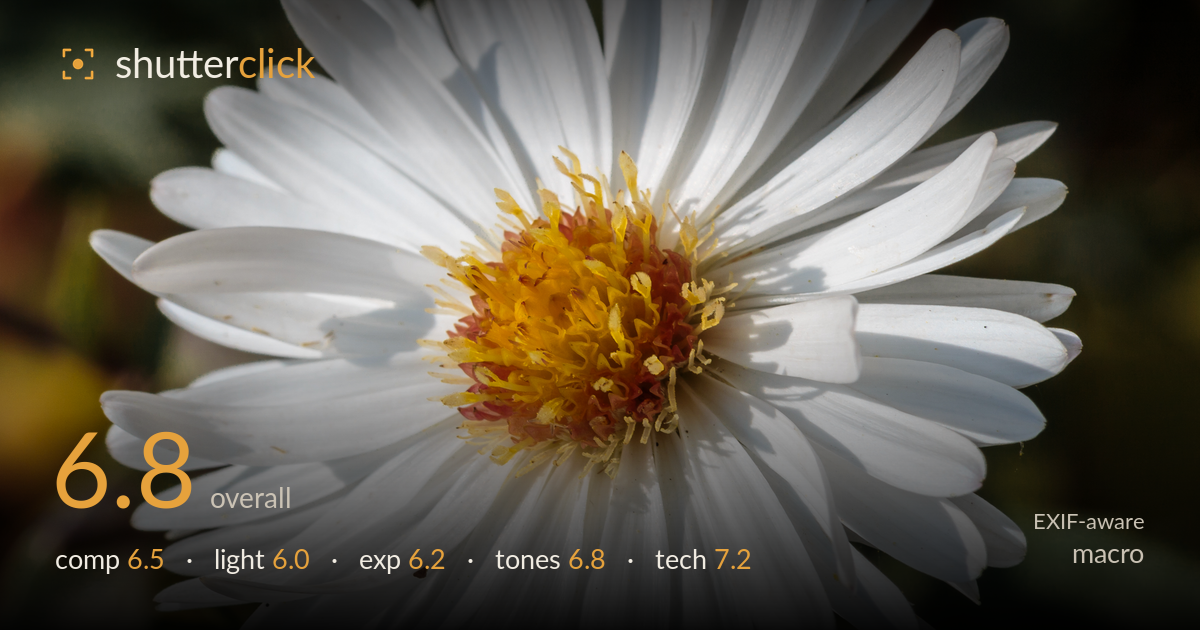
Sunlit white aster in bloom
Photo by Dominicus Johannes Bergsma

| Focal length | 60 mm |
| Aperture | f / 11.0 |
| Shutter | 1/125 s |
| ISO | ISO 100 |
| Exp. comp. | 0.0 EV |
| Shot at | 15:33 · Oct 6, 2018 |
A clean, well-detailed white aster with a crisp, textured yellow-orange center and a pleasantly blurred green-and-earth background. The strongest asset is the rendering of the central disk florets, which hold fine detail and color. The main limitation is hard, directional sunlight that blows the upper petals toward pure white while dropping shadow between them, flattening the delicate petal tips. Centering the bloom is safe but static, and the slight upward crop of a few petals nips the flower's outline. Softer light and a hair more breathing room would elevate an already competent frame.
The bloom fills the frame confidently and the round form reads well against the dark, soft background, which gives good separation. Centering the flower is the safe choice and here it works reasonably for a symmetrical subject, though the center itself sits low and slightly left, leaving the petal mass top-heavy. A few petals at the frame edges are clipped, particularly upper right and lower center, which nips the clean circular outline. Slightly more negative space and placing the disk closer to center would balance the form better.
Direct, hard sunlight rakes across the bloom from the upper right, and it is the frame's biggest constraint. It carves harsh shadow lines between petals and pushes the top-facing petals toward blown, texture-free white while shaded petals stay grey. The disk florets catch the light well, gaining dimension and warmth, but the petals lose the soft translucency that makes white flowers glow. Overcast light or a diffuser held over the bloom would even the range and preserve petal detail across the whole flower.
Exposure is close but leans hot on the sunlit petals. The brightest upper petals verge on clipping, losing the subtle ribbing that the shaded petals retain, while the dark background holds well without muddiness. The yellow center is handled nicely and keeps its saturation and structure. A third to half a stop of negative compensation, or metering off the brightest petals, would have preserved highlight texture where it now flattens. Overall a serviceable exposure, just pushed slightly far into the highlights under harsh sun.
The color palette is pleasing: cool clean whites set against a warm ochre-and-green bokeh, with a punchy yellow-orange core anchoring the eye. White balance looks accurate, keeping the petals neutral without a yellow cast. Contrast is a touch high because of the direct light, which deepens the inter-petal shadows more than ideal. The center's gradation from yellow tips into rust-red base is the tonal highlight of the image. Slightly lifted shadows would soften the harshness while keeping the appealing warm-cool contrast intact.
The settings are well chosen for the subject. f/11 on the 60mm macro delivers enough depth of field to hold the central disk and most of the petal plane sharp while still melting the background into clean bokeh, a sensible balance for a bloom of this size. ISO 100 keeps the image noise-free, and 1/125s is adequate for a still flower in bright light, though any breeze would risk motion at this magnification. Focus lands accurately on the disk florets, where fine stamen detail is resolved crisply. The main technical cost is diffraction softening: at f/11 on the EOS M's small sensor, the petals never reach true bite, and stopping to f/8 would have recovered some acuity while keeping adequate depth. A faint web strand crosses the lower petals, which careful cleanup or a slight angle change would avoid. Solid, deliberate execution overall.
What would elevate it
Tags
Shot something like this?
Expert photo critique, on demand — scored across six categories, EXIF-aware. Start with 3 free critiques, no credit card.
critique my photo — free