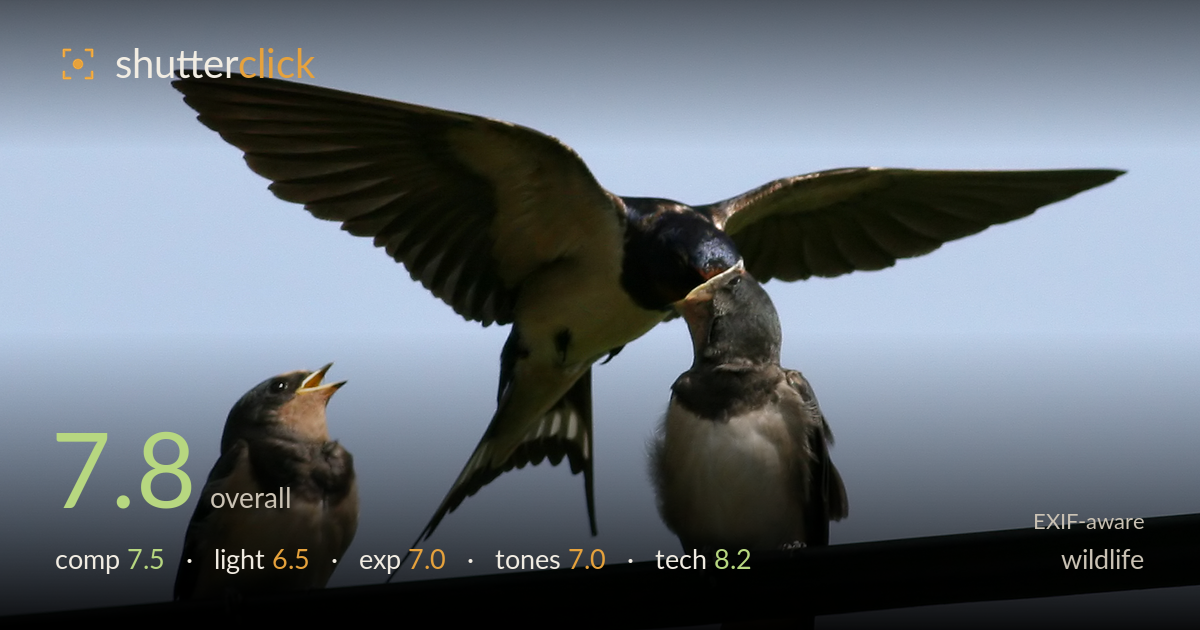
Swallow feeding its fledglings on a wire
Photo by Ken Billington

| Focal length | 400 mm |
| Aperture | f / 7.1 |
| Shutter | 1/3200 s |
| ISO | ISO 500 |
| Exp. comp. | 0.33 EV |
| Shot at | 15:50 · Jun 29, 2008 |
A genuinely difficult moment cleanly caught — the mid-air feeding of a fledgling with a second chick begging alongside, wings spread wide in a full arc. The behaviour is the star here, and the timing on it is excellent. The frozen wings, the beak-to-beak contact, and the open gape of the left fledgling tell a complete story in one frame. What most holds the image back is the light: flat and slightly top-heavy, leaving the parent's underside and both chicks in muted shadow with little modelling. A cleaner background moment already exists thanks to the plain sky, though the dark wire cutting across the lower third competes for attention.
The three-bird arrangement reads clearly, with the feeding pair forming a strong diagonal apex and the begging fledgling anchoring the left. The wide sky gives the wingspan room to breathe, which is the right call. The wire, however, slices across the lower third and draws the eye with its hard black line, and the right-hand fledgling sits partially obscured behind it. The tail of the parent nearly touches the wire, crowding that zone. A slightly higher angle or tighter framing on the feeding action would reduce the wire's visual weight.
The light is flat and comes from high and slightly behind, leaving the parent's pale underside and both fledglings' faces in soft shadow with limited modelling. There are no catchlights in the eyes, which flattens the connection in an otherwise intimate moment. The spread wings catch some directional light along their upper edges, giving a hint of translucency, but the key subjects — the beaks meeting — sit in shade. Softer, lower-angle side light, or shooting closer to golden hour, would carve out the plumage texture and lift the faces.
Exposure is well controlled for a bright-sky backdrop that could easily have blown out. The sky holds a clean pale blue without clipping, and the +0.33 EV compensation was a sensible nudge to keep the birds from silhouetting against it. The shadowed undersides retain workable detail, though they sit darker than ideal and the buff tones read a touch muddy. A little shadow lift in post would recover the fledglings' faces without harming the highlights. Overall a deliberate, safe exposure that protected the important tones.
The palette is restrained and natural — muted buffs, soft greys, and the rust throat patch of the adult against a cool desaturated sky. White balance sits slightly cool, which suits the daylight but leaves the warm plumage feeling subdued. Contrast is on the gentle side, which reads a little flat across the shadowed birds. A modest warmth adjustment and a touch more midtone contrast would separate the birds from the sky and let the chestnut throat and buff bellies glow rather than sit quietly.
The technical choices are well judged for the subject. At 400mm on the EOS 30D, 1/3200s froze the feeding action cleanly — wingtips and beaks are crisp with no motion smear, exactly what this behaviour demands. f/7.1 gave enough depth of field to hold all three birds acceptably sharp while keeping the sky clean, a smart middle ground for birds at slightly different distances. ISO 500 is very modest and keeps noise negligible, well within the sensor's comfort zone. Focus landed on the feeding pair, which is the correct priority, though the left fledgling is marginally softer — expected given the depth. The reach is adequate but the birds don't fill the frame, and the older 30D's resolution limits how far this can be cropped before detail breaks down. A stop faster glass or steadier support isn't needed here; the execution is sound. The main technical gain available would come from closer working distance or more reach to render finer feather detail.
What would elevate it
Tags
Shot something like this?
Expert photo critique, on demand — scored across six categories, EXIF-aware. Start with 3 free critiques, no credit card.
critique my photo — free