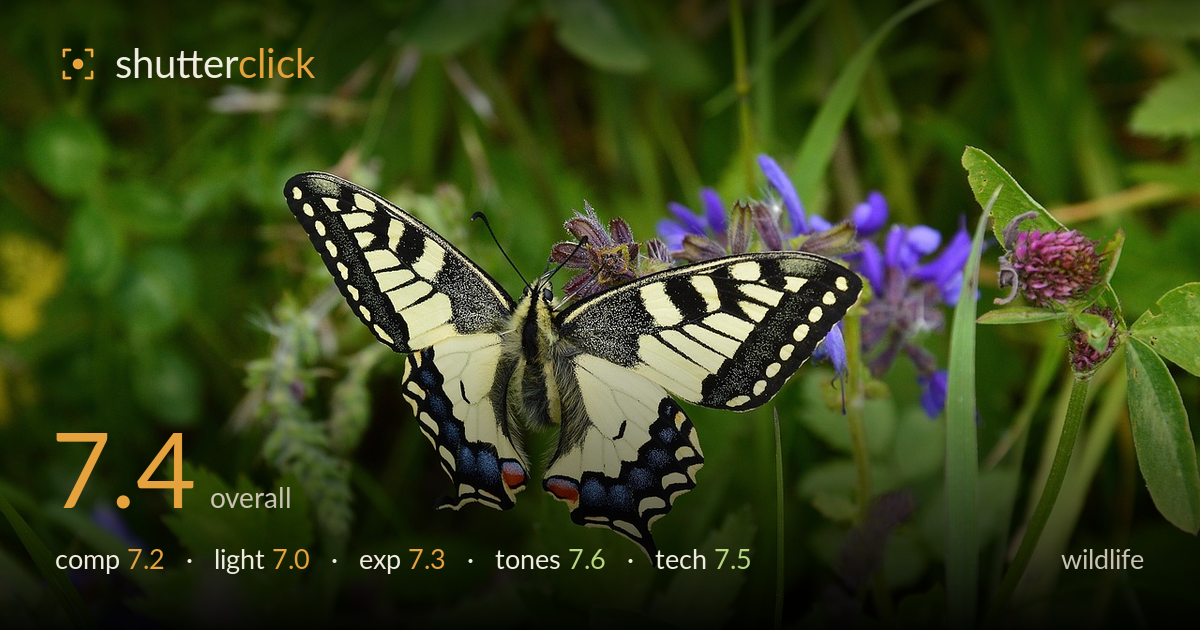
Swallowtail on meadow wildflowers
Photo by Alpelino

No EXIF metadata in this file
Technical analysis based on visual assessment only.
A textbook fully-open swallowtail, wings spread flat to the sensor and rendered with excellent detail across the scaling, set against a colour-complementary meadow of purple sage and clover. The wing pattern, blue lunules and red eyespots all read cleanly. What most holds the shot back is the busy background competing with the subject in places and the near-central placement that leaves the composition static. A slightly lower angle and cleaner separation from the surrounding foliage would lift a strong record shot toward something more dynamic. The moment and clarity are the clear strengths here.
The butterfly sits close to centre with wings symmetrically open, which suits an identification-style record but leaves the frame static. The purple sage flowers and pink clover on the right add welcome colour balance and context. Grass blades cutting diagonally through the lower frame and foreground clutter slightly compete for attention. Placing the subject marginally off-centre, or letting the flower it feeds on anchor a third, would give the eye more of a path. The wingtips are comfortably inside the edges, which is well judged.
Soft, diffuse light — likely overcast or shaded — keeps the wing pattern evenly lit without harsh specular hotspots on the pale cream panels, which is a real advantage for preserving detail on this high-contrast subject. The trade-off is flatness: the scene lacks directional modelling, so the body fur and the depth of the meadow read a little muted. A touch of side light or a lower sun angle would add dimension and separate the insect from the green backdrop more decisively.
Exposure is well controlled for a tricky subject. The cream wing panels hold texture without blowing out, and the deep black margins retain some structure rather than crushing to a void. Shadow detail in the surrounding foliage stays open. The blue lunules and red spots are rendered with saturation intact, no clipping evident. Overall brightness sits comfortably in the midtones. If anything, the green background carries slightly more luminance than ideal, drawing a fraction of attention from the subject, but nothing that harms the read.
Colour is the strongest aspect here. The cream-and-black wings, blue lunules and red eyespots pop against a natural green-and-purple palette that reads as genuinely complementary. White balance is neutral and believable, with greens that avoid the oversaturated cast so common in meadow shots. Contrast is handled well across the wing's extreme tonal range, holding both the pale panels and the dark bands. The purple sage adds tonal variety in the background. Saturation feels true to life rather than pushed.
Focus lands accurately on the wing plane, which is the correct priority with a flat-open butterfly — the scaling, veins and pattern edges are crisp across most of the wing surface. Depth of field is judged well: enough to keep both wings sharp while the background dissolves into soft green bokeh that isolates the subject. The body and antennae are also acceptably sharp. There is a slight softness toward the lower wingtips, suggesting the focal plane wasn't perfectly parallel to the fully spread wings, but it's minor. Noise is not a visible issue, indicating a reasonable ISO. Shutter speed was clearly sufficient to freeze the resting insect, and there's no motion blur in the grasses despite any breeze. The lens delivers pleasing subject-to-background separation with smooth out-of-focus rendering. A marginally smaller aperture would have pulled the trailing wingtips fully sharp without sacrificing the clean backdrop, but the balance struck here is sound.
What would elevate it
Tags
Shot something like this?
Expert photo critique, on demand — scored across six categories, EXIF-aware. Start with 3 free critiques, no credit card.
critique my photo — free