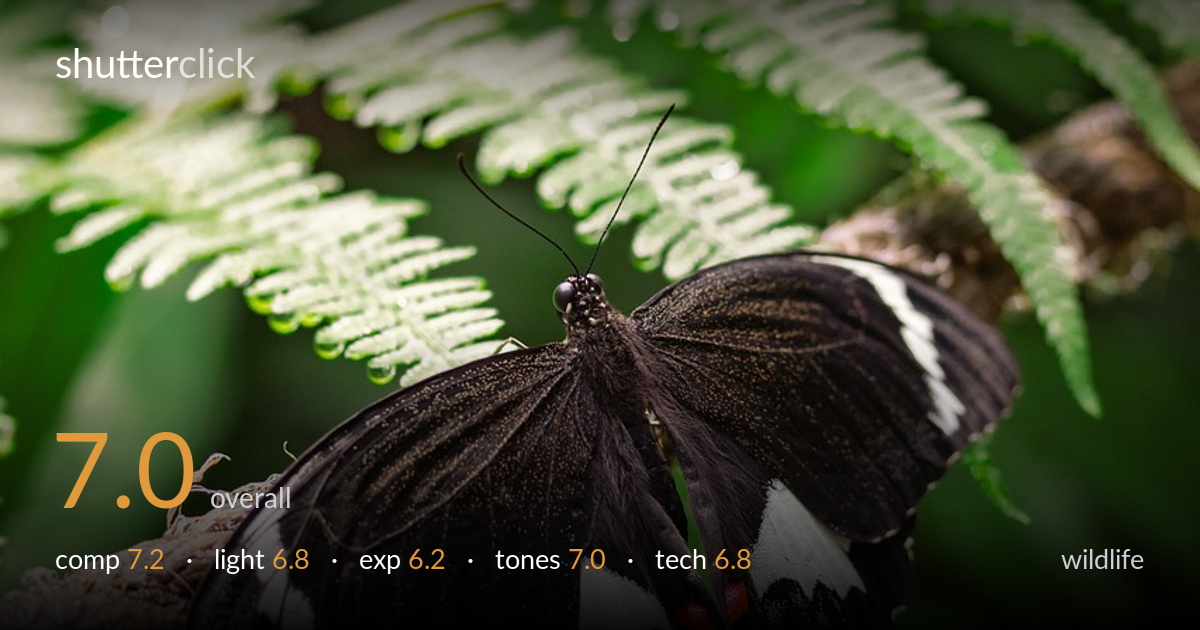
Swallowtail resting on a vine
Photo by Storme22k

No EXIF metadata in this file
Technical analysis based on visual assessment only.
A well-positioned swallowtail with wings fully spread, set against a lush green fern backdrop that frames it cleanly. The diagonal vine perch and the butterfly's symmetry give the frame a pleasing structure, and the red and white markings pop against the dark wings. The main weakness is the black wing detail: large areas of the wing read as featureless shadow, losing the subtle scale texture and venation that make these subjects sing. The head and eye, the natural focal point, also fall slightly soft. A touch more shadow recovery and sharper focus on the head would lift this considerably.
The fully open wings centred over a diagonal vine make for a balanced, symmetrical study, and the upright orientation suits the spread of the antennae and the fern fronds arcing behind. The butterfly sits a little low and central; lowering it further or nudging it off-centre would give the antennae more breathing room at the top. The fern radiating behind the head works as a natural halo, though the bright defocused blade upper right pulls slightly. Overall a clean, readable arrangement with strong subject prominence.
The light is soft and diffuse, typical of a shaded greenhouse or forest understorey, which avoids harsh shadows and keeps the green foliage gentle. That softness, however, gives the black wings little modelling — there are no specular highlights skimming the scales to reveal their texture and iridescence. A raking side light or a hint of directional sun would catch the wing surface and separate the dark form from the dark background. The catchlight-free eye also flattens the subject's presence.
Exposure is metered for the bright fern, which keeps the greens and white wing bands controlled, but it leaves the black wings sitting in deep shadow with much detail crushed to near-pure black. The wing membranes lose their venation and scale texture as a result. There appears to be recoverable information in the shadows worth lifting in post. The white wing patches and the brightest fern edges sit close to clipping but mostly hold. A more shadow-biased exposure would have served the subject better.
The green-against-black palette is striking and the saturated foliage gives the frame depth without feeling artificial. White balance reads natural for shade, with healthy greens that avoid the yellow or cyan cast common under canopy. The red wing spots provide a small but effective accent against the dark wings. Contrast is high, driven by the black subject against bright foliage, which suits the mood but contributes to the loss of shadow detail. Mid-tone gradation in the foliage is smooth and pleasing.
Depth of field is well chosen — the aperture renders the fern background as soft, creamy bokeh while keeping most of the wing plane acceptably sharp, giving good subject separation. The trouble is focus placement: the sharpest plane appears to fall across the mid-wing rather than the head and eye, which read slightly soft. For wildlife, the eye is the critical focus point, and missing it costs the image its connection. The wing edges and the white bands hold reasonable detail, suggesting a sufficiently fast shutter to freeze the stationary subject. Noise is well controlled, indicating a moderate ISO. The lens choice and working distance give a flattering, intimate framing. Stopping down a third to a half stop, or focusing precisely on the head, would bring the eye and antennae base into crisp focus while retaining most of the background blur. A focus-stacked pair could capture both head and full wing plane sharply.
What would elevate it
Tags
Shot something like this?
Expert photo critique, on demand — scored across six categories, EXIF-aware. Start with 3 free critiques, no credit card.
critique my photo — free