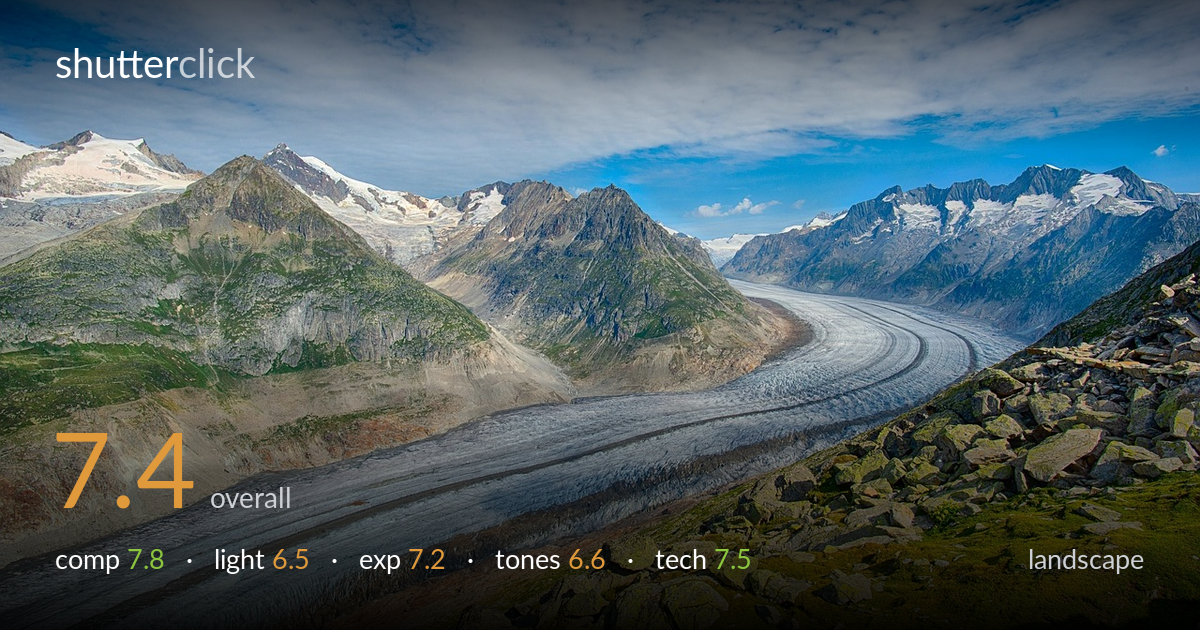
Sweeping alpine glacier vista
Photo by 15147632

No EXIF metadata in this file
Technical analysis based on visual assessment only.
A commanding subject — the Aletsch glacier sweeping through the frame in a graceful S-curve — is the photograph's biggest asset, and the medial moraine lines read like natural leading lines drawing the eye into the distance. The mossy boulder foreground anchors the right side and adds depth. What most holds the image back is the lighting and tonal treatment: flat midday sun mutes the modelling on the peaks, and an HDR-leaning grade pushes saturation and local contrast hard, lending the scene a slightly artificial cast. Shot in better light and graded with restraint, this composition would be genuinely striking.
The glacier's serpentine curve is the strongest compositional element, carrying the eye from the lower-left foreground into the mountains and acting as a natural leading line. The rocky, moss-covered slope on the right anchors the frame and builds foreground-to-background depth. The horizon sits reasonably high, giving the landscape room. The balance is good, though the right-hand boulders crowd close to the edge and feel slightly heavy. A touch more sky breathing room or a marginally lower angle on the foreground rocks would tighten the relationship between near and far.
The light is the weakest link. This appears to be shot under high, flat midday sun, which flattens the modelling on the peaks and leaves the glacier reading evenly bright rather than sculpted. Shadows are short and lack the raking quality that would reveal the ridge textures and the surface crevasses on the ice. The scene works because of the subject's scale rather than the light shaping it. Early or late side light would carve dimension into the ridges and give the glacier directional texture.
Exposure is handled competently across a demanding dynamic range. Highlights on the bright ice and the snow patches hold detail without obvious clipping, and the shadowed rock faces retain texture. The histogram looks well spread with no significant crushing. The sky is bright but the clouds keep their structure. The midtones in the foreground moss sit a touch hot from the grading rather than the exposure itself. Overall the brightness decisions appear deliberate and the full tonal range is used effectively.
The colour treatment leans into an HDR look — saturation and local contrast are pushed, giving the moss an electric green and the sky a heavy, slightly unnatural blue. The glacier picks up a cool cast that reads more processed than observed. There is detail everywhere, but the aggressive tone-mapping flattens the natural luminance hierarchy and gives the boulders a halo-edged, crunchy quality. A gentler grade with restored natural contrast and dialled-back saturation would let the scene feel more believable and let the glacier's subtle blues breathe.
Sharpness is strong from the foreground boulders through to the distant peaks, indicating a well-chosen small aperture and good front-to-back depth of field — appropriate for a wide landscape like this. The wide focal length captures the full sweep of the valley and the glacier's curve, suiting the grand scale. Focus accuracy looks reliable across the plane. The main technical concern is the post-processing rather than capture: the HDR tone-mapping introduces edge halos around the ridgelines and the rocks, and a slightly crunchy micro-contrast that betrays heavy local adjustments. Noise is well controlled and there is no visible motion issue. The wide lens shows mild edge stretching on the right-hand boulders, which exaggerates their size, though this is minor at this framing. Reining in the tone-mapping during processing would recover a more natural rendering while keeping the impressive detail the capture clearly contains.
What would elevate it
Tags
Shot something like this?
Expert photo critique, on demand — scored across six categories, EXIF-aware. Start with 3 free critiques, no credit card.
critique my photo — free