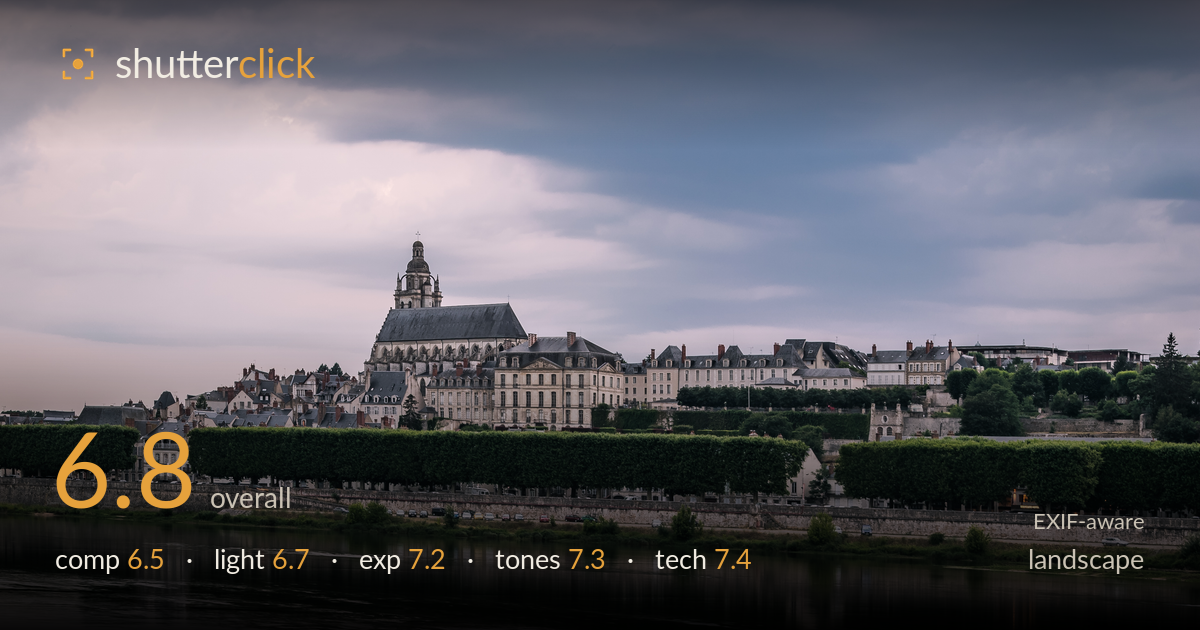
The cathedral of blois at dusk
Photo by Krzysztof Golik

| Focal length | 42 mm |
| Aperture | f / 11.0 |
| Shutter | 3/5 s |
| ISO | ISO 100 |
| Exp. comp. | 0.0 EV |
| Shot at | 22:02 · Jul 1, 2018 |
A calm riverside townscape anchored by the cathedral of Blois, with a soft dusk palette and a mirrored reflection that carries the lower half. The strongest asset is the muted, cohesive colour and the still water. What holds it back most is a heavy, undifferentiated sky that occupies more than half the frame without earning it, and a horizon line that sits almost dead centre, splitting the composition. The town band, though the real subject, reads as a thin sliver squeezed between sky and water. A recomposition that favours the architecture and the reflection would lift this considerably.
The horizon sits almost exactly mid-frame, dividing sky and water evenly and flattening the sense of hierarchy. The town — the actual subject — is compressed into a narrow horizontal strip, so neither the architecture nor the reflection gets room to breathe. The cathedral is nicely off-centre left, giving a natural anchor, but the vast sky above it feels unearned given how flat the cloud is. Lowering the horizon to give the reflection a third, or raising it to feature the sky only if it were more dramatic, would resolve the split.
The light is soft, overcast dusk — low contrast and even, which suits the pastel mood but denies the stone facades any modelling or warmth. There is a faint warm glow reflected in the water that hints at a setting sun behind cloud, and that is the most alive element of the lighting. The buildings themselves sit rather flat, lacking directional light to bring out texture and depth. A break in the cloud, or shooting a touch later into deeper blue hour, would give the scene more shape and drama.
Exposure is well managed for a tricky flat-light scene. The bright sky retains detail without clipping, the shadows in the trees and stone wall hold information, and the midtones on the buildings sit comfortably. The three-fifths-second exposure at ISO 100 keeps the water smooth and noise-free. Nothing looks accidental here — the histogram appears full and controlled. The only minor note is that the overall brightness leans slightly flat, which is faithful to the conditions but leaves limited punch. A gentle contrast lift in post is available without risk.
The colour grade is the picture's quiet strength — a muted lavender-and-grey sky playing against the cool green foliage and the soft warm reflection on the water. White balance reads neutral to slightly cool, appropriate for dusk. Tonal range is a little compressed, which reads as atmospheric rather than dull, but the sky and water occupy similar mid-values so the frame lacks a clear tonal anchor. Deepening the shadows slightly and letting the warm reflected highlights sing a touch more would add dimension without breaking the gentle mood.
Solid technical execution for the conditions. At f/11 and 42mm on the DX body, depth of field comfortably covers the town and its reflection, and diffraction is not a concern at this size. The three-fifths-second shutter, only possible on a stable support, is exactly right for smoothing the river into that glassy reflection while keeping the static architecture sharp — a good, deliberate choice. ISO 100 keeps the file clean, and the moderate zoom setting avoids the softest and most distortion-prone ends of the Tamron superzoom. Focus appears accurate across the building line. The main technical limitation is the lens itself: superzoom optics tend toward lower micro-contrast and edge softness, and the cathedral detail is competent rather than crisp. Stopping to f/8 would have edged toward the lens's sweet spot with negligible depth-of-field loss. Overall the settings show clear intent and the fundamentals are handled well; the ceiling here is set by glass, not decisions.
What would elevate it
Tags
Shot something like this?
Expert photo critique, on demand — scored across six categories, EXIF-aware. Start with 3 free critiques, no credit card.
critique my photo — free