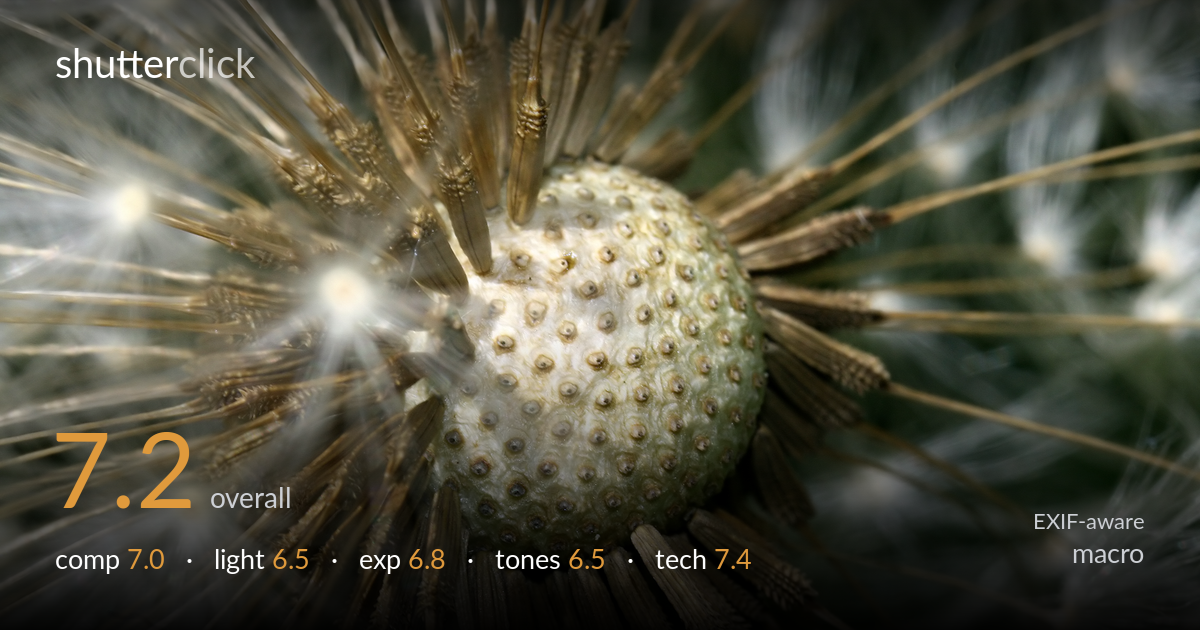
The heart of a dandelion
Photo by Richard Bartz, Munich Makro Freak

| Focal length | 65 mm |
| Aperture | f / 16.0 |
| Shutter | 1/125 s |
| ISO | ISO 400 |
| Exp. comp. | 0.0 EV |
| Shot at | 12:11 · Jun 11, 2007 |
A strong subject choice that reveals the dandelion's seed receptacle in compelling detail — the pitted, dimpled dome after the seeds have dispersed is genuinely engaging and not the cliché dandelion shot. The radiating pappus filaments create natural leading lines that pull the eye to the textured centre. What most holds the image back is the centred placement of the dome and the somewhat flat, diffuse light that leaves the texture under-modelled. The colour palette drifts toward a muddy olive-grey that mutes the natural appeal. Sharp where it counts, with handsome depth structure throughout.
The radiating filaments form a natural starburst that draws the eye inward to the dimpled dome — an effective use of converging lines built into the subject. The textured receptacle is the clear anchor. Placing it dead-centre, however, makes the frame feel static and symmetrical in a way that flattens energy. Shifting the dome off-axis, or letting the radiating lines run asymmetrically across the frame, would create more dynamic tension. The dense soft filaments at frame edges add depth without distraction.
The light is soft and even, which keeps the delicate filaments from blowing out and renders the white pappus gently — appropriate for the fragile subject. But it sits flat against the dome, leaving the raised bumps without much shadow definition. A lower, more raking side light would carve each pit and bump into relief, giving the central texture far more dimensionality. As shot, the modelling on the most interesting element is muted, and the overall scene reads slightly grey and lacking sparkle.
Exposure is well controlled for a high-key subject — the white filaments hold detail without clipping into pure white, which is the main risk here, and the dome retains midtone information across its surface. Shadows in the brown bracts at the base stay readable. The histogram sits a touch low overall, leaving the image slightly muddy rather than bright and airy. A modest positive exposure compensation, or a lift in the highlights in post, would give the pappus the luminous quality the subject invites.
The palette leans toward a desaturated olive-grey and muddy brown that undersells the subject. White balance reads cool and slightly murky, robbing the seed head of cleaner whites and warmer browns. The green of the dome is muted rather than fresh. Warming the white balance and adding a touch of contrast separation between the brown bracts and the pale filaments would clarify the tonal structure. As it stands the mid-tones bunch together, leaving the image feeling tonally flat and a little drab.
At f/16 on the 65mm focal length, depth of field is sensibly chosen to carry the dome's curved surface in focus — the dimpled texture is crisp across most of its breadth, which is the hardest part to nail in macro. Focus lands accurately on the central receptacle. The 1/125s shutter is borderline for a subject this prone to air movement; some filament softness at the edges may be motion as much as falloff. ISO 400 is reasonable and noise is well contained for the 400D's sensor. The f/16 setting does introduce some diffraction softening, slightly blunting the finest detail on the dome — f/11 might have delivered marginally crisper micro-texture while still holding adequate depth. A focus-stacked sequence would have rendered the full dome and the radiating bracts sharp together, a worthwhile pursuit for a subject with this much three-dimensional structure. Overall, solid execution of a demanding macro.
What would elevate it
Tags
Shot something like this?
Expert photo critique, on demand — scored across six categories, EXIF-aware. Start with 3 free critiques, no credit card.
critique my photo — free