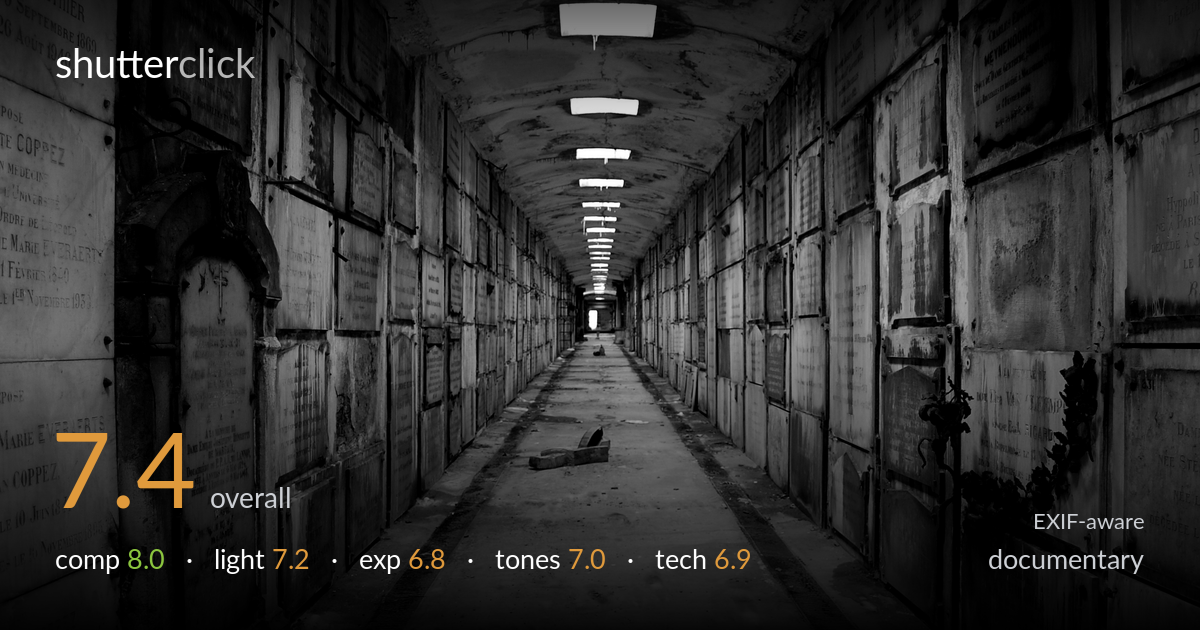
The long crypt corridor
Photo by P.J.L Laurens

| Focal length | 18 mm |
| Aperture | f / 3.5 |
| Shutter | 1/2 s |
| ISO | ISO 200 |
| Exp. comp. | 0.0 EV |
| Shot at | 19:33 · Jul 25, 2009 |
A strong one-point perspective carries this underground columbarium straight into deep space, and the receding ceiling lights pull the eye to a bright vanishing point that anchors the frame. The rows of inscribed plaques build genuine narrative density — names, dates, decay. What most holds it back is the exposure: the ceiling skylights blow to pure white with no roll-off, while the lower walls slide into murky shadow, flattening detail where the inscriptions matter most. The cool blue cast on a near-monochrome image reads slightly indecisive. A more controlled tonal balance would let the storytelling breathe rather than fight the contrast.
The central one-point perspective is the obvious and correct choice here — the corridor's converging lines and the regimented rhythm of overhead lights drive the eye decisively to the distant exit. Symmetry is held cleanly, with both walls of plaques framing the path evenly. The small debris on the floor mid-frame gives a human-scale anchor and breaks the geometric monotony. The very dark lower-left and right corners weigh the frame down slightly; a fraction more floor detail or a marginally higher vantage would balance the heavy foreground against the luminous centre.
The natural skylights doing all the work create a dramatic, top-lit cathedral quality entirely fitting for a crypt — pools of light marching down the vault with the walls falling into gloom. That directional fall-off shapes the corridor's depth well. The trouble is the dynamic range it demands: the highlights pin to white while the side plaques lose legibility. The light is atmospheric but unmanaged. Shooting on an overcast day or bracketing would have tamed the skylight intensity and revealed more of the inscriptions the scene depends on.
Exposed for the shadows to keep the corridor readable, which is defensible, but the consequence is the ceiling lights clip hard to featureless white with no recoverable detail. The midtones on the floor sit reasonably, yet the deepest wall shadows block up and swallow text. The histogram is stretched at both ends with thin midtone occupancy. A bracketed sequence blended to hold both the skylights and the wall plaques would have served this high-contrast interior far better than a single frame at this setting.
Treated as near-monochrome with a distinct cool blue wash, which suits the cold, sepulchral mood. The tonal range is wide but the midtones feel hollowed out between the crushed shadows and clipped highlights, reducing the gradation across the plaque surfaces. The blue cast is atmospheric but reads as an indecisive white balance rather than a committed grade — either a fuller monochrome conversion or a more deliberate cool tint would feel more intentional. Contrast is high; a gentler curve would recover texture in the stone.
At 18mm the wide field is right for the cramped corridor, and the f/3.5 aperture still yields ample depth across this deep scene because most of the subject lies well beyond the near focus. Focus appears placed on the mid-corridor floor and holds acceptably to the vanishing point. The real concern is the 1/2 second shutter at ISO 200 — this was clearly a handheld-or-tripod gamble in low light. Some softening is visible, suggesting either slight camera shake or the inherent limits of the D40 sensor; sharpness on the nearest plaques is less crisp than a tripod-steadied frame would give. ISO 200 was the sensible floor for this camera to keep noise minimal, and that pays off in clean shadows where they aren't fully crushed. A tripod with a two-second delay, or stopping down to f/8 for edge-to-edge bite, would have firmed up the inscriptions that carry the photo's meaning. The gear choice fits the scene; the steadiness is what limits the result.
What would elevate it
Tags
Shot something like this?
Expert photo critique, on demand — scored across six categories, EXIF-aware. Start with 3 free critiques, no credit card.
critique my photo — free