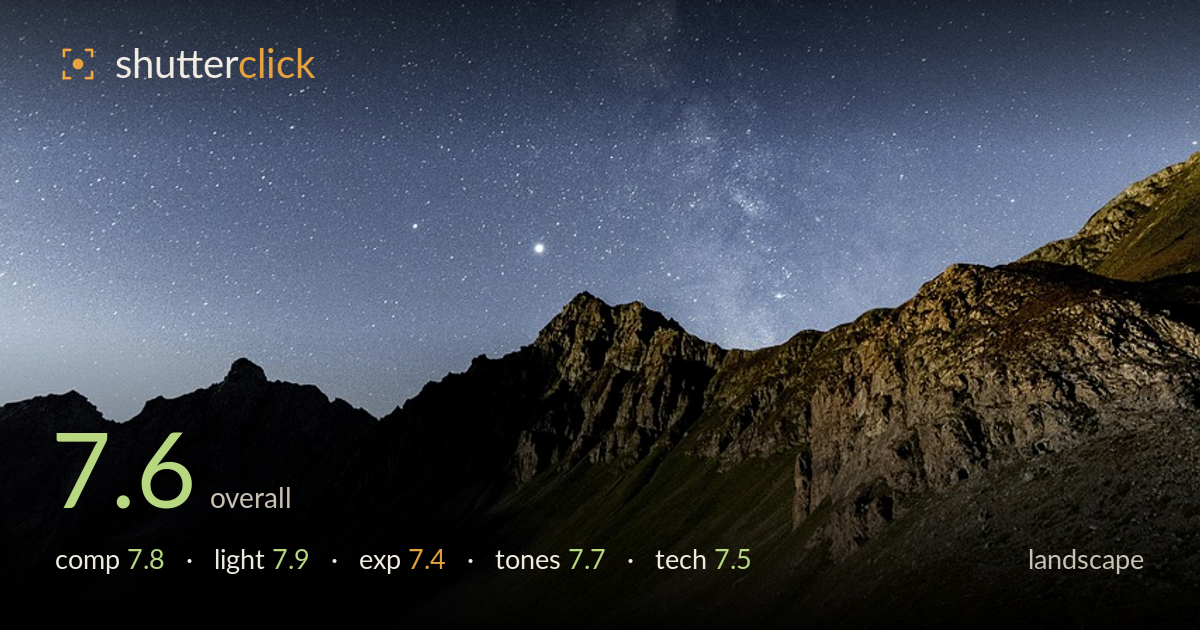
The milky way over moonlit peaks
Photo by andrecosso

No EXIF metadata in this file
Technical analysis based on visual assessment only.
A well-executed nightscape that lets the Milky Way arc anchor the sky while moonlight rakes across the ridgeline to reveal terrain that would otherwise vanish into black. The vertical framing suits the diagonal core of the galaxy, and the foreground grasses give a foothold. What holds it back most is the lower-left corner, where a lake and slope fall into near-featureless shadow, weakening the base of the frame. The peak silhouettes are strong, but the composition leans heavily right, leaving the left side comparatively empty. A stronger, more legible foreground anchor and a touch more shadow recovery would lift this from good to memorable.
The portrait orientation is a sound choice, following the diagonal sweep of the Milky Way down toward the peaks. The jagged ridgeline forms a strong lower boundary, and the sunlit grass slope on the right provides warmth and a foreground foothold. The weakness is balance: the frame tilts heavily to the right, while the lower-left lake and slope sink into unreadable shadow, giving the base little to hold. A foreground element on the left, or a slight reframe, would distribute weight more evenly across the wide base.
Moonlight is working well here, side-raking across the ridge to model the rock faces and pull warm colour from the grass slopes — a real asset for a night scene, since it separates terrain from sky rather than leaving a flat silhouette. The gradient from the brighter horizon glow up into deep sky is natural and pleasing. The trade-off is that the moon also washes some faintness from the stars near the horizon. Timing the shoot balances Milky Way visibility against this terrain modelling reasonably.
Exposure is largely well-judged for the difficult dynamic range of a moonlit nightscape. The sky retains star detail without blowing the brighter planets, and the sunlit slopes hold colour. The shortfall is the lower-left quadrant: the lake and adjacent slope drop into near-black with little recoverable detail, and the darkest ridge faces lose separation. Lifting shadows in post, or a slightly longer or blended exposure for the foreground, would restore the base of the frame without harming the sky.
The colour palette is handled with restraint — a cool blue sky grading to a warmer horizon glow, set against the earthy ochres and rust of the grass. That warm-cool contrast gives the image depth and holds the eye. White balance sits believably for moonlight. Star colours read subtly rather than being over-saturated, which is the right call. The main tonal issue is the crushed shadow region lower-left, which flattens into a dead patch and breaks the otherwise smooth tonal gradation across the terrain.
The execution reads as a competent single or short-stack astro frame. Stars appear reasonably pinpoint across most of the sky, suggesting exposure length and focal length were matched to keep trailing minimal — the wide field and steady point sources indicate careful focus at infinity. Noise is controlled in the sky, staying clean enough that the Milky Way structure remains legible without heavy smearing from aggressive noise reduction. Depth of field is a non-issue at this scale; everything sits at effective infinity. The primary technical limitation is in the deepest shadows, where noise and lost detail combine to make the lower-left largely unusable — a sign the foreground exposure was pushed too far into the dark. A dedicated longer foreground exposure blended with the sky, or shooting under slightly more ambient light, would give cleaner shadow detail. Focus and sharpness on the ridgeline hold up well where the light reaches it.
What would elevate it
Tags
Shot something like this?
Expert photo critique, on demand — scored across six categories, EXIF-aware. Start with 3 free critiques, no credit card.
critique my photo — free