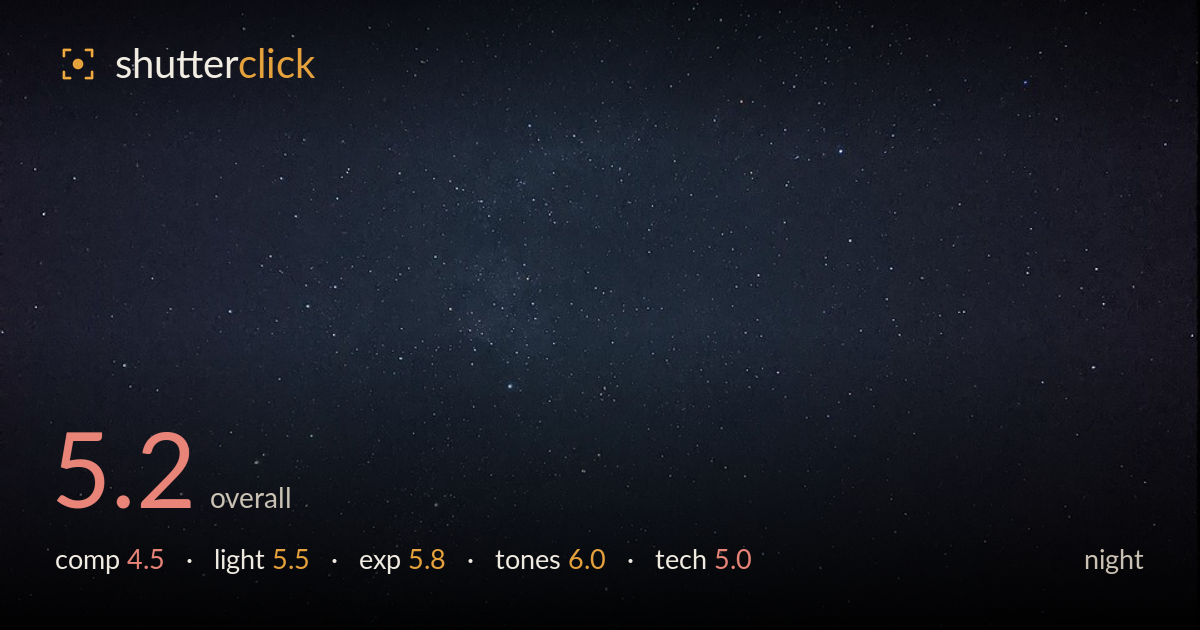
The milky way overhead
Photo by necrofury

No EXIF metadata in this file
Technical analysis based on visual assessment only.
A faint band of the Milky Way registers diagonally through the frame, which is the image's real strength — but the composition is all sky and no anchor. With no foreground element, horizon, or landmark, the star field floats without scale or narrative, and the frame reads as an unmoored patch of sky rather than a scene. The stars themselves are recorded but small and low in contrast, so the galactic core lacks presence. A grounding foreground, more decisive framing of the Milky Way band, and stronger contrast processing would transform this from a sky snapshot into a night landscape.
The frame is entirely sky with no foreground, horizon, or subject to give scale or a point of entry. A dark strip at the very bottom hints at land but is too minimal to anchor anything. The Milky Way band runs diagonally, which is a natural leading line, but it isn't positioned deliberately — it drifts through the centre rather than being framed against something. Without a tree, ridge, or structure, the eye has nowhere to rest and the composition feels incomplete.
This is essentially available starlight, and the sky is genuinely dark with minimal light pollution — a real asset for astrophotography. The faint airglow and the soft luminance of the galactic band give some tonal variation across the frame. However, without any foreground receiving light, there's nothing for the sky to relate to. Some ambient or low-level illumination on a landscape element would create the dimensional contrast that makes night scenes read as places rather than flat star fields.
The exposure holds the faint Milky Way structure without blowing out the brighter stars, and the shadows retain a touch of tonal information rather than crushing to pure black — a reasonable balance for a dim sky. The overall level is a little dark, leaving the galactic band muted and the fainter detail buried. A slightly longer exposure or a brighter push in processing would lift the core's presence while the sky is dark enough to tolerate it without noise dominating.
The cool blue-black palette is appropriate and pleasant for a night sky, and the subtle warm tint in the galactic band adds interest. White balance sits in a natural range for starlight. Contrast is on the flat side, which keeps the Milky Way faint and undifferentiated from the surrounding sky. A modest contrast lift, particularly in the midtones where the band lives, would separate the galactic structure from the general background glow and give the tones more depth.
Judged visually, the stars are recorded as clean points without obvious trailing, suggesting the exposure was short enough — or the focal length wide enough — to avoid star movement. Focus appears close to correct, with pinpoint stars rather than bloated discs, which is the hardest thing to nail in the dark. Noise is present in the shadow areas but reasonably controlled for a night frame, indicating a sensible ISO choice. The main technical limitation is that the star detail is faint and small: the Milky Way is barely resolved, which points to either a short single exposure or a small sensor struggling for signal. Stacking multiple frames would dramatically improve signal-to-noise and let the galactic core emerge with far more detail. A faster lens or a longer tracked exposure would gather more light. Overall the execution is competent for a single handheld or short-exposure attempt, but the technique is being pushed to its limit by the demands of deep-sky work.
What would elevate it
Tags
Shot something like this?
Expert photo critique, on demand — scored across six categories, EXIF-aware. Start with 3 free critiques, no credit card.
critique my photo — free