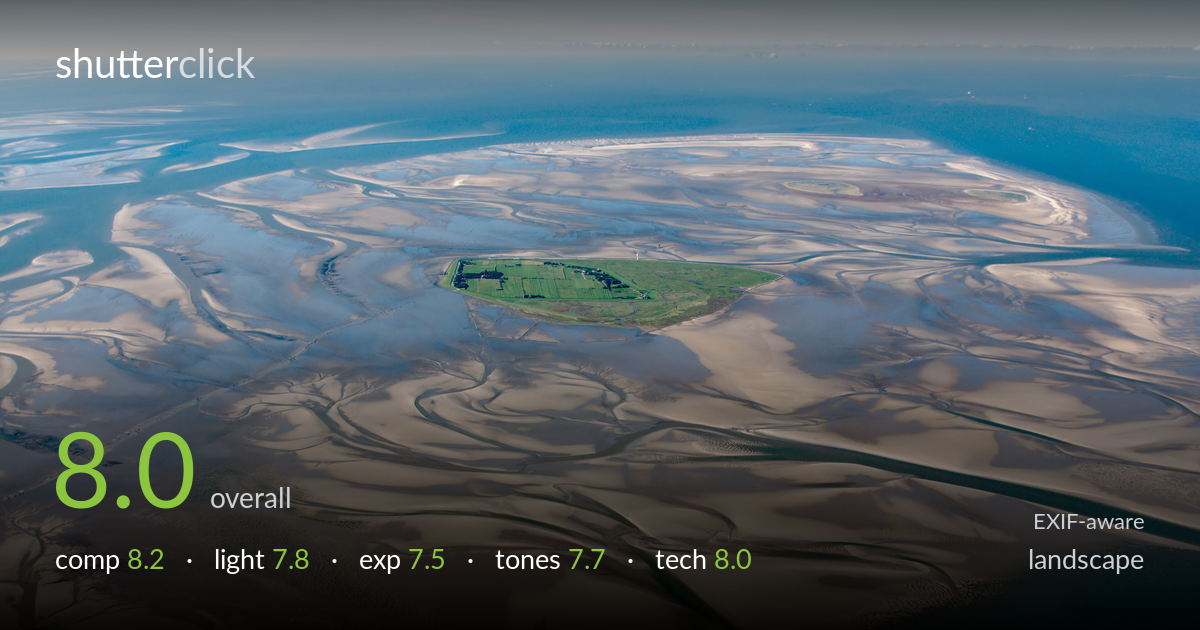
Tidal flats around a green island
Photo by Ralf Roletschek

| Focal length | 24 mm |
| Aperture | f / 9.0 |
| Shutter | 1/320 s |
| ISO | ISO 200 |
| Exp. comp. | 0.67 EV |
| Shot at | 13:35 · Sep 29, 2013 |
An aerial of tidal flats whose branching channels and rippled sandbanks form an intricate, organic tapestry — the small green inhabited island anchors the frame and gives the abstraction a focal point and sense of scale. The serpentine drainage patterns lead the eye effortlessly through the composition. What most holds it back is the upper third: a slightly hazy horizon and flat band of sea that dilutes the energy of the foreground. The light is workable but not peak — a lower sun angle would carve the sand textures far more dramatically. A strong, genuinely distinctive frame.
The branching tidal channels function as natural leading lines, drawing the eye from the rich foreground texture up to the green island, which sits just off-centre and anchors the whole scene effectively. The diagonal flow of the sandbanks creates real depth and movement. The horizon is placed high, which rightly prioritises the patterned flats. The weakness is the upper band of flat sea and hazy sky — it occupies real estate without contributing much. A slightly higher tilt to emphasise more of the textured flats would tighten the frame.
The side light is low enough to model the sandbank ridges and rippled textures in the foreground, giving the flats welcome relief and dimension. Shadows in the channel edges add separation and depth. It reads as morning or late-afternoon light rather than peak golden hour, so the modelling is good but not at its most dramatic. The distant flats flatten out under haze, losing the raking definition that animates the foreground. A lower sun would have extended that sculptural quality further into the frame.
Exposure is well controlled across a tricky range of bright sand and darker channels. The +0.67 EV compensation keeps the pale flats luminous without clipping the brightest sandbanks, and shadow detail in the channels holds. The midtones are nicely placed. The sea band along the top is the weakest area — slightly muddy and hazy rather than crisp — but that is atmospheric haze, not an exposure fault. Overall a measured, deliberate reading that preserves the full tonal range of the wet and dry sand.
The palette is restrained and natural: warm sand tones playing against the green island and teal channels. The contrast between wet and dry flats reads cleanly. The colours are accurate rather than punchy, which suits the documentary feel of an aerial. The main limitation is atmospheric haze flattening the distance into a muted blue-grey band, compressing the tonal separation up top. A touch of dehaze and a gentle warmth lift in the foreground would strengthen the sand-against-water contrast without making it artificial.
Solid execution for an aerial frame. At 24mm the wide field captures the full sweep of the tidal system while keeping the island readable as a focal point. f/9 is a sensible choice for front-to-back sharpness across a near-flat subject, sitting comfortably away from diffraction on the D300S sensor. ISO 200 keeps noise negligible, and 1/320s is fast enough to counter aircraft vibration and forward motion at this altitude — the foreground textures resolve cleanly with no visible motion smear. Focus appears accurate across the plane. The only technical limitation is atmospheric: haze softens the distant flats and the horizon, which no aperture choice can fully overcome from altitude. A polarising filter could have cut some of that haze and deepened the water tones, though it can introduce uneven banding across a wide sky. Within the constraints of shooting from a moving aircraft, the settings are well judged and the result is sharp where it matters.
What would elevate it
Tags
Shot something like this?
Expert photo critique, on demand — scored across six categories, EXIF-aware. Start with 3 free critiques, no credit card.
critique my photo — free