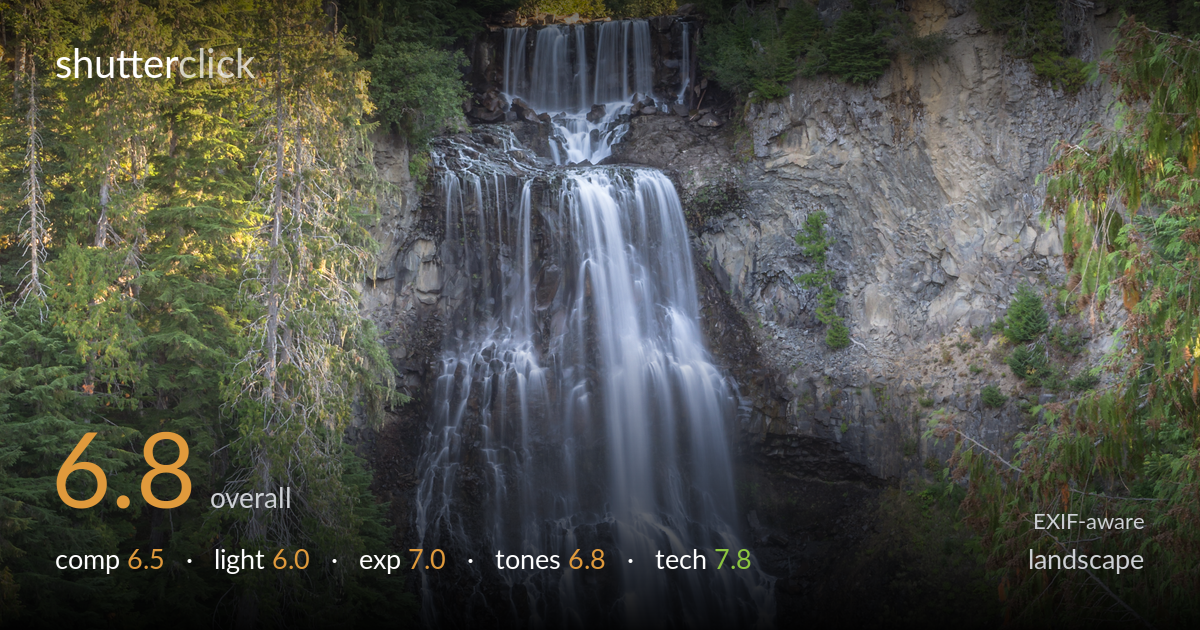
Tiered forest waterfall
Photo by Florian Fuchs

| Focal length | 35 mm |
| Aperture | f / 11.0 |
| Shutter | 2/5 s |
| ISO | ISO 100 |
| Exp. comp. | 0.0 EV |
| Shot at | 09:01 · Sep 12, 2014 |
A cleanly executed multi-tier waterfall with well-controlled water motion, but the framing keeps the falls from commanding the scene. The vertical orientation suits the tall cascade, yet the foreground rubble and tangled branches at lower right clutter the base rather than leading into it, and the flat overhead light drains contrast from the rock face. The water silk and the surrounding firs are the strongest assets. Tighter attention to a foreground anchor and a softer time of day would lift a competent record shot toward something more atmospheric and intentional.
The vertical format matches the falls' three-stage drop, and the framing firs build a natural corridor. But the cascade sits slightly left of centre while the right side carries a large expanse of dry, undifferentiated rock face that pulls weight away from the subject. The lower-right branch intrudes awkwardly into the frame, and the boulder-strewn base reads as clutter rather than a foreground anchor. A stronger leading element at the plunge pool, or a step left to balance the rock wall, would tie the tiers together.
Light here is the main limitation. The overhead, slightly hazy sun renders the rock face flat and the water bright but without modelling, flattening the depth of the gorge. Patches of warm side light catch the left-hand firs nicely, hinting at what raking light could do, but the falls themselves sit in even, shadowless illumination that mutes texture. Open shade or the diffuse light of an overcast day would actually suit a waterfall better, deepening the rock tones and letting the white water stand out more.
Exposure is well judged for a high-dynamic-range scene. The white water retains texture rather than blowing out, which is the hardest part of a long-exposure waterfall, and shadow detail in the rock and forest holds up. The pale sky at top is bright but not badly clipped. Midtones in the conifers sit a touch dark, leaving the left edge slightly heavy, but overall the histogram looks deliberate and balanced. A graduated approach or gentle shadow lift in post would even out the dense foreground.
Colour is natural and restrained, with believable greens in the firs and neutral grey rock. White balance leans slightly cool, which keeps the water clean but leaves the overall palette a little flat and lifeless under the hazy light. The rock face occupies a narrow mid-tone band that could use more separation. The warm rust accents in the right-hand foliage add welcome variety. A modest contrast and vibrance boost, plus warming the highlights, would give the scene more dimensional punch.
Technically this is the strongest aspect. At f/11, ISO 100 and 2/5s the settings are well chosen for a daylight waterfall: the aperture delivers front-to-back sharpness across the tiers and forest, the base ISO keeps noise negligible, and the 0.4s shutter silks the water convincingly without erasing all internal structure in the cascade. Focus appears accurately placed on the falls, with the rock and surrounding firs crisp. The 35mm focal length on the D7000's crop sensor gives a natural perspective that includes the full drop without distortion. An ND filter would have allowed an even longer exposure for smoother flow if desired, and a polariser would have cut glare on the wet rock and deepened the foliage. Minor softness toward the frame edges is consistent with the zoom at this setting and is not objectionable. The exposure time was clearly deliberate, and the execution shows solid command of the technical fundamentals for this kind of scene.
What would elevate it
Tags
Shot something like this?
Expert photo critique, on demand — scored across six categories, EXIF-aware. Start with 3 free critiques, no credit card.
critique my photo — free