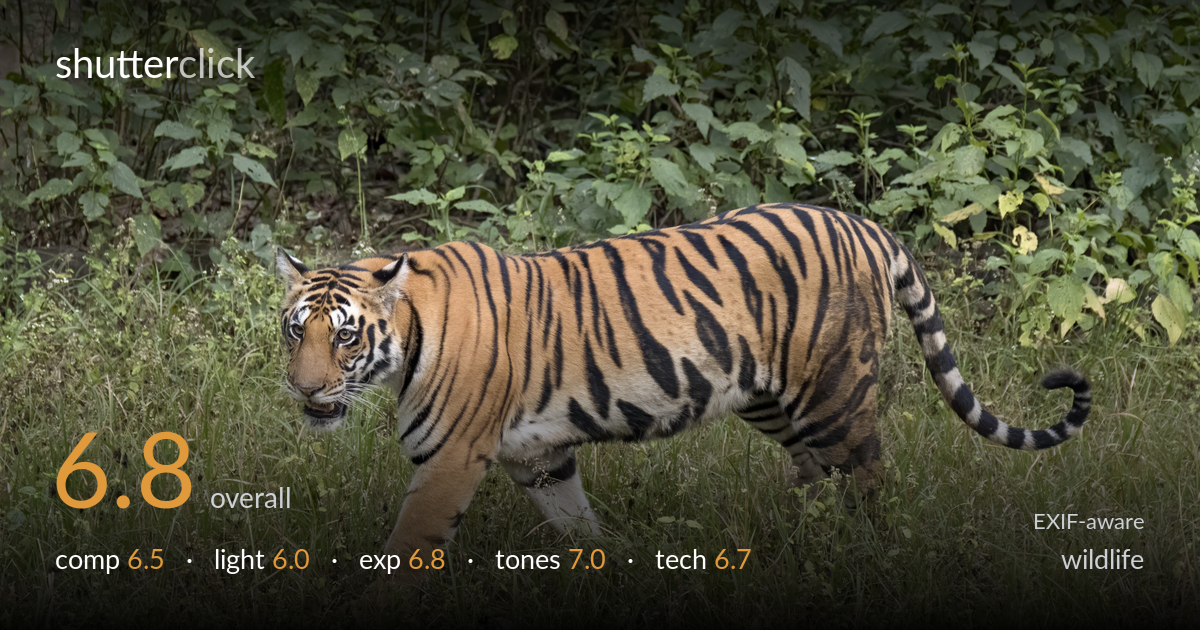
Tiger on the prowl
Photo by Charles J. Sharp

| Focal length | 62 mm |
| Aperture | f / 4.0 |
| Shutter | 1/500 s |
| ISO | ISO 1600 |
| Exp. comp. | 0.0 EV |
| Shot at | 16:24 · Nov 16, 2017 |
A clean, full-body tiger in habitat with direct eye contact — a solid wildlife encounter capably rendered. The animal is sharp, the stripe pattern reads beautifully against the green surround, and the walking gesture with head turned to camera gives the frame life. What holds it back most is the flat, overcast light, which mutes the modelling and dimensionality the coat could carry, and a placement that leaves the tiger drifting toward the centre-right with crowding at the tail. The shallow-depth wildlife look is missing here at f/4 on a mid-range zoom, so the busy background competes more than it should.
The side-on profile with the head turned back to camera is the strongest decision here — it reads as a deliberate encounter rather than a passing snapshot. The tiger occupies the lower-right two thirds, leaving useful space ahead of its gaze. The tail nearly touches the right edge, however, and a touch more room there would breathe. The foreground grass is pleasant but undifferentiated, offering little leading interest. The horizon-line wall of foliage sits high and flat, compressing depth. Lowering the angle would lend the subject more presence and scale.
Soft, diffused overcast light dominates, which is forgiving on contrast but does little to sculpt the tiger's form. The coat reads somewhat flat, lacking the directional raking that would separate muscle and bring out fur texture. There are no harsh shadows to fight, which keeps detail intact across the body, but also no catchlight in the eye to anchor the gaze — a real loss in a wildlife portrait. Early or late side light, or a break in the cloud, would have added the modelling this frame wants.
Exposure is well controlled across a tricky tonal mix. The bright orange coat retains highlight detail without clipping, and the dark stripes hold density rather than crushing to black. The white belly and chest keep texture, which is the easiest area to blow. Shadows in the background foliage stay open enough to read. The overall balance sits a touch flat, partly a product of the light, but the histogram looks healthy with no obvious accidental under- or over-exposure. A slight contrast lift in post would add the snap the scene lacks.
The colour relationship is the frame's quiet strength — warm orange against saturated green is naturally pleasing, and white balance reads accurate under the overcast conditions with no unwanted colour cast. The stripe blacks are neutral and the coat tones are convincing rather than oversaturated. The greens are slightly heavy and could threaten to overwhelm, but they stay believable. Mid-tone gradation across the fur is smooth. A subtle desaturation of the background green would let the subject's warmth carry more of the frame's attention.
At 1/500s the walking tiger is cleanly frozen — an appropriate shutter for this pace of movement, with no motion blur in the legs or face. Focus lands accurately on the head and eye, which is exactly where it needs to be. ISO 1600 on the 80D's APS-C sensor introduces modest noise, visible in the shadowed foliage and softer areas, but it is well within acceptable limits for the low light and does not degrade the subject. The real limitation is the EF24-70mm f/4L at 62mm: a fine lens, but neither the reach nor the maximum aperture suits wildlife. At f/4 with this focal length the background stays distractingly in focus, denying the subject separation a longer, faster lens would deliver. A 300mm or longer at f/2.8–f/5.6 would have blurred the foliage into a clean wash and let the tiger dominate. Sharpness on the subject itself is good and the capture is technically sound for the gear in hand.
What would elevate it
Tags
Shot something like this?
Expert photo critique, on demand — scored across six categories, EXIF-aware. Start with 3 free critiques, no credit card.
critique my photo — free