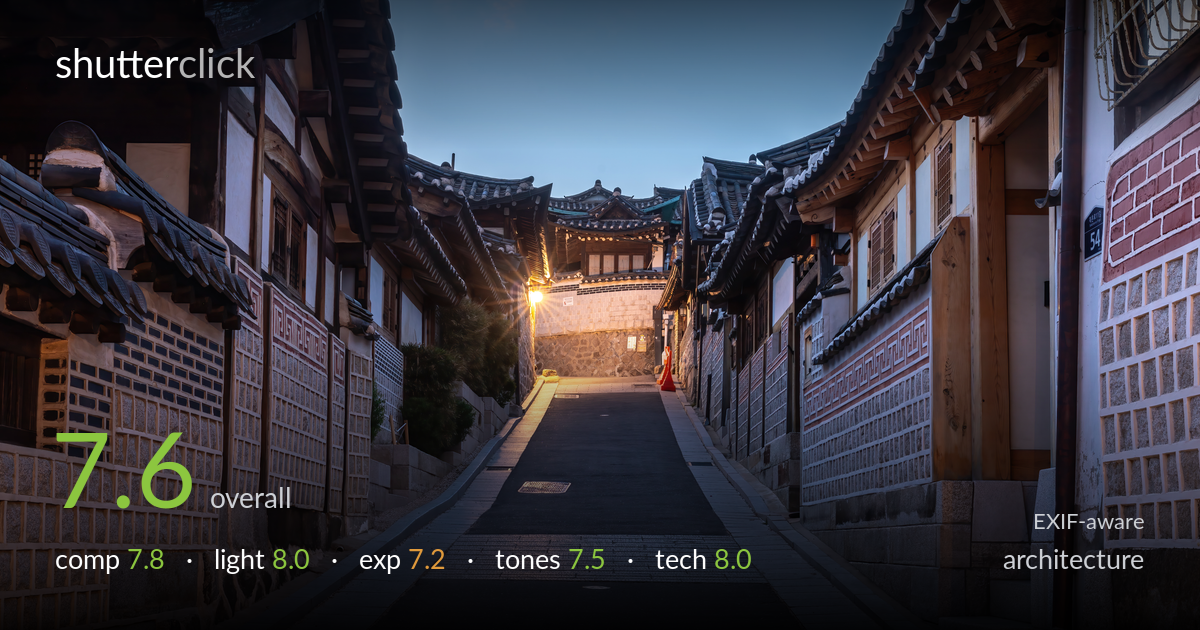
Tranquil hanok alley
Photo by Basile Morin

| Focal length | 41 mm |
| Aperture | f / 11.0 |
| Shutter | 13.0 s |
| ISO | ISO 125 |
| Exp. comp. | 0.0 EV |
| Shot at | 18:15 · Jun 3, 2024 |
A well-executed hanok village scene that converges two rows of traditional rooflines toward a sunburst at the vanishing point — a classic, effective use of leading lines. The symmetry of the alley and the receding eaves carry the eye cleanly to the lit gateway, and the lone red figure adds a welcome focal accent. What most holds it back is the heavy foreground shadow on the right buildings and the slightly flat, empty upper sky. A touch more shadow recovery and a tighter sky crop would lift it from competent to memorable.
The converging rooflines and stone walls form strong leading lines that funnel the eye to the bright gateway at the end — a textbook one-point perspective that works well here. The lane is centred, which suits the symmetry, and the small red-clad figure at the vanishing point gives the depth a payoff. The upper third is dominated by empty sky that adds little; lowering the top edge or finding cloud interest would tighten the frame. The right-side eaves crowd slightly, but the balance between the two rows holds.
The low sun bursting through the gap at the far gateway is the photograph's anchor, casting a warm pool of light onto the stone and pavement that contrasts beautifully with the cool blue ambient. Catching the sun at this raking angle through the alley is good timing and gives the scene its mood. The trade-off is the deep shadow swallowing the right-hand buildings and rooflines, which lose much of their tile detail. A moment slightly later, or fill from reflected light, would even the two sides.
Exposure is balanced toward protecting the bright sunburst, which retains a clean star shape rather than blowing out — a sensible priority. The pavement and sky sit at pleasing midtones. The cost is the right-side facades and the foreground-right wall falling into murky shadow with crushed detail. The histogram leans dark in those zones. A bracketed blend or a lifted shadow curve in post would recover the tile and brickwork texture without flattening the contrast that gives the scene its depth and atmosphere.
The cool-warm split — blue twilight sky against the golden gateway glow — is the tonal strength here, and white balance reads natural. The dark roof tiles hold a pleasing slate-blue, and the red figure and brick accents punctuate the muted palette. Contrast is generally well judged, though the shadow areas verge on muddy rather than richly black. The upper sky is a flat, even gradient that contributes little tonal interest. A subtle warmth lift in the shadows would prevent them reading as a dead grey-blue.
Settings are well chosen for the scene. At f/11 the depth of field carries sharpness from the near pavement to the distant gateway, exactly what this perspective shot needs, and ISO 125 keeps noise negligible with clean shadow rendering potential. The 13-second exposure on a tripod was necessary in this low light and explains the smooth pavement and still, deserted lane — though it also means the lone figure may register soft if they moved. The 41mm focal length gives a natural perspective without the distortion a wider lens would introduce, keeping the vertical posts and walls honest. Focus appears accurate through the centre line. The only technical caution is that the long exposure protects highlights at the expense of shadow detail in the right buildings; bracketing additional frames would have given more latitude to blend. Overall this is disciplined, deliberate capture with the right tools applied correctly for an architectural twilight scene.
What would elevate it
Tags
Shot something like this?
Expert photo critique, on demand — scored across six categories, EXIF-aware. Start with 3 free critiques, no credit card.
critique my photo — free