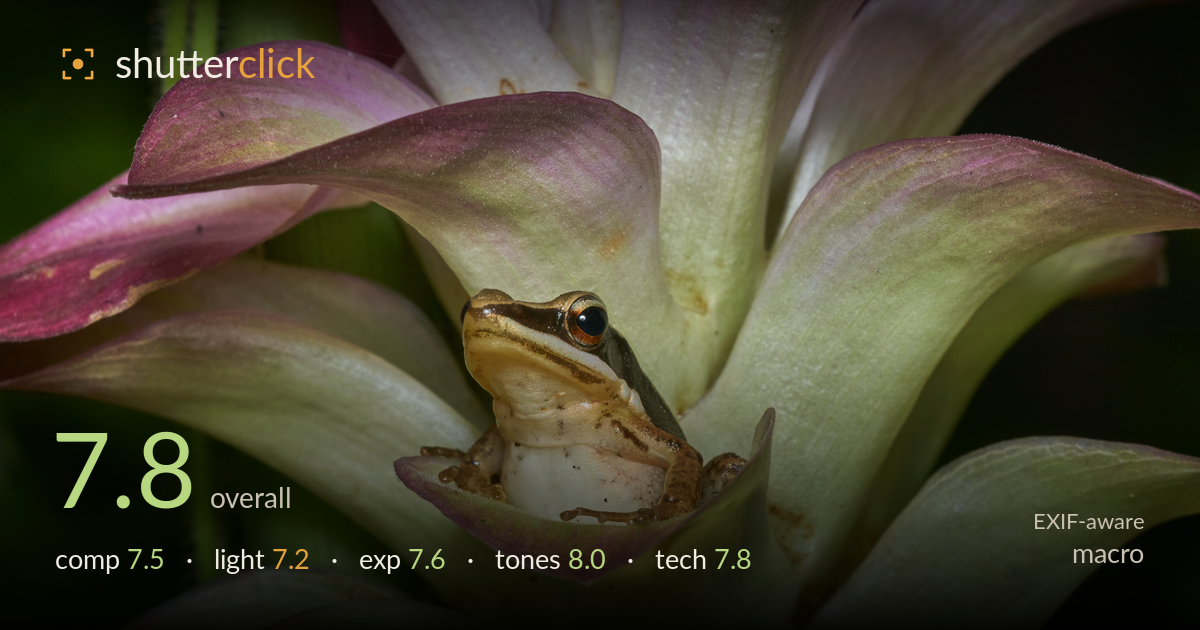
Tree frog nestled in a turmeric bloom
Photo by Jeevan Jose, Kerala, India

| Focal length | 150 mm |
| Aperture | f / 14.0 |
| Shutter | 1/250 s |
| ISO | ISO 320 |
| Exp. comp. | 0.0 EV |
| Shot at | 07:27 · May 5, 2017 |
A charming subject-and-setting pairing: a tree frog nestled in the cradle of a turmeric bloom, its warm bronze tones set against soft magenta and green bracts. The eye is sharp and the natural framing does most of the compositional work. What most holds the image back is the frog's low placement in the lower-left, leaving the upper third dominated by petals that compete for attention, and light that renders the frog a touch flat. The colour relationship is the real strength — a natural complementary palette that makes the subject feel discovered rather than staged.
The nested bract structure creates a natural frame that funnels the eye toward the frog — an effective use of the environment. Placement in the lower-left quadrant sits reasonably on a thirds intersection, but the subject reads small against the expanse of petals filling the upper half, which pull weight away from it. The diagonal bracts on the left add rhythm, while the busier top petals verge on clutter. A composition that let the frog occupy more of the frame, or tightened toward the flower's throat, would strengthen the subject-to-setting balance.
Soft, diffused light suits the delicate petal surfaces and avoids harsh highlight blowout on the pale green bracts. The frog, however, is lit rather frontally and flatly, so its form lacks the modelling that would give it dimension and separate it from the bloom. The catchlight in the eye is present but small. Raking light from the side, or a touch of directional fill, would carve out the frog's contours and the ridged texture of its back, lifting it from the surrounding tones.
Exposure is well judged for a scene with bright pale bracts and a mid-toned subject. Highlights on the whitish green bases hold detail without clipping, and the dark background falls to near-black without swallowing important information. The frog's pale belly retains texture. Shadow areas in the flower's throat stay readable. The 0.0 EV choice was appropriate given the balanced tonal spread. Nothing looks accidental here — the histogram appears to sit comfortably within range across the frame.
The palette is the standout: magenta petals shading to pale green, playing against the frog's warm bronze and gold — a natural complementary relationship that feels rich without oversaturation. White balance is accurate, greens and pinks reading true. The dark background isolates the bloom cleanly. Contrast is gentle and suited to the soft subject. If anything, the frog's warm tones could be nudged marginally to further separate them from the similarly warm speckling on the bracts, but the grade is largely well handled.
The 150mm macro at f/14 is a sound choice for this working distance, delivering enough depth of field to hold the frog's head, eye, and much of its body in acceptable focus while the petals fall off progressively — though at this magnification the frog's rear legs and the far bracts still soften noticeably. Focus is placed accurately on the eye, which is the critical plane, and it renders crisply with visible detail in the iris. ISO 320 keeps noise negligible and preserves the smooth tonal gradations in the pale bracts. 1/250s was sufficient to freeze a stationary frog and any minor breeze on the flower. The f/14 aperture is a reasonable compromise — stopping down further would have invited diffraction softening on a body this size. A focus-stacked sequence would have been the way to render the entire frog sharp front to back, but as a single frame the execution is technically clean and the key plane is nailed.
What would elevate it
Tags
Shot something like this?
Expert photo critique, on demand — scored across six categories, EXIF-aware. Start with 3 free critiques, no credit card.
critique my photo — free