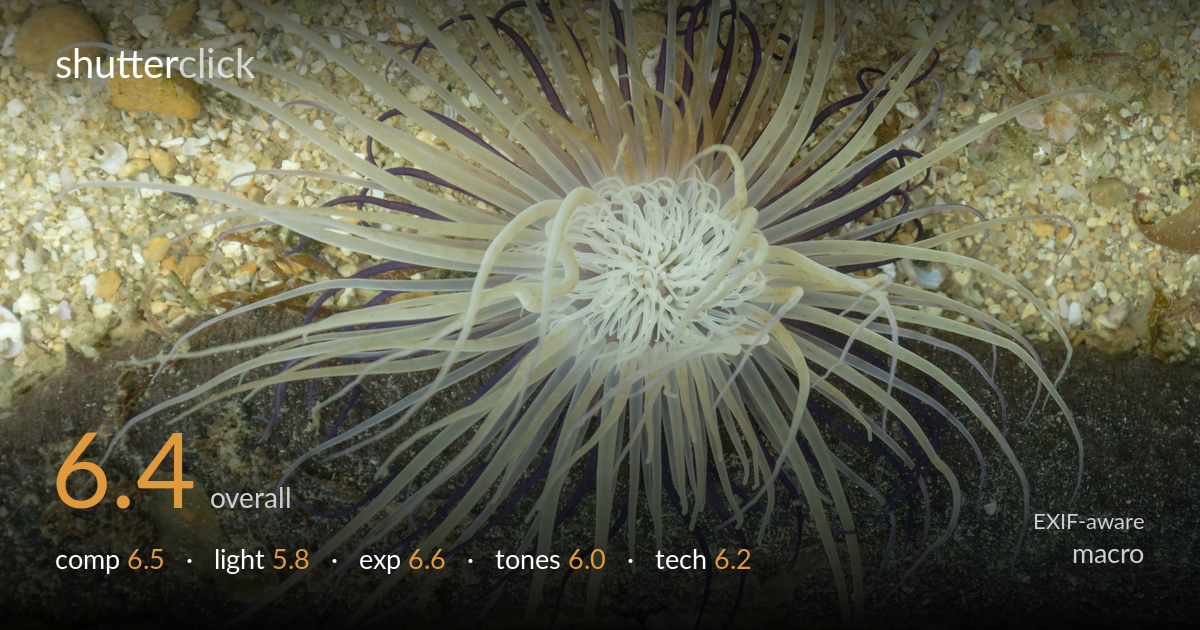
Tube anemone among the shells
Photo by Diego Delso

| Focal length | 35 mm |
| Aperture | f / 6.3 |
| Shutter | 1/200 s |
| ISO | ISO 500 |
| Exp. comp. | 0.0 EV |
| Shot at | 11:28 · Sep 9, 2021 |
A tube anemone centred in the frame, its radiating tentacles forming a strong natural starburst — the dominant strength here. The pale cream and violet tentacles read clearly against the busy substrate, and the central oral disc holds the eye. What most holds the image back is focus: the key plane sits on the foreground tentacles and central knot, but many tentacle tips and the wider crown drift soft. The granular sand-and-shell background is cluttered and competes for attention, and the flat, even light keeps the subject from gaining dimensional separation. A cleaner frame and sharper crown would lift this considerably.
The radial symmetry of the anemone is the photograph's backbone, and placing the oral disc near centre suits this kind of starburst form. The dark horizontal band of substrate beneath gives the subject a base and a little tonal contrast. The frame is busy, though — the granular sand and shell field fills every edge and competes with the delicate tentacle tips, which dissolve into similar tones. A slightly tighter crop, or an angle that placed a cleaner, darker zone behind the crown, would isolate the form and let the radiating lines breathe.
The light is flat and even, as is common with overhead or on-camera illumination in shallow water. It records the subject faithfully but does little to model the translucent tentacles or build any sense of depth. The pale cream tones and the sand sit at similar brightness, flattening separation. A lower, raking light would catch the translucence of the tentacles and rim them against the darker substrate band, giving the crown dimensionality and lifting the subject off a background that currently shares too much of its tonality.
Exposure is well controlled. Highlights on the pale tentacles and the bright central oral disc hold detail rather than clipping, and the shadowed substrate band retains texture without blocking up. The histogram sits in a usable mid-to-high range with no obvious crushing. The even, slightly bright key keeps everything legible, which serves documentation well. If anything, a touch less exposure or a deeper background would have added contrast and helped the subject separate from the sand, but nothing here reads as an exposure error.
The palette is muted and low in contrast — creams, soft violets in the inner tentacles, and the yellow-grey of the sand all sit close together, which suits the subtlety of the subject but reduces punch. White balance leans slightly warm-green, typical of shallow water, and the violet accents are the most distinctive colour note. Tonal range is compressed: there is little deep shadow and no strong highlight anchor. A modest contrast and clarity lift, plus cooling the cast slightly, would give the tentacles more presence against the substrate.
At 35mm on a 5DS R this is not true macro but a close environmental frame, and the 50-megapixel sensor demands precise focus to reward it. Focus landed on the central oral disc and the nearer foreground tentacles, which read acceptably sharp, but many of the outer and upper tentacle tips fall outside the plane and turn soft — f/6.3 simply cannot carry depth across a subject this three-dimensional at close range. Stopping down to f/11 or f/13, or focus-stacking a few frames, would bring the whole crown into focus. 1/200s and ISO 500 are sensible for a moving subject in water, freezing tentacle drift cleanly with no meaningful noise. A longer macro lens, such as a 100mm, would also give working distance and better isolation than the 16-35mm zoom, which is wide for this kind of detail study and pulls in more cluttered surroundings than the subject needs.
What would elevate it
Tags
Shot something like this?
Expert photo critique, on demand — scored across six categories, EXIF-aware. Start with 3 free critiques, no credit card.
critique my photo — free