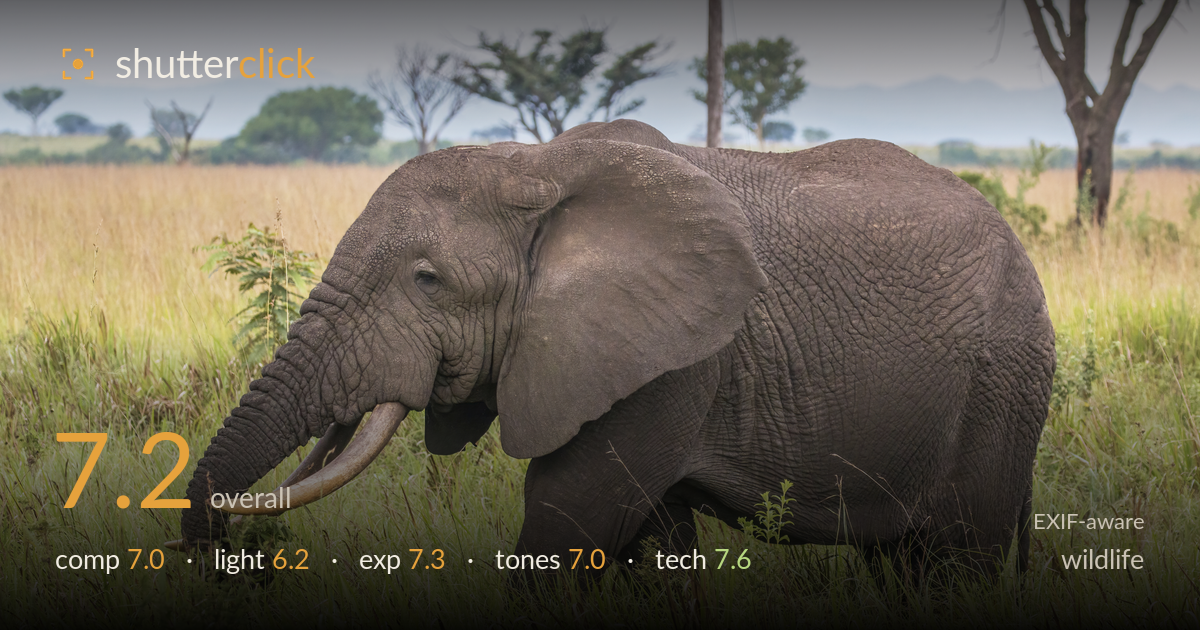
Tusked bull grazing on the savanna
Photo by Charles J. Sharp

| Focal length | 176 mm |
| Aperture | f / 5.0 |
| Shutter | 1/1600 s |
| ISO | ISO 800 |
| Exp. comp. | 0.33 EV |
| Shot at | 15:37 · Oct 20, 2016 |
A clean, well-executed side profile of a tusked bull elephant with the animal filling the frame handsomely and the tusks reading as a clear anchor. The savanna context adds place without clutter. What most holds it back is flat, overcast light that mutes the modelling of the elephant's textured hide and leaves the sky a featureless white. The trunk-tip and tusk drop toward the lower-left corner where the crop tightens uncomfortably. A shot with directional light and a touch more room ahead of the animal would lift this from a solid record shot toward something with real dimensionality.
The elephant is placed well, moving into the frame with its bulk dominating the right two-thirds and the head reading clearly against grass rather than sky. The acacia-studded background gives scale and habitat. The main weakness is the tightness at lower-left: the trunk tip and near tusk crowd the corner, leaving little breathing room in the direction the animal faces. A wildlife profile generally wants more space ahead of the subject than behind. The high grass foreground is pleasant but competes slightly with the legs.
Flat, diffuse overcast light dominates, which keeps the exposure even and avoids blown highlights on the pale tusks, but it costs the image dimensionality. The deeply wrinkled hide of an elephant is a gift for raking light, and here that texture reads only weakly because shadows are soft and shallow. The white sky offers no directional cue. Early or late side light would carve the folds of skin and separate the ear from the body far more convincingly than this even, shadowless illumination.
Exposure is well judged for the conditions. The dark hide retains detail across shanks and shoulders without blocking up, and the bright tusks hold their gradation rather than clipping to paper white. The +0.33 EV compensation was a sensible call against the bright sky. The sky itself is essentially blown to white, but under flat overcast that is largely unavoidable and not distracting given its small share of the frame. Shadow detail in the belly and legs remains readable. A balanced, deliberate result.
The green-gold grass and the grey elephant sit in a natural, believable palette with no obvious white-balance cast. Contrast is on the gentle side, a direct consequence of the flat light, leaving the midtones slightly muted. The hide's greys could carry a touch more separation. The grass tones are the liveliest element, with pleasant warm-to-cool variation across the field. A modest contrast and clarity lift on the elephant alone would restore some of the punch the overcast conditions removed.
The 100-400L at 176mm is an ideal choice for this working distance, and the settings are sound. 1/1600s comfortably freezes a slow-moving elephant, with margin to spare for the swinging trunk. ISO 800 on the 70D is well within the sensor's clean range and noise is a non-issue at this brightness. f/5.0, near wide open, keeps the shutter fast and gives just enough depth to hold the animal sharp along its length while softening the background acacias into pleasant separation. Focus appears accurately placed on the eye and forward hide, with crisp rendering of the skin texture and tusk. The lens's sharpness and stabilisation are evident. One consideration: stopping to f/6.3 or f/7.1 would have added a little depth across the full body without meaningfully raising ISO, since light was ample. Overall this is technically assured wildlife capture with settings matched to the subject.
What would elevate it
Tags
Shot something like this?
Expert photo critique, on demand — scored across six categories, EXIF-aware. Start with 3 free critiques, no credit card.
critique my photo — free