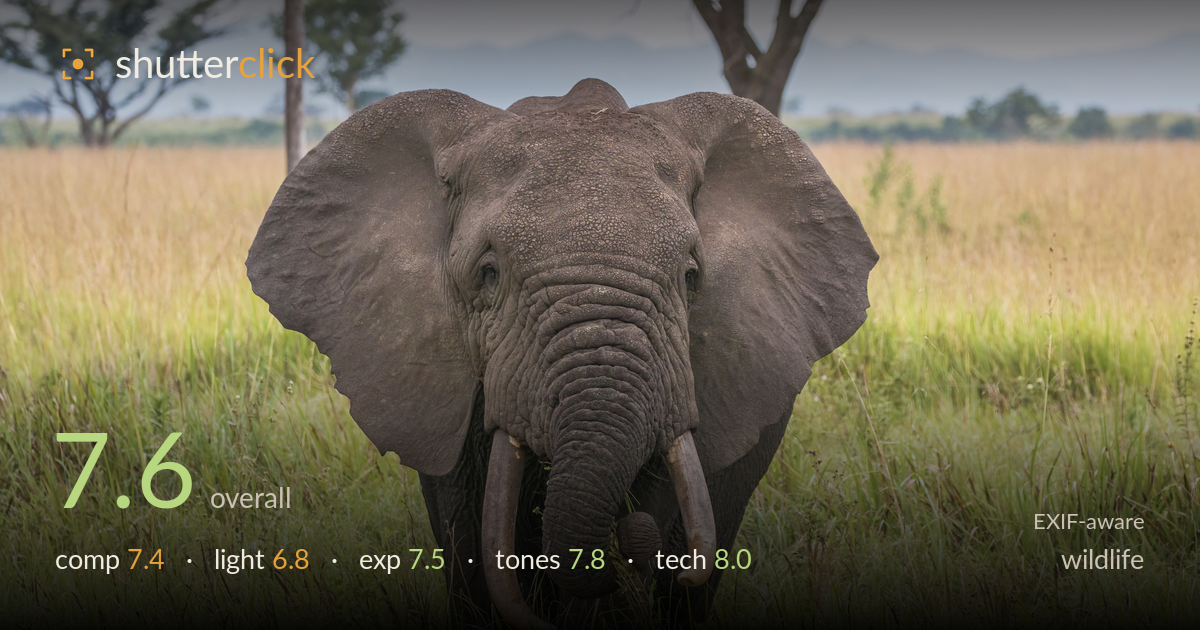
Tusker head-on in the savanna grass
Photo by Charles J. Sharp

| Focal length | 214 mm |
| Aperture | f / 5.0 |
| Shutter | 1/1600 s |
| ISO | ISO 800 |
| Exp. comp. | -0.33 EV |
| Shot at | 15:36 · Oct 20, 2016 |
A commanding frontal portrait of a tusker, with the animal centred and filling the frame in a way that reads as intentional and works for this head-on posture. The savanna context — acacia trees, distant mountains, layered grass — grounds the subject nicely. What most holds it back is the flat, overcast light, which mutes modelling on the dark hide and leaves the face lacking the sculptural depth stronger light would bring. The grass in front of the trunk and lower tusks is slightly distracting. Still, the sharpness on the eye, the ears fanned wide, and the environmental storytelling make this a genuinely strong wildlife frame.
The head-on symmetry with ears fully fanned justifies the central placement — an off-centre crop would waste the animal's spread. The acacias and blue mountains build a real sense of place, and the grass foreground gives depth. The bright utility pole behind the left ear is a distraction that pulls the eye. The tusks reaching toward the bottom edge feel slightly cramped; a touch more room below would let them breathe. Horizon sits high and level, which suits the layered savanna.
Overcast light is even and free of harsh shadows, which protects detail across the dark hide and avoids blown highlights on the tusks. But it is flat — the diffuse sky offers little directional modelling, so the wrinkled skin and the mass of the face read softer and less dimensional than they could. The face falls slightly into shadow under the overhang of the brow. Softer overcast light is forgiving for texture but sacrifices the drama that raking, low-angle sun would bring.
The slight -0.33 EV compensation protects the bright sky and the tusks from clipping, and it works — highlights hold. The dark hide retains ample shadow detail across the ears and face without muddiness, a good balance given the wide tonal range between grass, sky, and the animal. The bright overcast sky at top edges toward washed-out but stays within range. Midtones sit well and the grass keeps its detail. A deliberate, well-judged exposure for a high-contrast scene.
The green-to-gold grass gradient reads naturally and gives the frame a pleasant tonal layering, while the grey hide holds a believable, neutral cast. White balance looks accurate under overcast conditions. Saturation is restrained and appropriate — nothing feels pushed. Contrast is on the gentle side, a direct product of the flat light, leaving the overall look slightly muted. A modest contrast lift on the elephant alone would separate it further from the busy grass without touching the softer background tones.
Solid technical execution throughout. At 214mm on the 100-400L, f/5.0 gives enough depth to hold the whole head sharp while softening the distant treeline and mountains — a sensible balance for a frontal wildlife portrait. 1/1600s freezes the animal cleanly with margin to spare for any head movement, and ISO 800 on the 70D is well within the sensor's comfortable range, leaving minimal noise in the shadowed hide. Focus lands accurately on the eye, which is critical for wildlife, and the skin texture across the trunk and brow resolves crisply. The lens choice is ideal for the working distance and delivers good sharpness across the plane of the face. The only refinement worth noting is that grass blades cross in front of the lower trunk and tusks, which the shallow separation cannot fully hide — a slightly different shooting angle or higher vantage would clear the near foreground. Overall, the gear was used to its strengths and the settings were well matched to the subject.
What would elevate it
Tags
Shot something like this?
Expert photo critique, on demand — scored across six categories, EXIF-aware. Start with 3 free critiques, no credit card.
critique my photo — free