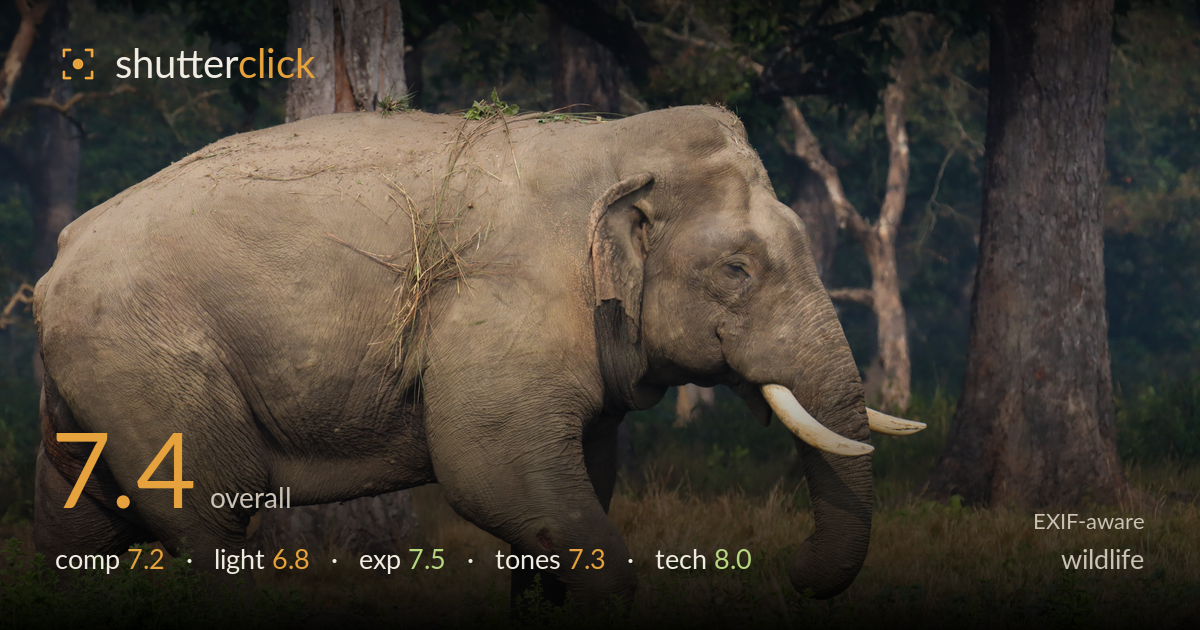
Tusker walking through the grass
Photo by Shadow Ayush

| Focal length | 309 mm |
| Aperture | f / 8.0 |
| Shutter | 1/1250 s |
| ISO | ISO 640 |
| Exp. comp. | 0.0 EV |
| Shot at | 05:00 · Jan 29, 2025 |
A clean, well-executed profile of a tusker bull, sharp where it counts and framed with room to move into. The full side-on posture reads clearly and the grass draped over the back adds a note of natural behaviour. What most holds it back is light: flat, diffuse overcast that keeps the grey hide low in contrast and offers little modelling on the face and tusks. The eye, mostly closed and in shadow, weakens the connection a strong wildlife frame wants. The foliage across the lower frame is busy and slightly encroaching. Solid, publishable work with clear paths to lift it further.
The elephant sits on the left with open space ahead into which it walks — the right instinct. The full-body profile is clean and the tree trunks behind add depth and scale without cluttering the subject. The band of green foliage across the bottom is busy, and the tuft of vegetation rising in front of the trunk competes slightly with the tusks. A touch more separation between subject and foreground growth would help. The framing is level and the animal is comfortably contained without crowding any edge.
Soft, even overcast light spreads across the scene with no harsh shadows, which keeps highlight detail on the pale tusks intact. The trade-off is flatness: the grey hide lacks the raking directionality that would carve out the deep wrinkle texture, and the face falls into low-contrast shade that mutes the eye. There is no catchlight to give the animal life. This is manageable light for wildlife, but a lower sun angle or a break of directional light would add the sculpting the subject deserves.
Exposure is well handled for a grey subject against mixed foliage. The tusks retain detail rather than blowing out, the hide holds midtone information across its bulk, and shadow areas under the belly and legs keep enough detail to read form. The bright grasses in the foreground sit near the top of the range but stop short of clipping. Nothing looks accidental here — the metering coped well with a tricky tonal mix. A slight lift in the shaded facial area would be the only refinement.
The palette is naturally muted — warm dry grass, cool green undergrowth, and the neutral grey of the elephant — and white balance reads accurately with no cast. Contrast is on the gentle side, a direct product of the overcast light, leaving the image feeling slightly soft overall. The greens are pleasant and not oversaturated. A modest contrast and clarity boost on the hide would separate the wrinkle texture and give the tusks more presence against the background without pushing anything unnatural.
The Tamron 150-600 at 309mm, f/8, 1/1250s and ISO 640 is a well-judged set of choices. f/8 gives enough depth to hold the full flank of the animal sharp while softening the background trees into a clean, non-distracting wash — good separation for a subject this size. 1/1250s comfortably freezes a walking elephant, and the frame shows no motion blur. ISO 640 is low enough to keep noise negligible and detail crisp; the hide texture and tusk surface resolve cleanly. Focus appears placed accurately on the head and lower face, with sharpness carrying well down the body. The main limitation is that the eye is nearly closed and in shade, so the sharpest, most engaging detail a wildlife frame usually anchors on is muted — no fault of execution, but it lowers the impact. Overall the technical package is sound and the settings suit the reach, subject, and conditions well.
What would elevate it
Tags
Shot something like this?
Expert photo critique, on demand — scored across six categories, EXIF-aware. Start with 3 free critiques, no credit card.
critique my photo — free