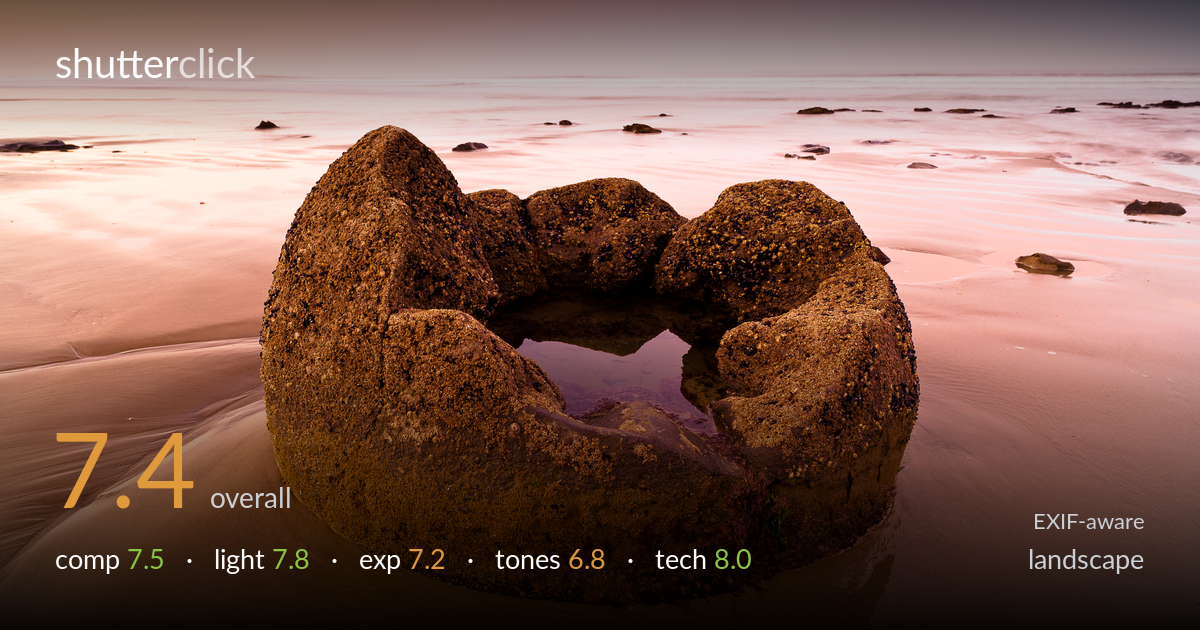
Twilight tide pool rock
Photo by Martin Sojka

| Focal length | 21 mm |
| Aperture | f / 8.0 |
| Shutter | 4.0 s |
| ISO | ISO 200 |
| Exp. comp. | 0.0 EV |
| Shot at | 15:54 · Apr 29, 2011 |
A broken, weathered concretion at low tide anchors a strong twilight seascape with genuine foreground presence. The wide-angle, low vantage exaggerates the rock's scale and the swirling wet-sand textures lead the eye well. What most holds it back is the colour grade: the pink-to-orange wash is pushed far enough that the rock and sand drift toward an unnatural near-monochrome warmth, flattening tonal separation. The hollow centre with its small pool is a nice draw, though it reads slightly cluttered rather than clearly resolved. Restraint on saturation and a touch more tonal contrast would let this image's strong bones show.
The broken ring of rock is well placed left of centre, large in the frame, with the hollow and small pool offering an interior focal point. The horizon sits high enough to give the wet sand room to lead inward, and the receding scatter of smaller rocks builds depth toward the soft sea. The swirling sand channel curving from lower left is an effective lead-in. The rock's bulk slightly crowds the lower frame, and the hollow's interior reads busy. A fraction more breathing room beneath the foreground would settle the balance.
Twilight delivers soft, directionless ambient light that suits the long-exposure mood and renders the sea and sky as smooth gradients. The afterglow warms the rock and sand pleasantly, and the absence of harsh shadow keeps the textured concretion legible across its whole surface. The trade-off is flatness: without directional light the rock lacks the raking modelling that would make its barnacled, pitted surface pop. Catching the moment a few minutes earlier, with low sun skimming the texture, would have added dimensionality without sacrificing the calm.
Exposure is well controlled for a difficult twilight scene. The long four-second frame smooths the water and holds the bright sky without clipping the highlights into pure white, while the shaded base of the rock retains detail. Midtones sit a touch heavy in the wet sand, pulling some areas darker than ideal, but nothing is lost. The histogram looks deliberate rather than accidental. Lifting the foreground shadows slightly and protecting the brightest sea reflections would balance the tonal weight between top and bottom.
This is the weakest link. The pink-orange grade is pushed hard enough that sand and rock converge into a single warm cast, eroding the natural separation between subject and surroundings. The sky gradient is attractive but verges on candy-coloured, and the rock loses its true earthy tones to the wash. White balance reads intentionally warm but overcooked. Dialling back saturation, cooling the shadows, and restoring some neutral grey in the sand would give the frame more honest tonal range and let the textures breathe.
The settings are well matched to the scene. The Zeiss 21mm at f/8 on the 5D Mark II is an ideal pairing for this kind of foreground-dominant landscape: f/8 sits in the lens's sharpness sweet spot and delivers deep front-to-back focus from the rock's near edge to the distant sea. The four-second shutter is the right call for low tide twilight, smoothing the retreating water and softening the surf into a calm wash without going fully featureless. ISO 200 keeps noise negligible and protects highlight headroom. Focus appears accurately placed through the rock's mid-section, carrying detail across the barnacle texture. The low, close vantage maximises the wide lens's drama without obvious distortion stretching the rock unnaturally. A tripod was clearly used and held steady. The only refinement worth considering is a slightly smaller aperture or a focus-stacked frame if the very nearest sand needed crisper resolution, but as executed the technical craft is clean and assured.
What would elevate it
Tags
Shot something like this?
Expert photo critique, on demand — scored across six categories, EXIF-aware. Start with 3 free critiques, no credit card.
critique my photo — free