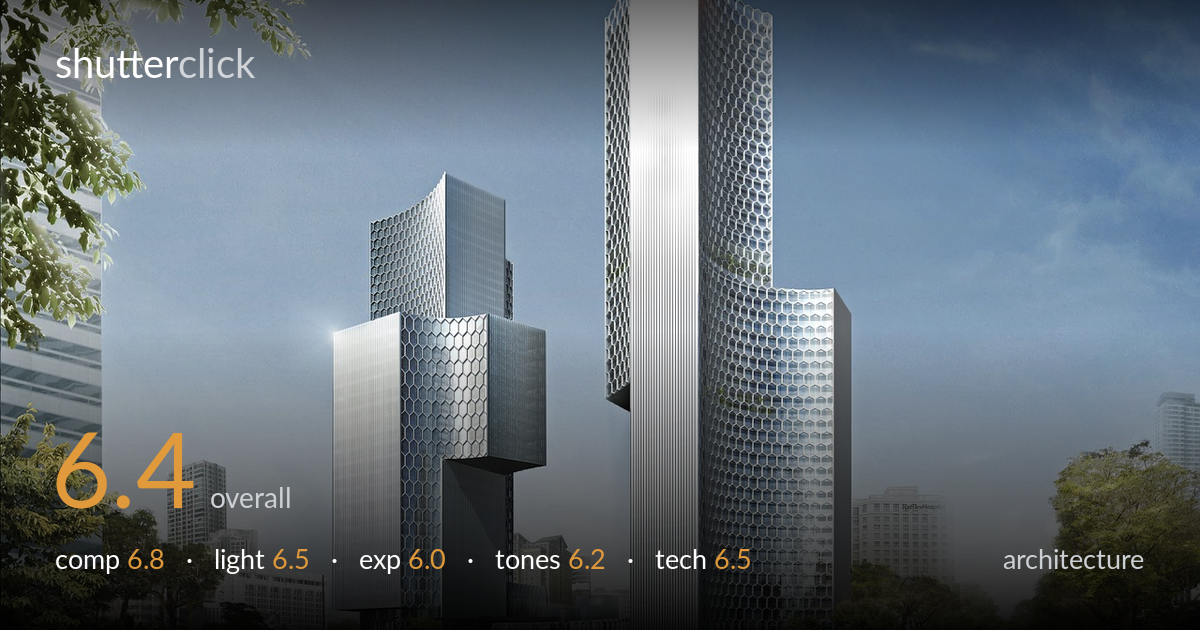
Twin honeycomb towers
Photo by 12019

No EXIF metadata in this file
Technical analysis based on visual assessment only.
The stacked, honeycomb-clad towers are the clear strength here, rendered with strong textural detail and a confident sense of scale against an open sky. What most holds the image back is its origin as an architectural rendering rather than a captured photograph — the foliage framing, street life, and lighting all read slightly synthetic, which flattens the sense of place. The verticals lean inward and the blown highlight on the tower crown undercuts technical polish. As a presentation image it communicates the design well; as a photograph it lacks the grounded, atmospheric weight that natural light and genuine perspective control would bring.
The two towers anchor the frame well, with the taller right-hand structure given dominant weight and the stepped left tower providing counterbalance. The overhanging tree branch top-left adds depth and a natural frame, while the street and crossing lead the eye in from the foreground. The lower third gets busy with cars, pedestrians, and signage that compete without resolving into a clear secondary subject. The horizon and base sit low, which suits the towering subject, but the right edge feels slightly crowded by trees. A cleaner foreground would let the architecture breathe.
Light comes from high and slightly behind the right tower, catching its faceted crown and skin in a bright sheen that conveys the cladding's reflective quality. The honeycomb facade picks up directional shading that reveals the building's curvature nicely. However, the overall light is flat and high-contrast in a way that feels rendered rather than observed — shadows are soft and somewhat uniform, lacking the raking warmth that a golden-hour or low-angle pass would bring. The sky gradient is pleasant but the lighting does little to dramatize the geometry.
Midtones across the facades are well placed and the honeycomb texture holds detail throughout most of the frame. The clear weakness is the blown highlight at the crown of the tall tower, where the sun flare clips to pure white and loses all structural detail. Shadow areas in the lower podium and street retain information without muddiness. The sky holds a clean gradient without banding. Reining in that highlight, either through exposure or local recovery, would meaningfully tighten the technical impression.
The cool silver-blue palette suits the glass-and-metal subject and the sky gradient supports it cohesively. White balance leans slightly cool, which keeps the cladding crisp but drains warmth from the foliage and street, leaving greens looking a touch artificial. Contrast is moderate and controlled, with reasonable separation between facade planes. Saturation is restrained and tasteful. A subtle warming of the lower foreground would better integrate the human-scale elements with the cool towers and add tonal variety to an otherwise monochromatic blue-grey scheme.
Judged on visual evidence, the image shows the smooth, uniformly sharp rendering characteristic of architectural visualization rather than a lens-captured photograph — detail is consistent edge to edge with no depth-of-field falloff or atmospheric haze gradient. The honeycomb facade texture is crisp and the cladding reflections are convincing, suggesting careful surface work. The verticals on both towers lean inward noticeably, a keystoning effect that architecture work judges strictly; correcting the perspective so the parallels run true would significantly improve the geometry. The foreground figures and vehicles are rendered cleanly but read as composited, lacking the motion or grain cues of a real exposure. Noise is effectively absent. Focus, where applicable, is uniform and accurate. For architecture, the priorities of line convergence and perspective control are partly met but the inward lean and the clipped highlight at the crown are the two clearest execution issues. Tightening verticals and recovering that highlight would lift the technical score notably.
What would elevate it
Tags
Shot something like this?
Expert photo critique, on demand — scored across six categories, EXIF-aware. Start with 3 free critiques, no credit card.
critique my photo — free