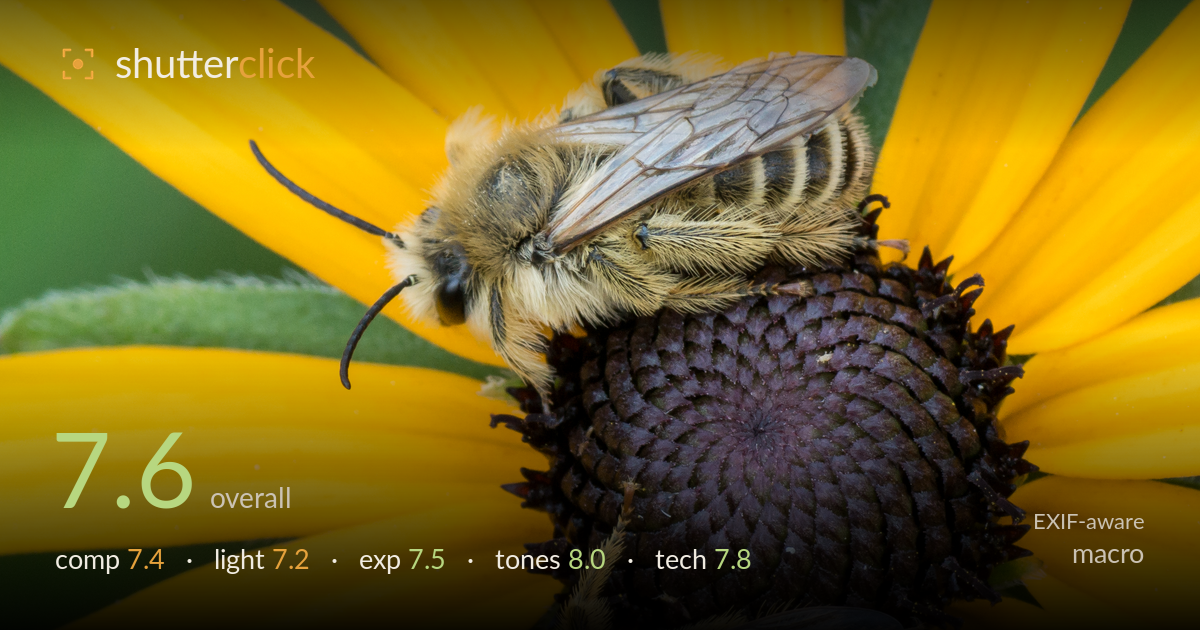
Two bees on a black-eyed susan
Photo by Mathias Krumbholz

| Focal length | 90 mm |
| Aperture | f / 11.0 |
| Shutter | 1/50 s |
| ISO | ISO 400 |
| Exp. comp. | 1.0 EV |
| Shot at | 16:47 · Aug 6, 2013 |
Two long-horned bees resting on a black-eyed Susan make a genuinely compelling macro — the pairing, the antennae, and the wing detail all reward close viewing. The spiralling seed head anchors the frame beautifully and the colour palette of gold, brown and green is coherent and striking. What most holds it back is depth of field: at f/11 the focus plane favours the upper bee's thorax and wing while the lower bee's head and the near petals soften. The near-central placement of the disc also flattens the composition slightly. A touch more focus-stack coverage would push this from good to excellent.
The radiating petals form a natural burst that draws the eye inward, and placing two bees on either side of the seed head creates a pleasing diagonal balance across the frame. The spiral pattern of the disc is a strong graphic anchor. The seed head sits almost dead centre, however, which is slightly static — nudging it off-centre would add tension. The upper bee's wing tip and the lower bee's antenna both brush frame edges; a hair more breathing room would keep those key elements from feeling cramped against the borders.
Soft, even light renders the fine thoracic hairs and the translucent wing venation without harsh specular hotspots, which suits the subject. The diffusion keeps shadow detail intact across both insects and the petals. That softness does come at a cost, though: the flatness reduces separation between the bees and the busy floral background, and the seed head lacks the raking directional light that would carve out its three-dimensional spiral. A subtle side or grazing light would add sculptural depth to the disc florets.
Exposure is well judged for a high-key yellow subject — the +1 EV compensation lifts the petals without blowing the golden tones, and highlight detail survives across the wings and hairs. The dark seed head retains structure rather than plugging to black, showing good dynamic-range handling. A few brightest petal edges near the top approach clipping but stay recoverable. Midtones on the bees are placed nicely, holding both the pale abdominal bands and the darker head. Overall a clean, deliberate exposure.
The colour rendering is the standout — saturated but not garish yellows against the deep maroon disc and the muted green background make a classic, harmonious macro palette. White balance looks accurate, with neutral browns in the seed head and no colour cast on the bees' hairs. Contrast is well controlled, preserving gradation in the petals from bright edges to shadowed bases. The green backdrop is desaturated enough to stay subordinate. Tonal separation between the two bees and the flower is clean and pleasing.
At f/11 on a 100mm macro, depth of field is still shallow at this magnification, and the single-frame approach shows its limits: the upper bee's thorax, wing base and the seed-head surface are crisp, but the lower bee's face and the nearest petals fall off into softness. Focus landed on the upper subject's plane rather than being distributed across both bees. ISO 400 is well chosen — noise is negligible and detail in the hairs holds up. The 1/50s shutter is adequate for static insects and a stable setup, though any breeze or subject movement risked blur; the sharp antennae suggest good stability here. The 90mm working distance gave enough reach without disturbing the bees. A focus stack of several frames would have brought both insects and the foreground petals into achievable sharpness, which is the main technical gap. Focus accuracy on the chosen plane is solid, and the exposure settings are sensibly balanced for the light.
What would elevate it
Tags
Shot something like this?
Expert photo critique, on demand — scored across six categories, EXIF-aware. Start with 3 free critiques, no credit card.
critique my photo — free