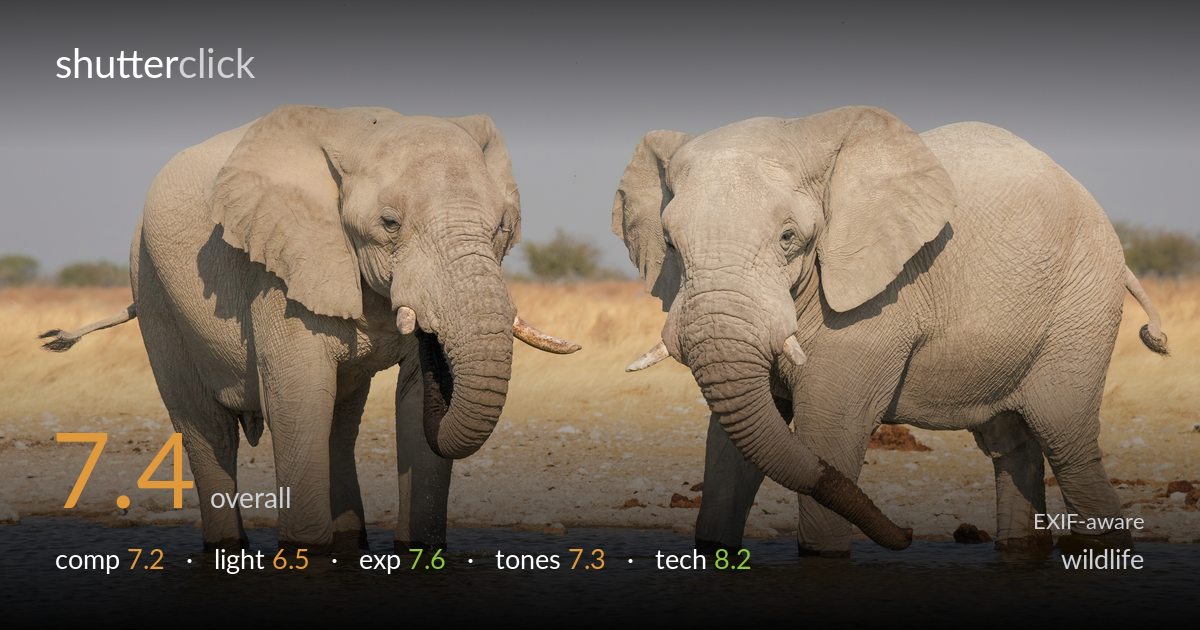
Two bulls drinking
Photo by Giles Laurent

| Focal length | 400 mm |
| Aperture | f / 7.1 |
| Shutter | 1/2000 s |
| ISO | ISO 400 |
| Exp. comp. | 0.0 EV |
| Shot at | 14:16 · Jul 29, 2025 |
Two bulls at a waterhole, both turned toward the lens with clean eye contact and trunks engaging the water — a genuinely strong wildlife moment with two subjects working in parallel. The execution is sound: sharp, well frozen, deep enough depth of field to hold both animals. What most holds it back is flat midday light that mutes the modelling of the skin and the empty grey sky, which adds little. The pairing reads slightly static rather than interactive, and the dead space above the elephants could be tightened. A stronger hour of light would lift this considerably.
Two elephants fill the lower frame nicely, both facing in for symmetry and eye contact — a pleasing, balanced arrangement. The waterline anchors the base and the slight gap between the animals lets each read clearly. The large band of grey sky above contributes little and leaves the subjects sitting low; a tighter crop from the top would concentrate attention on the action. The right elephant's tail and rump press close to the frame edge, costing a little breathing room. A touch more space on that side would settle the balance.
Hard, high midday sun delivers even, frontal illumination that keeps both faces and eyes lit, but it flattens the skin's wrinkled texture and renders the scene low in dimensionality. Shadows fall directly beneath the animals with little shaping value, and the overall effect is documentary rather than evocative. The pale dry grass and bleached sand reflect a lot of light, adding to the washed feel. Early or late light raking across the herd would carve out the skin texture and warm the whole scene considerably.
Exposure is well controlled across a bright, high-key scene. The pale elephant hide holds detail without clipping, and the sand and water retain information. Shadows under the bodies stay open with recoverable detail rather than blocking up. The flat grey sky sits where it should without blowing out. Metering coped well with a scene dominated by light tones — the zero exposure compensation was the right call here. Nothing crucial is lost at either end of the histogram; the rendering is clean and faithful to the harsh conditions.
A natural, believable palette — warm tans in the dry grass, cool blue-grey in the water, neutral hide. White balance reads accurate with no colour cast. Contrast is modest, a consequence of the flat light, which leaves the skin tones a little lifeless. The grey sky is tonally inert and drains some energy from the upper frame. A gentle contrast and clarity lift on the elephants in post would restore some of the depth the light failed to provide, while the overall colour relationships are already pleasant and cohesive.
The 400-800mm G at 400mm is an excellent reach for this subject, and the settings are well judged. f/7.1 gives enough depth of field to keep both elephants acceptably sharp across the slight depth separation, while 1/2000s freezes the trunk movement and dripping water cleanly — visible in the crisp splash droplets. ISO 400 keeps noise negligible, leaving plenty of latitude that the bright scene didn't strictly need but does no harm. Focus appears accurately placed on the near elephant's eye, with the second animal holding well within the depth of field. Detail in the skin folds is rendered sharply where the light allows. The only quibble is that f/7.1 at this distance was already enough; nothing here is misjudged. On a tripod or stable monopod the same frame could have used ISO 200 for marginally cleaner files, but at 400 ISO this is essentially flawless capture execution for the conditions.
What would elevate it
Tags
Shot something like this?
Expert photo critique, on demand — scored across six categories, EXIF-aware. Start with 3 free critiques, no credit card.
critique my photo — free