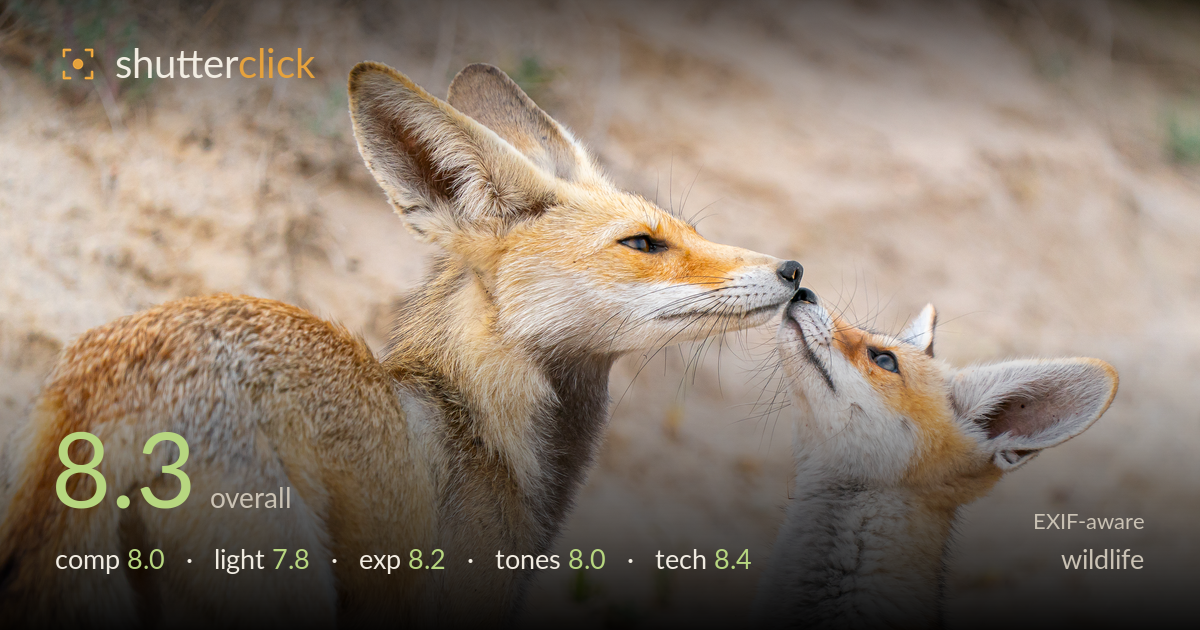
Two foxes touching noses
Photo by BirderSajan

| Focal length | 571 mm |
| Aperture | f / 6.3 |
| Shutter | 1/500 s |
| ISO | ISO 1000 |
| Exp. comp. | 0.3 EV |
| Shot at | 11:54 · Mar 21, 2022 |
A tender nose-touch between two foxes, caught at the moment of contact — this is the behaviour that elevates a wildlife image beyond a portrait. The two adult heads meeting at the frame's centre carry genuine narrative weight, and the muted sandy background pushes all attention onto the warm fur. What holds it back is the third fox on the left, turned away and cropped, competing for space without adding to the story. The soft, diffuse light is flattering but lacks the directional modelling that would separate the animals from a background of near-identical tone. Still, the moment carries it.
The touching noses land almost dead-centre, and that works here because the gesture is the subject — the eye goes straight to the contact point. The two connected heads form a clean diagonal that reads immediately. The left-hand fox, rump toward the camera and clipped by the edge, is the weak point: it fills a third of the frame without contributing, and pulls balance away from the interaction. A tighter framing on the two engaged animals, or waiting for the third to turn, would concentrate the story.
Soft, overcast or shaded light renders the fur cleanly with no blown highlights and gentle shadow transitions — kind to the delicate ear and whisker detail. The trade-off is flatness: the light gives little directional modelling, so the foxes and the sandy bank share a similar tonal register and separation relies on colour and focus alone. A low, raking side light — early or late in the day — would carve more dimension into the faces and lift the subjects off the background more decisively.
Exposure is well judged. The warm mid-tones of the fur sit comfortably, whisker detail and the dark eyes hold, and there is no clipping in the pale background despite its brightness. The +0.3 EV compensation was a sensible call against the light sandy surroundings, preventing the meter from underexposing the scene. Shadow detail inside the ears and along the chest is retained. Highlights on the sunlit fur roll off smoothly rather than burning. A confident, accurate reading throughout.
The warm ginger and cream palette is handled well, with natural-looking whites in the ruff and no obvious colour cast. White balance sits slightly warm, which suits the desert setting. The background's muted tan complements rather than competes with the fur. Contrast is on the gentle side, consistent with the soft light, which keeps things natural but limits punch. A touch more local contrast on the faces would add bite without disturbing the harmony already present.
The 200-600mm at 571mm is exactly the right tool for this subject, and the working distance let both engaged faces sit within the shallow depth of field at f/6.3. Focus is placed accurately on the touching noses and the near fox's eye, which is where it needs to be — the critical plane is sharp, with whisker and fur detail crisply resolved. At 1/500s the shutter froze this relatively static moment cleanly; had the interaction turned to play, that speed would have risked motion blur, so 1/800 or faster would offer more margin for wildlife behaviour. ISO 1000 on the A9 is well within its comfortable range, and noise is essentially invisible against the clean rendering. The wide-open aperture gives pleasant background blur but leaves the left-hand fox's head slightly soft — acceptable since it isn't the subject. Overall the gear choices and execution are sound and the focus discipline on the key plane is the standout.
What would elevate it
Tags
Shot something like this?
Expert photo critique, on demand — scored across six categories, EXIF-aware. Start with 3 free critiques, no credit card.
critique my photo — free