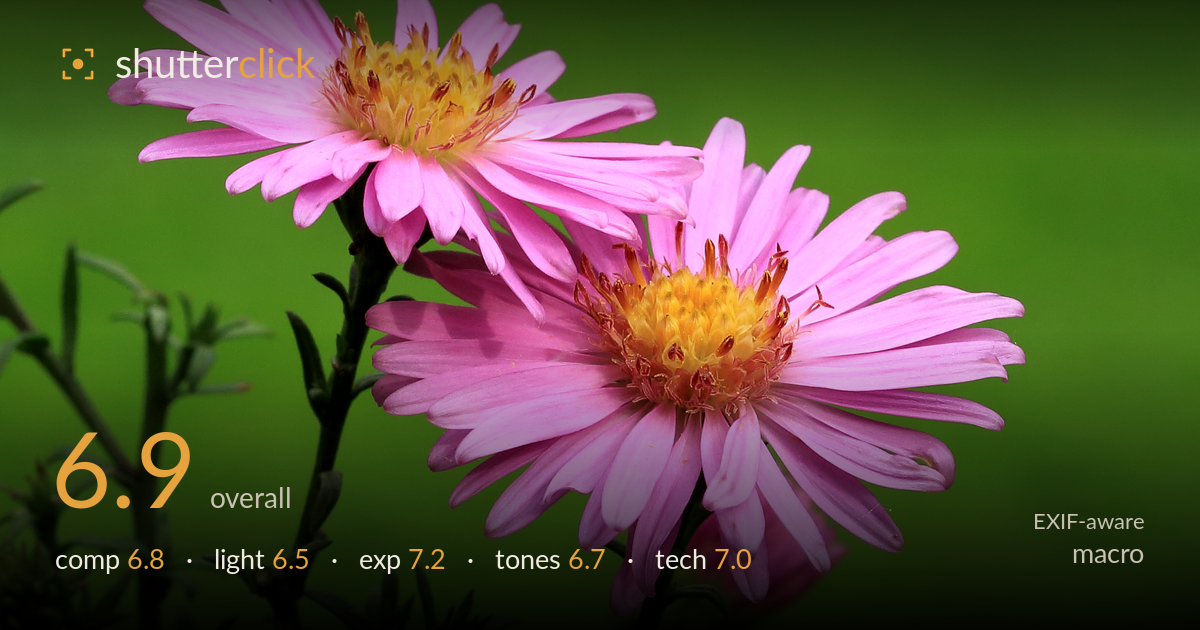
Two pink asters against green
Photo by Dominicus Johannes Bergsma

| Focal length | 60 mm |
| Aperture | f / 11.0 |
| Shutter | 1/125 s |
| ISO | ISO 200 |
| Exp. comp. | -0.67 EV |
| Shot at | 14:28 · Sep 29, 2014 |
A clean, appealing two-flower study of pink asters against a smooth green field, let down mainly by focus that favours the lower bloom while the upper one drifts soft. The diagonal stem and paired heads give the frame a natural flow, and the colour contrast between pink, yellow centres, and green is pleasing. The most limiting factor is depth of field: at f/11 the near flower's disc is crisp but the second head and its petal tips soften, and the vertical clutter of stems and leaves at bottom-left competes without adding much. Light is flat, muting the fine texture macro rewards.
The two flower heads arranged along a rising diagonal create a natural sense of movement, and the lower bloom sits close to a thirds intersection. The expansive green negative space at upper right gives the subjects room to breathe. Less resolved is the lower-left tangle of stems and leaves, which reads as busy clutter against the clean background and pulls the eye down. The upper flower is slightly clipped by the frame edge at left. A tighter arrangement isolating the two heads would strengthen the reading.
The light is soft and even, likely overcast or open shade, which keeps the pink petals free of harsh clipping and renders the green backdrop uniformly. That softness comes at a cost for macro: the petal ridges and the textured yellow disc florets lack the raking modelling that would give them dimension. The subject sits front-lit and flat, so form reads more by colour than by shadow. A lower, angled side light would carve out the fine structure of the flower centres.
Exposure is well controlled. The -0.67 EV compensation protects the bright pink petals, holding highlight detail in the lightest tips without letting them blow. The yellow centres retain gradation, and shadow areas in the lower foliage keep enough detail to read. The overall brightness sits comfortably in the midtones with no obvious clipping at either end. The green background is bright but not distractingly hot. A very slightly brighter rendering would lift the shadowed foliage, but the current balance is a sensible, deliberate choice.
The pink-and-green complementary pairing is the image's strongest tonal asset, clean and pleasant. White balance looks accurate on the petals, though the green backdrop is quite saturated and slightly electric, edging toward artificial. The yellow centres carry warm richness. Petal tones show smooth gradation from deep pink to pale tips. Pulling back green saturation a touch and warming the overall balance marginally would keep the background from competing with the subject and give the whole frame a more natural feel.
At f/11 on the 60mm macro, depth of field should have been ample, yet the plane of focus clearly favours the lower flower's disc while the upper bloom's centre and several petal tips fall soft. This points to focus placement between the two heads rather than on the more prominent one, or slight subject movement. The 1/125s shutter is adequate for still flowers but leaves little margin for breeze at this magnification, and some petal-tip softness may be motion rather than defocus. ISO 200 is ideal, keeping noise negligible and tones clean. The 60mm macro is exactly the right tool here, and stopping down to f/11 was the correct instinct for a two-subject scene. Focus stacking a few frames, or focusing precisely on the nearer disc with a marginally faster shutter, would deliver both heads sharp. As shot, the lower flower's crisp centre confirms the lens resolves fine detail well when the plane lands right.
What would elevate it
Tags
Shot something like this?
Expert photo critique, on demand — scored across six categories, EXIF-aware. Start with 3 free critiques, no credit card.
critique my photo — free