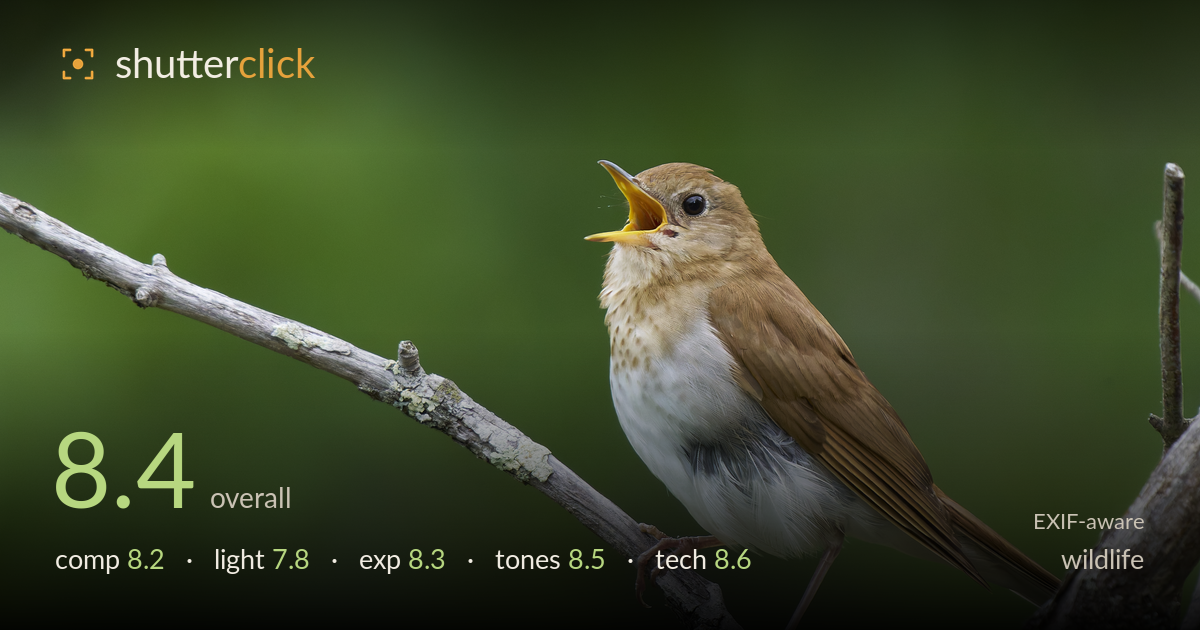
Veery singing on a branch
Photo by Paul Danese

| Focal length | 840 mm |
| Aperture | f / 9.0 |
| Shutter | 1/1250 s |
| ISO | ISO 8000 |
| Exp. comp. | 0.0 EV |
| Shot at | 08:04 · Jul 1, 2025 |
A singing veery captured mid-song with an open bill — the behavioural peak moment that elevates this above a static perch shot. The bird sits sharp against a beautifully clean green wash, and the diagonal lichen-covered branch adds structure and leads the eye upward toward the subject. The mouth agape, the throat feathers slightly puffed, the alert posture — all of it reads as a genuine moment rather than a portrait. What holds it back most is the crossing dead snag on the right that clutters the frame near the tail and competes with the clean left side. Light is soft and pleasant but a touch flat.
The bird sits well right of centre facing into open space, giving the song somewhere to travel — a smart choice for a vocalizing subject. The diagonal branch is a strong compositional anchor and leads the eye to the perch. The generous green negative space on the left balances the busy right well. The intrusion is the second dead snag on the right edge, which crowds the tail and adds visual clutter where the frame should breathe. A cleaner right side or the bird placed with more room ahead would sharpen the read.
Soft, diffused light — likely overcast or open shade — wraps the bird evenly and avoids blown highlights on the white breast, which is difficult with pale plumage. The catchlight in the eye is present and gives life to the face. The tradeoff is flatness: there is little directional modelling to sculpt the feather texture on the flank and wing, so the bird reads slightly two-dimensional. A touch of low, raking side light would carve more depth into the plumage and separate the layers of the wing.
Exposure is well judged for a tricky subject — the bright white breast retains detail without clipping while the brown upperparts hold tone and the black eye stays inky. The green background sits at a pleasant mid-brightness that doesn't pull attention. Nothing appears blown or blocked. The open bill interior and yellow gape are rendered cleanly. At this ISO the shadows stay clean rather than muddy, which speaks to a careful reading of the histogram and no unnecessary lifting in post.
The colour palette works in the bird's favour — warm cinnamon-brown plumage against the cool green backdrop creates natural complementary separation. White balance looks accurate, with neutral whites in the breast and no green cast bleeding onto the subject. The gape's yellow-orange pops as a focal accent. Saturation is restrained and believable rather than pushed. The green gradient behind is smooth and even. Mid-tone gradation across the flank feathers is handled well, holding the subtle spotting on the throat.
An impressive technical result given the constraints. At 840mm with the 1.4x teleconverter on the 200-600, reaching f/9 wide open, 1/1250s froze the perched bird cleanly with no motion blur even during song. Focus is locked on the eye, which is critically sharp with visible feather detail across the face and breast. ISO 8000 is high, but the ILCE-7RM5's sensor and evident noise reduction keep the image clean, and the soft even light helped — noise is barely perceptible in the smooth green background where it would show most. Depth of field at f/9 and this focal length is shallow enough to melt the background yet deep enough to hold the whole bird sharp from bill to tail. The teleconverter costs a little bite, but detail holds up well. The only quibble: stopping to f/9 was necessary for coverage, but a hair more shutter margin was available if a faster song-flutter needed freezing.
What would elevate it
Tags
Shot something like this?
Expert photo critique, on demand — scored across six categories, EXIF-aware. Start with 3 free critiques, no credit card.
critique my photo — free