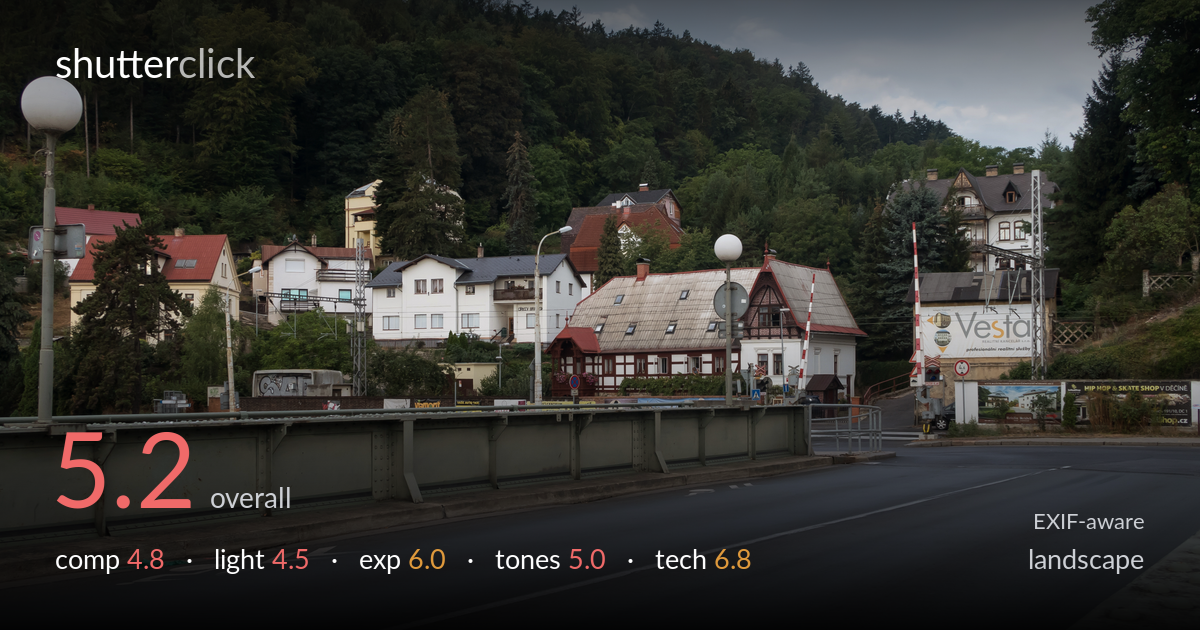
Village beneath a forested hillside
Photo by Michielverbeek

| Focal length | 13 mm |
| Aperture | f / 5.0 |
| Shutter | 1/400 s |
| ISO | ISO 125 |
| Exp. comp. | -0.67 EV |
| Shot at | 08:31 · Aug 11, 2018 |
This reads more as a documentary record of a Czech valley village than a landscape with a clear visual argument. The forested hillside and cluster of houses have genuine charm, but the foreground is dominated by an empty road and a long grey-green guardrail that consume the bottom third without rewarding the eye. The flat overcast light flattens the forest into a single tone and drains the architecture of dimension. The strongest material — the half-timbered house and tiered cottages against the hill — sits in a narrow band across the middle. Getting closer to that cluster, or shooting in raking light, would transform the result.
The frame splits into three competing bands — sky, hillside village, and road — with the most interesting element, the village cluster, compressed into a thin middle strip. The empty asphalt and the long horizontal guardrail eat the entire lower half without offering a leading line into the scene; they simply block access. The bridge railing runs flat across rather than diagonally inward. The lamp posts add some vertical rhythm but also clutter the houses. Tightening on the half-timbered house and tiered cottages would concentrate the genuine subject.
Flat, fully overcast light leaves the scene without modelling. The forested hillside collapses into a near-uniform dark green mass with no separation between the layers of trees, and the white houses lack the shadow that would give their facades dimension. There is no direction to the light, so the half-timbered detailing and rooflines read flat. Overcast can work for even colour rendering, but here it removes the depth and texture that a hillside village needs. Side light late in the day would carve out the layers.
Exposure is competently judged. The -0.67 EV compensation has protected the bright overcast sky from blowing out, holding faint cloud structure rather than a paper-white void. Shadow detail survives in the forest mass and under the eaves, though the darkest evergreen blocks approach featureless. Midtones on the road and houses sit reasonably. The overall result is slightly muted and low-key for the conditions, which suits the grey day. Nothing is clipped destructively; the histogram appears well controlled across a difficult flat-light range.
The palette is dominated by muted greens and greys, which honestly reflects the overcast day but leaves the image feeling drab and low in contrast. White balance leans slightly cool, reinforcing the dull mood. The forest greens lack separation and saturation, merging into one mass; the red rooflines and the half-timbered house provide the only colour relief and they are too small in the frame to carry it. A modest contrast and clarity lift, with selective warmth on the architecture, would add the life the flat light removed.
Settings are sensible for the conditions. At 13mm (roughly 36mm equivalent) and f/5.0, depth of field is ample and everything from the foreground road to the distant hillside is acceptably sharp — appropriate for a deep-field landscape from a 1-inch-sensor compact. ISO 125 keeps noise negligible and tonal gradation clean in the sky. The 1/400s shutter is far faster than this static scene required; it cost nothing here but represents headroom that could have allowed a smaller aperture for edge-to-edge crispness, or a lower ISO had light been dimmer. Focus appears accurately placed on the mid-distance houses with no visible front- or back-focus. The lens shows the typical mild corner softness and slight loss of micro-contrast of this zoom at moderate focal length, but resolves the village detail well. Execution is clean and the camera was handled correctly; the limitations here are compositional and light-driven rather than technical. A polariser would have cut the dull haze on the foliage and deepened the sky.
What would elevate it
Tags
Shot something like this?
Expert photo critique, on demand — scored across six categories, EXIF-aware. Start with 3 free critiques, no credit card.
critique my photo — free