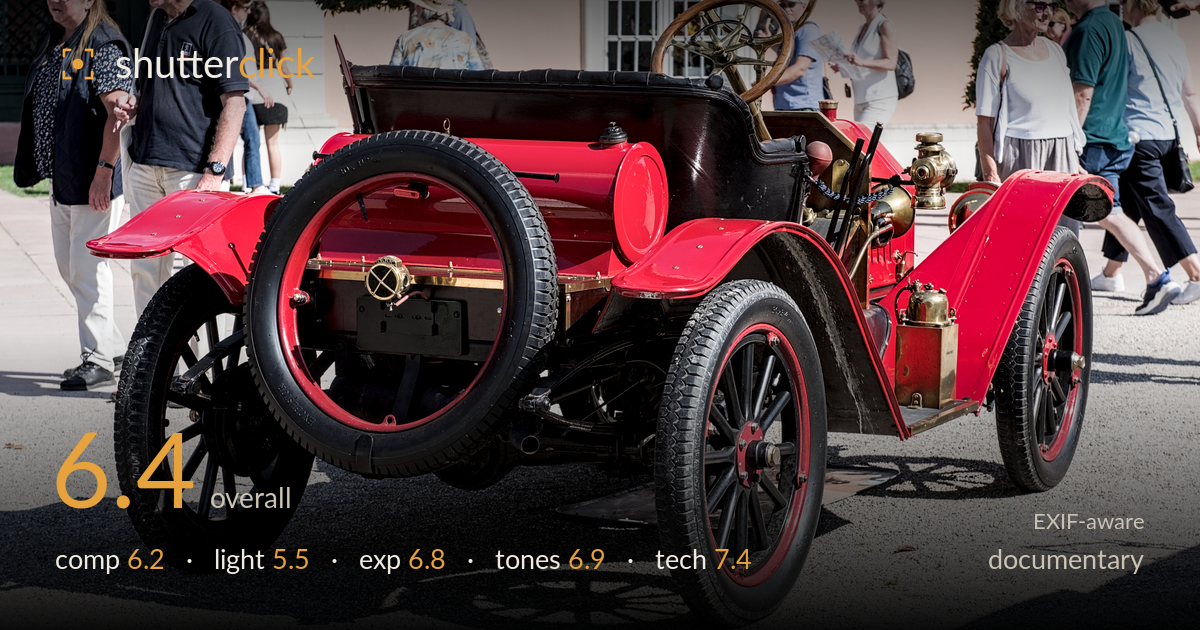
Vintage red roadster on display
Photo by Alexander Migl

| Focal length | 70 mm |
| Aperture | f / 7.1 |
| Shutter | 1/400 s |
| ISO | ISO 100 |
| Exp. comp. | 0.0 EV |
| Shot at | 15:01 · Sep 6, 2025 |
The vintage red roadster is a strong, characterful subject, cleanly rendered and rich in brass and mechanical detail — but the frame reads as record documentation rather than storytelling. The three-quarter rear angle shows off the spare-wheel drum and cockpit, yet the busy crowd of pedestrians competes rather than adds narrative, and the harsh midday sun flattens colour and scatters distracting shadows across the gravel. What holds it back most is light timing and the lack of a decisive relationship between the car and the people around it. A cleaner moment, or a person genuinely engaging with the vehicle, would lift this from catalogue shot to document.
The three-quarter rear framing works well for a car of this era, showcasing the mounted spare, cockpit and brass fittings, and the low angle gives the wheels presence. The car sits comfortably filling the lower two-thirds. However, the row of pedestrians strung across the top forms a distracting, unresolved band — several are half-cropped and none connect to the vehicle. The bright pink wall and topiary further split attention. A background with fewer, more purposeful figures, or a tighter crop on the machine, would strengthen the frame.
Hard, high midday sun is the biggest limitation here. It renders the red panels bright but flat, blows small highlights off the brass and the fender curves, and throws a tangle of sharp shadows across the gravel that clutter the lower frame. The cockpit and dark upholstery fall into heavy shade, losing detail. Direction is roughly side-front, which at least models the wheels. Softer, lower light — overcast or early morning — would deepen the reds and reveal the brasswork without the glare.
Exposure is well judged for difficult contrast. The red bodywork holds saturation without clipping, and highlight detail survives on the brass lamps and radiator. Shadows under the fenders and in the cockpit go dark but retain enough information to read the mechanicals. The gravel foreground is bright but not blown. ISO 100 keeps everything clean. The overall placement leans slightly toward protecting highlights, which suits the scene, though a touch more shadow lift in post would open up the dark upholstery.
Colour is the image's strength — the deep reds are vivid and consistent, and the brass reads warm and convincing against the black wheels and trim. White balance is accurate under the daylight. The pink wall and green topiary add pleasant background colour without clashing. Contrast is high from the sun, which serves the red but crushes the darker areas. The gravel carries a slightly cool cast that balances the warm subject. A gentle reduction in overall contrast would recover mid-tone gradation in the shadows.
The settings are well matched to the task. At 70mm and f/7.1, depth of field is sufficient to hold the car sharp front to back while keeping the background from becoming a distraction, and focus lands accurately on the bodywork and spare-wheel drum. 1/400s comfortably freezes the moving pedestrians with no motion blur, and ISO 100 delivers clean files with full detail in the brass and tyre tread. The D750's dynamic range is used sensibly to manage the harsh contrast. The 70mm perspective is natural and undistorted, appropriate for a documentary record of the vehicle. Sharpness is strong across the plane of the car. The only technical criticism is depth-of-field philosophy: a wider aperture would have thrown the crowd out of focus and isolated the subject more effectively for a cleaner document, though at the cost of some panel sharpness. As executed, the technical craft is sound and reliable.
What would elevate it
Tags
Shot something like this?
Expert photo critique, on demand — scored across six categories, EXIF-aware. Start with 3 free critiques, no credit card.
critique my photo — free